

Hope Horsemanship may be quiet recently, but not out of inactivity. I’ve been working with horses at the Akhal-Teke Foundation (Lexington, VA) which has been fascinating. I showed up in the midst of breeding and baby season and each visit had different needs around moving horses in and out of herds and fields to visit stallions and be weaned from or reunited with mamas. There are cute babies in the nursery paddocks and yearlings needing some handling and attention. With twenty-eight horses on site, there’s always more to do than time to do it! The purpose of the foundation is to steward a bio-diverse breeding population of this very rare breed and the people behind it are dedicated and fun to get to know. There will be more to share about this partnership as time goes on.
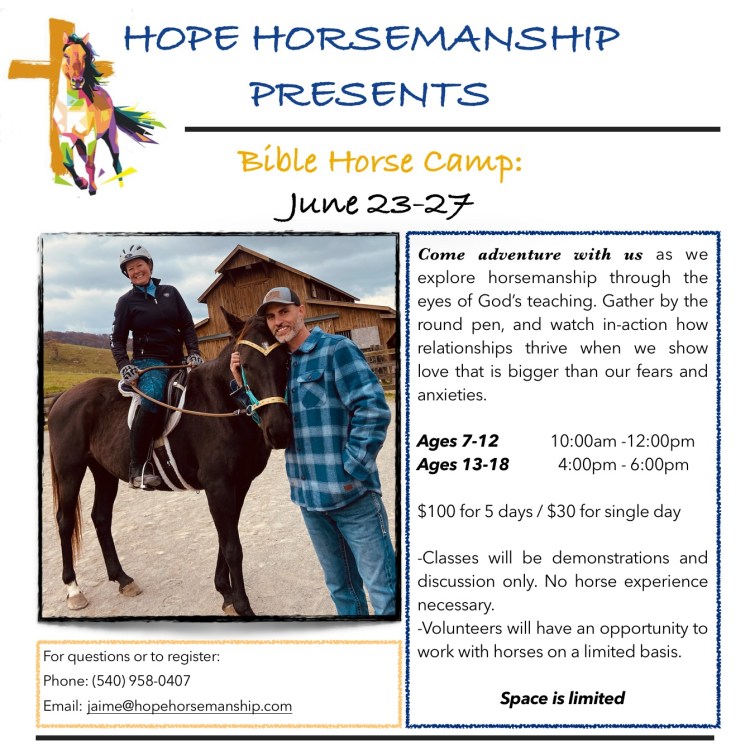
Between getting Khaleesi ready to take on the Vermont 100 in July, just over a month away, some clients and the Akhal-Teke Foundation work, we are planning a Tom Moates Clinic July 11-12 here at HQ (there is still room for one more horse to participate!), and a new program we’re excited to develop with kids June 23-27 where we’ll be addressing a topic each day, discussing it and doing demos with the horses to show how to take on fear, anxiety, how to love well and know what good boundaries look like, how to find confidence in yourself, and what good leaders do, and more. For anyone local to us, there is still room, and though the program is 5-days for 2 hours each day, single days can work as space allows. Contact Jaime@HopeHorsemanship.com for enrollment details!
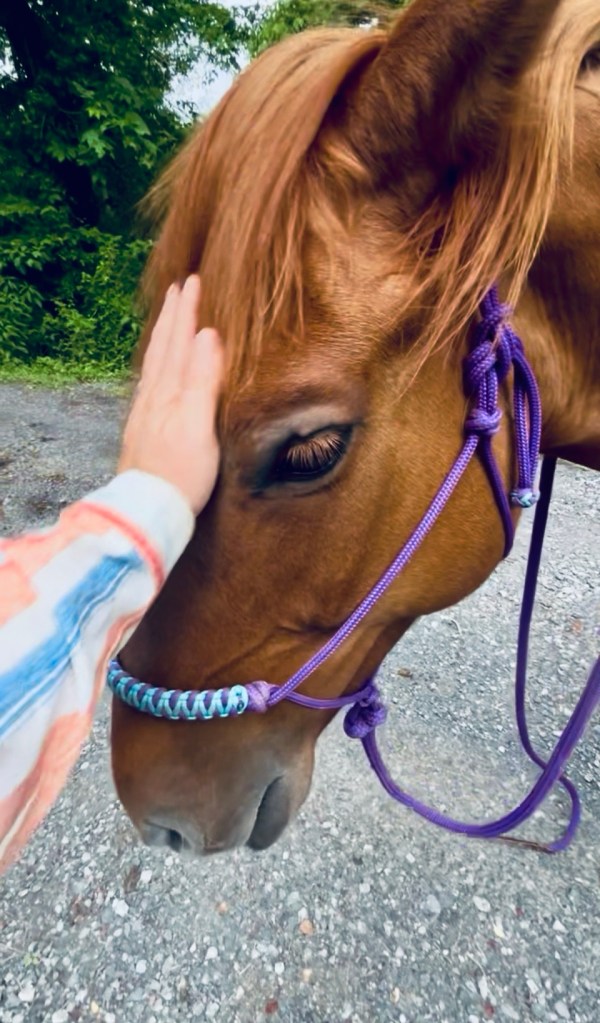
I’ve managed to carve out a couple short sessions to check in with Wyoming in between. First, I was able to put on her halter without any nipping threats- which is encouraging (twice!). She is still mildly concerned, but gave me the benefit of the doubt. I sense our connection continues to improve in general over the last year or two. I rubbed her and stood in place for a moment after she accepted the halter and told her ‘that was really nice, and thank you.’ I was glad she relaxed before we continued on – the halter means we’ll be working today. I don’t want to trick her, that erodes trust. I want her to be ok with the work we do together and to stay with her each step.
I moved her away from Khaleesi gradually, checking in with her every few steps when she got sticky, and reconnected her mentally to me. I was asking her to let go of Khaleesi and take a few more steps with me. It is not about if I’m acting like a predator, pretending to be part of the herd, “listening to the horse”, or getting the correct approach angles. It’s not even about sensing discomfort and starting on “pressure-release” from a distance. I have incorporated all of those things over the years with various change in the horse. They all have limitations that Wyoming has ensured I learn.
I mentioned it’s not about “listening to the horse” and what I do not mean by that is one should not be aware of what the horse is telling us. What I mean is I’ve “listened to the horse” so well at times that I’m not able to direct or lead because I’m only responding to what she is putting out and the horse is not intended to lead the dance.
Instead, I observe and try to understand. With that information, I can better know where the horse’s mind is, and I need to have influence on that mind in order to guide her. Wyoming’s mind goes back to Khaleesi, I pause and do not move forward until I am able to bring that mind back to me, draw a few more steps… mind goes back to Khaleesi, pause, ask her again let go of Khaleesi, focus on me… take a few steps. This is a practice and she lets go a little at a time. Khaleesi is important to her. She is the security of a good leader and the only herd she has. I am increasingly able to offer what Wyoming recognizes as good leadership, however I am not going to be a herd mate (ever). I am not a horse, I’ll never convince her otherwise. I am a human who cares about these horses, and will do everything I can to bring peace and security to her if she’ll stay with me. I can enter her world, and invite her to participate in mine in a way that honors her and lifts her up to be able to participate and do more than she could ever imagine in her horsey brain.
I’ve heard the argument that a horse is content in a life of foraging and grazing and resting under a shady tree. That’s probably true. However, when a horse and human partner with trust and integrity, something bigger than either the human or the horse alone could reach happens, and it is a thing of exquisite beauty. When it’s done poorly, it is sad and discouraging. It is hard to see people using horses for their own glory and the trauma and damage that results. My hope is keep learning how to do it well, and honor the horse as I grow- and walk in a sense of grace along the path.
Eventually Wyoming truly lets go of Khaleesi, and we walk together to the tack room without further hitches. I put the saddle pad on her back and begin poking at her side where the cinch will go. I’ve noticed she carries tension here, and sometimes in the saddle, she seems physically uncomfortable. At times she almost colicky- and then also no issues. Sometimes both in the same day… The saddle is a good fit, and the cinch is wide, distributing the pressure across a generous area. It’s too intermittent for me to be convinced it is ulcers. Addressing her built up anxiety has had the most effect in resolving the issue.
When you poke a horse, which I don’t recommend doing just to annoy it, you either find relaxed muscle and it can be almost like a massage, or you find tension and the horse will “boing” like a spring. Depending on the amount of tension, I’ve seen the entire horse’s body act like a giant spring. It can seem pretty disturbing, however I have seen this done in a way that over a few minutes the tension begins to release, the horse starts to soften, and this feels much better for the horse. The kind of tension that’s created when the entire body springs from the contact does not feel good at all, and ignoring it doesn’t make it go away. Putting a saddle over that and trying to ride probably really doesn’t feel very good.

Wyoming is mostly relaxed, but there are a couple specific points that when poked at create the spring reaction in her side. Surprisingly for what it looks like, she isn’t bothered. In fact she stands still while I poke around at her and eventually she even yawns and shakes her head. The tension begins to release. I do this on both sides, and THEN get the saddle. Once the saddle is on, I poke again in the same places. There is still spring tension there so I poke around a bit more and she still stands calmly. More yawning and licking and releasing. The tension is not completely gone when I go to cinch up, but it’s diminished. The saddle brings up that tension to some extent; it starts with the saddle pad, and it’s connected to experience being ridden more than direct physical pain from.
Once I get the saddle on, we enter the round pen and my plan is to check in, ask her to move around me and return in both directions to see how she’s doing. This horse gets sticky in the forward both on the ground and in the saddle, and I’d like to see this improve.

As expected, I had some stickiness asking her to move around. I am not lunging to tire her out, and I’m not running her in circles in order to “suck her in” to draw to me. I want her to get connected to me before we begin, then I want her to stay connected to me while she walks or trots around the pen, and then remain connected when I stop and invite her back in. Both directions. With me the entire time. When this connection is broken, I must re-establish it before we continue. I worked through the stickiness of forward both directions until she accepted then relaxed into walking around without halter or lead, with me directing her in the pen, was not so bad.
Leading, on lead or at liberty, is not a problem. The stickiness comes when I ask her to move on to circle without me being out in front leading. This is important because if I’m riding I cannot be out in front leading which is where she seems to prefer me.
This goes well, and I end our short session there. She willingly puts her nose in the halter, and we walk to the tack room. I remove the saddle and then do a poking test. Zero reaction. No spring. Relaxed.
The second day is similar to the first, only there is almost no tension spring on poking the second day. I have more time to play with the mounting block, sitting in the saddle (though I didn’t ride off), and some experimental time “riding” from the ground. This is when I stand at the saddle, drape my arm over and walk next to the horse in a similar behind the head position as if I were riding.
Here I discover something interesting. I can get this working for me when I stand on her left (though it is sticky at first), but when I change sides and stand on her right and ask her to walk off, I get chaos. First she paws the ground and then tries to paw at her underside (as if colic or ulcers), then she reaches over to nip at me. This is very similar to the behavior that has been randomly concerning in the saddle.
I was not sitting on her, and doing this from the left side did not create the trouble. Whenever she is uncomfortable enough to reach around to bite at the rider’s boot, it is 90% to the right side. I am pretty certain this is not a physical issue, I hang in there until she takes a couple steps. It’s challenging but I reward small improvements in the right direction. This side never comes smooth, but it does get better. I go back to working from the mounting block then end the session. The strong reaction on the right side is valuable information toward helping her become comfortable carrying a rider. I will certainly dig in there more as time goes on.

I am happy with our work.
First, I am increasingly aware of the horse’s focus and how to encourage her to connect with me, and then how to direct her mind. This leads to what Harry Whitney calls with-you-ness. If I have a calm confidence, a presence in the moment, and can get the horse to stay with me in that space, we have a much better chance at working together. The better chance she will feel better about the work.
Second, I stay aware of what Ross Jacobs calls the worry cup. A common pitfall working with horses is moving ahead one thing to the next without noticing until the cup runneth over, and that usually means an explosion or some kind of injury scenario for the human. How often have I heard things like: I don’t understand, you have seen X, Y or Z a million times, and now you freak out? That could tell us that X, Y or Z can be tolerated when the cup is low, but if the worry and anxiety is already at 7/8 full, X is just too much for the moment. Before we judge the horse harshly, I can recall a day when things keep going wrong until a simple thing that would normally merit an eye roll, instead gets a full out tantrum. Most horses have various degrees of concern reactions and it can be different day to day.
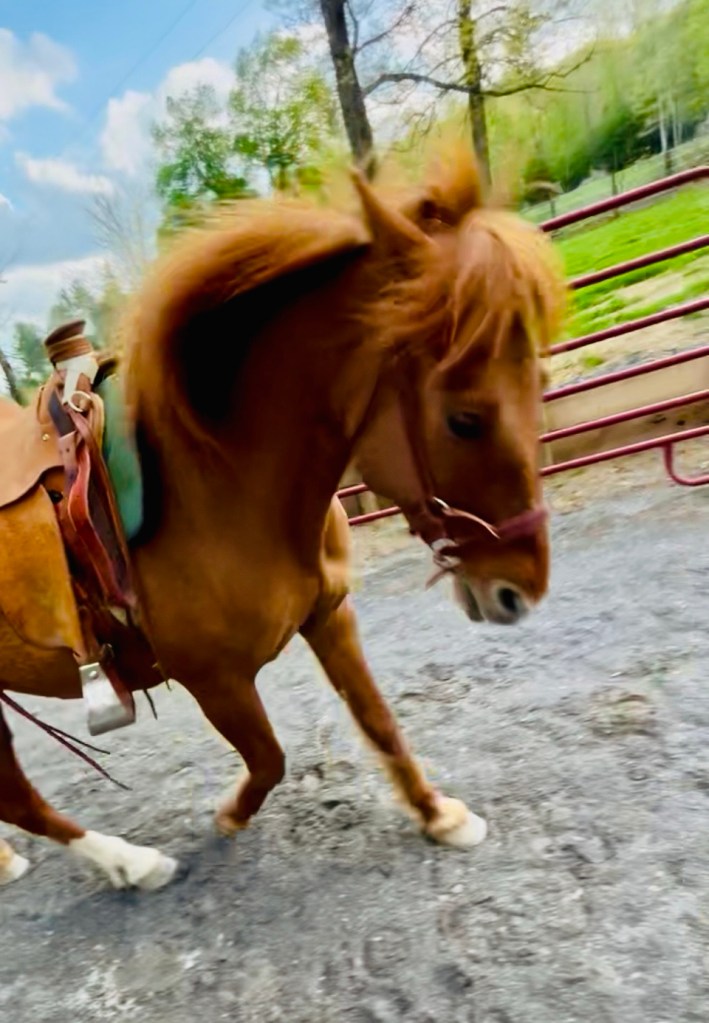
If I would have trapped her with the halter, walked off to the tack room without looking back (or worse, drove her onward as she struggled to leave) then put on the saddle and went to work, we would have had more problems to fix in the round pen. It’s likely I could have pushed her through, but when I returned her to the field she wouldn’t feel very good about it, and the next time I arrived with the halter, she’d put more effort into evading me. If I’d have tried to ride her after the cup was brimming full, I’d probably have us both in a situation neither of us would be feeling good about. This is one way people get hurt. When the cup runneth over…
Third, I have more joy in the process. I like to see results, but this horse has been a gift of growth in my life for years. She has challenged my horsemanship, my emotional maturity, and my relational concepts. I have let go more of the expectations I carry in my ability to get things done with her. I’ve had more of my own self-worth and identity wrapped up in not failing this horse than I would like to admit over the years, and that’s a burden she can sense even if I pretend it’s not there. I am more curious and less pressured to see “results” with her. I have also come to just plain like the mare for who she is, even though what she does is often everything I wish she wouldn’t do!
I actually enjoy her, even if I’m standing next to her at the tack room poking at her sides to see if she’ll let go of some tension. I have been reading more about how important joy is to the brain for personal growth and transformation.
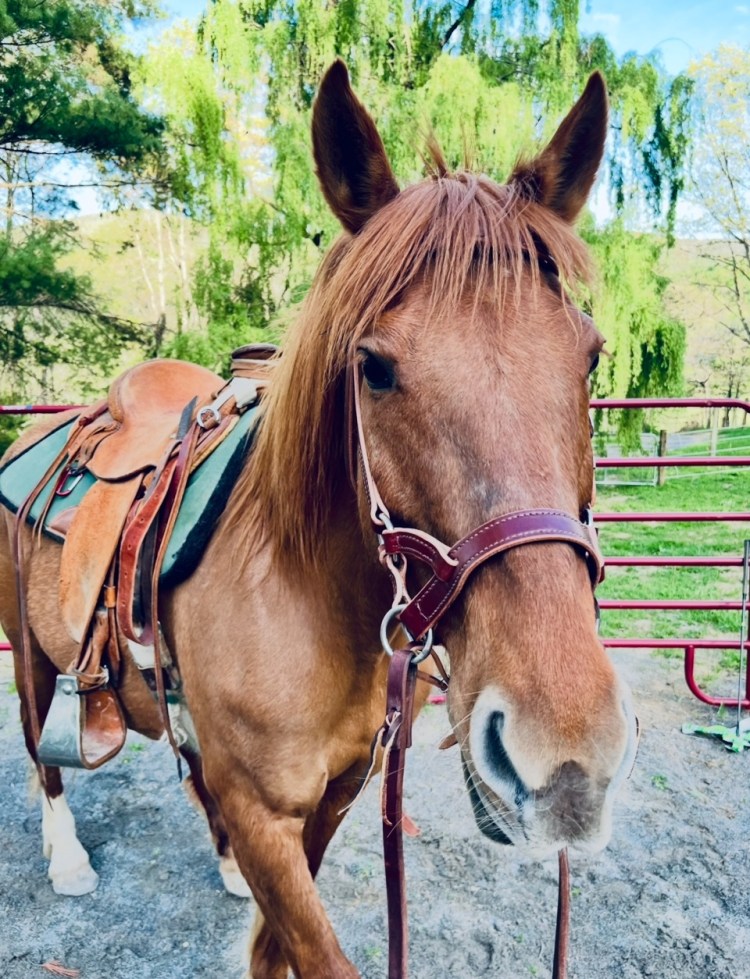
This weekend is the Old Dominion 55 for Khaleesi and me. It’s our last event before heading to Vermont. We are doing all the things we learned to prepare for the OD 100 in 2023, and it seems the mare is on a good track for giving me her best. I feel confident that we will take these rides on together and whatever comes it will be fun, and we’ll either grow from increased success, or we’ll grow from learning through failures. Regardless we will grow, and what fruit that comes, we will share it with you!
Stay tuned! Come visit! And do it all with Joy.
 Hope Horsemanship