

Anything will give up its secrets if you love it enough. Not only have I found that when I talk to the little flower or to the little peanut they will give up their secrets, but I have found that when I silently commune with people, they give up their secrets also – if you love them enough.
George Washington Carver
George Washington Carver revolutionized agriculture in the South after the Civil War. Working with children of ex-slaves in a land exhausted by cotton and a painful history, his hope was to “improve the lot of the man farthest down.” He made it his purpose to find ways to renew the land and teach farmers about self-sufficiency and conservation. An article from Tuskegee University revealed that: Dr. Carver took a holistic approach to knowledge, which embraced faith and inquiry in a unified quest for truth, believing that commitment to a Larger Reality than ourselves is necessary if science and technology is to serve human needs rather than the egos of the powerful. His belief in service was a direct outgrowth and expression of this.
This resonated with me. I also am on a unified quest for truth in each part of my life with a commitment to a Larger Reality (a creator God) who gave us an orderly world to be studied and deep truths uncovered that hold true in many different applications. I also believe if we seek in honest humility and the heart to love and serve other instead of self we will have more clear vision and understanding.
In other words, in the language of Dr. Carver:
Anything will give up its secrets if you love it enough.

This quote came at a time when I had begun to see what appeared to be positive changes in my progress with Wyoming, and I had been considering what was bringing about the change after so many years… It is always likely the change is more in me than she (my wild mare is already just about perfect at being herself) but what was the change in me? I knew it was a deeper level of serving her needs above my own, which coincides to a deeper love for her than I’d been walking out previously.
I am also a violinist and I’ve played more weddings than I could count. There was a local Catholic priest who always had the same wedding homily. He would talk about love. I remember him saying we throw the word around for too many things— we love chocolate or coffee or wine or soccer or traveling or staying home… we love people to death (what does that even mean?) in English we have one word and we use it to speak of our favorite sports team in one minute and our “till death do we part” spouse in the next. I don’t think I completely followed him to what this meant about marriage, but the point that our language falls dreadfully short in expressing more accurately what we feel-choose-carry in the way of affection.
I have always said, and believed, I love my horses. More than chocolate (anyone else humming along to that lyrics your love is better than chocolate… better than anything I think I’ve tried….) But what did it really mean to say I loved my horses, and was it true? Could it be truer?
What I propose in this meandering ponderance of truth, love, and deep secrets, is that a shift came in me that brought new levels of improvement between Wyoming and myself. I really do like her- even as she has been unable to cooperate with me in any way that could be seen as successful from any angle for about seven years (that’s a long time to have and try to work with an uncooperative horse I think for most people…) and regardless of her performance I have been dedicated to staying in the process with her. Yet though I’d say I love her, I realize how I saw her was a problem/project to conquer. This summer, gradually, I began to see her less as a complicated mystery to untangle, less a representation of my current failure to work with an equine I’ve had in my care for many years… and I began to see her.
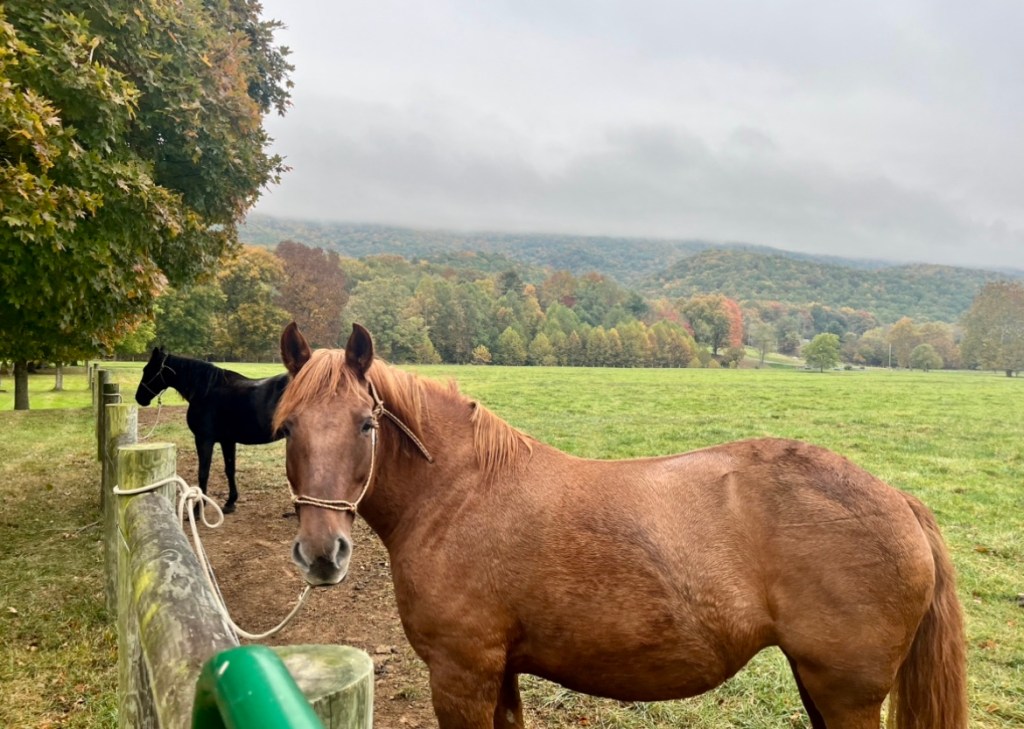
As I was able to release more of my ego, to let go of my need to fix things and solve problems, I began to have a more authentic compassion for her, how she feels, and what her experience was in all of this. The filter I’d been seeing her through which created some minor distortions was disintegrating, and the more I truly loved her (instead of what I might be able to do with her, or how she could perform for me, or even what she could teach me) the more I had clear vision of what was happening in the moment between us.
Wyoming has been challenging, but I often related to her strong willed, fiery spirit and refusal to go along with a program that was not working for her. The mare in all these years has never given up on me, and I haven’t given up on her. We’ve gotten in a few near wrecks, and yet she has always come back to reconnect with me and try again. For a mare that occasionally threatens my life, she actually has a lot of grace.
But did I love the horse? I wanted to. I thought I did, and maybe I did in part, but not the way I have come to recently.
I didn’t understand: what was it that kept her from walking in the compliance I could extricate from Khaleesi? What on earth did this horse have to fret about? She didn’t want for any necessity, including pasture, a stable herd to depend on, shelter, non-invasive but attentive health and nutrition care… I’ve never been able to ask much of her- so her life is pretty ideal it seems from my human point of view. I could not wrap my head around why on earth she could be so snarky and grumpy at every interaction that wasn’t custom fit to her short sighted equine demands. I’ve had her checked out physically on just about every level. This inability to understand what could possibly be so bad that she’d threaten to take me out when I try to work with her has been mystifying.
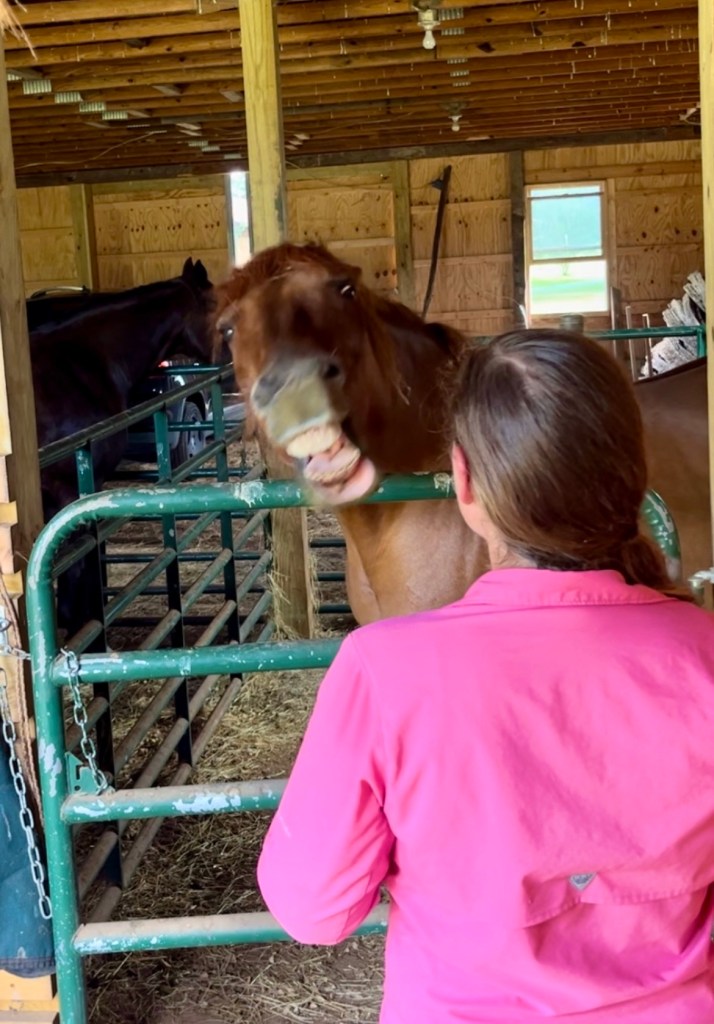
Then I began to work with Tom Moates, who has been a Godsend for getting an outside pair of eyes on us and guiding me to work with her within the truths he has picked up from years of close work with Harry Whitney. His regular visits to help us sort out a better path have been a game changer to chipping away at the trouble we seem to get into.
That doesn’t mean it’s been roses and sunshine. Honestly, it has looked on the surface like everything was getting worse, yet I sensed something was different this time. I felt that deep tuning fork reverberate, telling me that we were going deeper in, digging out some wounds, some history, some infection, some sewage, but if we could face these things together and try to release them without fear, maybe this time we might get to a new place. So I kept trying.
Over the summer, armed with guidance from Tom in person and via email/video, I spent many hours a week trying to find common ground. Wyoming’s stall (aka the shark tank) has been my classroom this year.
The halter has always been sticky to some extent. Though for years I have been able to get her head in the rope halter (and she will comply), I have always sensed that it was not ok. My gut tells me this is a key: the halter is a basic loss of her freedom, and it takes a lot of trust to volunteer to submit to anyone in that way. I am still not on her list of trustworthy enough to relinquish that level of control.
It is worth considering that putting a halter on a horse- a very small piece of equipment- takes away almost entirely their ability to self govern. There are limits, horses can jerk a lead rope out of a human’s hands, or I’ve had Tom tell me I looked a bit like a kite as she pulled me right off the ground in retreat, but once we have the ability to control the somewhat delicate head with all those nerve endings and the soft tissue places around the nose, we have a powerful level of force over them, especially if tied secure to a post with a strong rope.

Over the years I have tried to find better ways to use the halter than force, and last year when I heard Mark Langley talk about guiding horses instead of driving them it impacted me as kernels of truth tend to do when I hear them. Being prey animals, horses can be driven into things especially if we have a halter/lead rope that prevents real escape. I have driven her over the years to do a lot of activities, but she has never felt good about it, and no matter how pretty and snappy she looks trotting or cantering around me, she is not relaxed or happy.
I didn’t not love her. I wanted what was best for us both, which is a cooperative relationship with her humans. She lives in a human world now. The wild life is not all it’s cracked up to be so I do not agree that she would be better off left on the range. There’s starvation, drought, predators, and extreme weather there. I doubt she would be less fearful than she is here when she goes into high alert when the deer roam through at night.
Still, I didn’t know how to help her or me, and I flailed around with various levels of success and unsuccess and the mysteries remained out of reach.
As I continued to regress this summer to the most basic fundamentals, I once again asked: can you be ok with me putting the halter on you? I found myself summoning the courage (thank you Tom for being the guinea pig and flag man) to open the stall gate and stand in the gap, vulnerable to attack,and offer the halter to her knowing she could choose to take me out. But oddly enough, if I came in with too much self-protection, she felt the fear brace in me, she would brace right back against me, and we could not breach the impasse. I had to make the choice to risk being hurt and show up with a white flag (actually no flag) instead of a weapon. With some basic safety in mind, I would hold out the halter from one knot away from my body so the noseband draped open and allowed her to make the choice to put her nose in on her own.
I did not encourage her to bite at the halter. It’s not good manners at the minimum, and I don’t want her nipping at my tools to “work out for her” but the other problem is, her reaction to that piece of equipment is actually that strong so I also had to acknowledge that without punishing her. I don’t want her to spend her life thinking it’s ok to bite at my equipment- or at me, and I don’t want to send the message that I don’t want to know what she’s thinking or feeling. It was a very fine line, how to express ones thoughts and feelings in an appropriate way! I’m sure I did not always successfully navigate this delicate balance and it takes impeccable timing. She must think it’s her action of nipping at the halter that creates the reaction that might be a poke from my finger at her cheek, but that she has control of not being poked (try not nipping at the halter!). The right instant timing is action-reaction; just a moment too soon in anticipation is picking a fight; enough delay becomes punishment (which we NEVER want). However, as I began to care more about how she felt and helping her, than getting my task done without being injured, something shifted.
It seems that letting go of what I really wanted was the path toward actually receiving what I really wanted.

Harry and Tom both talk about creating an imbalance that the horse will work to correct. Take for example how a bit works. When the human takes “hold” of the bit in some way, it creates an imbalance that the horse will move its entire body around to fix, which is how we can control so many things along a huge animal’s body with a small piece of metal carried in the mouth.
I had come to see that just my presence creates a strong imbalance for very sensitive Wyoming. I can stand in Hope’s stall doorway a very long time before she bothers to find out why I’m there. I might need to make some noise to get her to care at all. With Wyoming it’s different. Even without the halter, just standing at her stall gate, it did not take long before she stopped munching on hay and began to move. She looked out her window… but she was not unaware of me, she was trying to find peace, and if she could send her mind out the window it might help, but, as I waited I saw it did not work for her. My presence was still too disruptive even if I did nothing but stand there.
I added the halter and this was even more disruptive without making a sound. The same looking out the window was her first try to make things right, then she would look at me, then look back out the window, then look at me again. Then she would take a step in a circle toward me, and pin her ears giving me threatening dragon face. Maybe she could scare me away. Nope. I just stood there with the halter held out. She would step toward me and nip toward the halter, I would do various things to discourage that without picking a fight. Then she would stand with her nose over the half wall/gate to khaleesi’s stall, a position that would be very hard for me to force the noseband on her. And I would still wait. Someday, I hoped she might choose to allow the halter. If she would choose, it would change everything.
In the process of this I could see the depth of how disturbing this was for her. It didn’t make sense in my human brain, but I could not disregard what was in front of me. I began to be intensely curious toward this dynamic. She did not go back to eating hay. She would occasionally cycle back to the window, but never for long. For most of the time she would stand very close to me, I could touch her with the halter on the neck, or other parts of her body, but she did not want that noseband to capture her. In all this I did nothing to force her to participate, and yet participate she did, in the all the ways she could.
I had begun paying more attention to what the truth was for her, as strange as her truth seemed to me, than what I was trying to do or get done.
Gradually I was able to halter her with increasing relaxation. This process wasn’t a dramatic moment where she chose as I hoped to put her nose in the halter voluntarily. It started with a shift in position where she seemed to suggest: I cannot bridge this gap yet, it’s too much for me, but if I stand here quietly you can put the noseband up my nose and I will try not to fight you.
The reason I believe this is accurate, is because when she did begin to position herself allowing room where I could put on the noseband, she had minimal nippy reactions, and once the halter was on and tied she began to relax there in the stall with me. This is a time when I would stand there in the stall with the halter on, rub on her, scratch her, breath deep, and make it a really nice place to be together. It was here I began to notice just how much tension she carries in her neck. She has such a level of self-protection about her it’s no wonder she feels terrible.
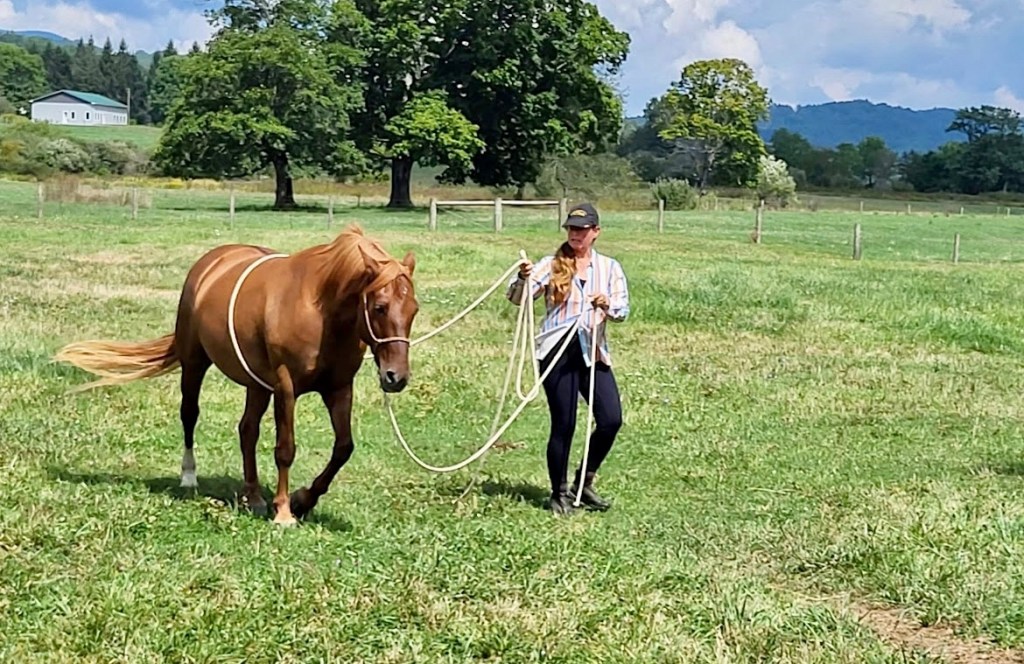
As summer melted away to fall, I had a shift in routine that meant I had to bring the horses in and out of the barn across the yard to a remote pasture which meant I had to halter them. I knew this would come and it concerned me- having to take my life in my hands to manage the wild thing did not sound fun (in the summer I could get the halter on or walk away and it didn’t really matter, now I had to get this job done in order to move her). However the foundation we built through the summer set us up for success.
At first I’d move the herd one at a time. I liked spending the time and attention on Hope solo, who is slow, as we did the walk together. Khaleesi is pretty manageable at whatever pace or need, but Wyoming benefits from focus and clarity in everything we do, so walking her alone was preferable. This meant some days I would start in the barn and take Khaleesi into the remote field. When I returned Wyoming was already becoming stressed because of the imbalance in her environment (herd separation). She is smart enough to realize that it was the halter that was her pathway to rebalancing in rejoining her lead mare. Instead of a mess or violence I would step into the stall and she would come to me and dip her head at the noseband (very willing) and I had to ask her to slow down and not revert to autopilot with her brain already in the other field and her body stuck with me (this the the condition where a horse has lost her mind). In this way she began to invite the haltering process because it had meaning attached to it she wanted to engage in. Similarly in the large field where I worried I might never catch Wyoming again, she was usually the first one who came to me and agreed to the halter to go back into the barn for breakfast and a break. This new routine I worried might get one of us killed actually helped us establish some good patterns.
Looking back however, it was one of the days I was rubbing and scratching the mare in her stall trying to help her see she could let go and relax and trust me even with the halter on, that the rock hard muscles in her neck simply would not relax. Even as her eyes began to soften and she was reveling in the butt and underbelly scratches she was getting, the tension was rooted deep, and it was here that something broke loose inside me.
Harry Whitney says it would really help horse people if they could learn to recognize the motions that go with good emotions, and the motions that go with negative emotions. As I stood next to this wild creature who has lived with us for seven years, I realized looking back how much tension and brace this horse carries all the time. Tears stung my eyes as I considered the depth of the worry she carries around, and I felt overwhelming compassion for her.

I have not loved her like this before.
I didn’t want to fix her issues. I didn’t want her to have safer “manners” for all the human interactions that would be required of a normal horse. I didn’t want to know I could get her on the trailer… I didn’t want to solve the problem of why I’ve had this horse seven years and can’t ride her still. I didn’t even want to know I could halter her without her nipping at me. (Although I did want those things, they became highly insignificant)
I wanted to know how on earth I could intervene in her world in a way that could help her let go of some of what she was packing around, and that she would feel better about her life. I found myself begging for the insight that would help her to feel good for maybe the first time in her equine life since being rounded up on the range all those years back.
This is when something began shifting anew.
What changed?
Me.
I have always loved this horse, I thought.
But not like this.
George Washington Carver was knows for his humility and service. He cared so much for the people that were struggling, forgotten, rejected, or oppressed, that he went into his lab with the peanut and love poured out of him. A kind of love that opened up the secrets of the soil, the peanuts themselves, and in that place revelation came and revolutionized agriculture forever. Crazy and unscientific as it might seem, it was in his posture of love and not ego or fame or self-interest, the secrets were revealed.
I had a glimpse that day in the barn with Wyoming, when my heart broke for the years I’ve seen her gallop across the field with tension through her body brought on by stress, neck raised and stiff, instead of that beautiful fluid movement that comes with relaxation and a stretching out of the muscles and joints, and I grieved that I hadn’t yet figured out how to help her. Not for my ego. For her.
Hope Horsemanship carries a verse instead of a tagline or motto. It is Jeremiah 33:3 Call to me, and I will answer you, and will tell you great and hidden things that you have not known. I then pondered another truth in the same big book of wisdom: If I had a profound understanding of God’s hidden secrets… but have not learned to love, then I am nothing.
We are not worthy of the deep secrets, we are not trustworthy of them, if we don’t love first and foremost.

Wyoming, and most people around us- know the difference between saying we love and having that love authentically pouring out of us. You cannot fake what is in the heart. Not to a horse at least. Until she knew that love coming through me authentically, her secrets were kept under a tough braced up shell. She couldn’t trust me with vulnerability. This is a road. I have not arrived. Still, I can see progress.

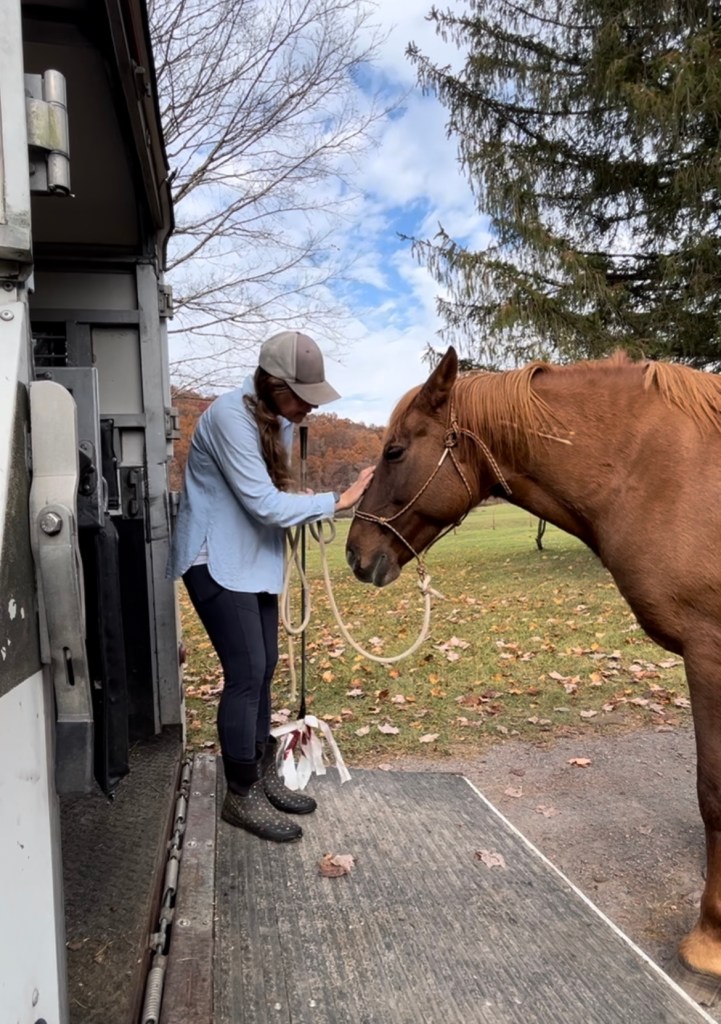
I wanted to say she didn’t have much choice, as a horse she couldn’t choose another owner. But the truth struck me that I also didn’t have much choice! Considering she wouldn’t get on a trailer to save her life, I didn’t have much opportunity to sell or give her away either! We have been bound together for some greater purpose. Now she appears to be at least somewhat loadable, but it’s too late to go back now. I am hers and she is mine. Hopefully the mystery will continue to reveal and it will be a good story when it’s all told.
 Hope Horsemanship