

For want of a nail the shoe was lost.
For want of a shoe the horse was lost.
For want of a horse the rider was lost.
For want of a rider the message was lost.
For want of a message the battle was lost.
For want of a battle the kingdom was lost.
And all for the want of a horseshoe nail.
This proverb dating back to the 14th century came to mind as I considered my week with Harry Whitney (and Ronnie Moyer, and clinic host and friend Tom Moates). It is amazing to consider what something seemingly insignificant can affect. A simple nail missing begins a cycle of events that ends with the loss of a kingdom. Missing a thought in a horse has in fact culminated in otherwise undiagnosable lamenesses, plenty of distressing behavioral concerns, and depending on circumstances can lead to various potential train wrecks that cause damage to horse and rider.
For want of a forward thought the relaxation in movement was lost.
For want of relaxation the physical balance was lost.
For want of balance the strength in movement was lost.
For want of strength in movement the soundness was lost.
For want of soundness the usefulness of the horse was lost.
For want of usefulness the horse and rider partnership was lost.
And all for the want of a forward thought.
Last week, finally, the appointed time came when instead of finding Harry Whitney working with folks and horses and sitting with only a notebook around the round pen or arena, it was my turn. I brought a horse and got in the circle myself, in hope of being guided into some changes.

I brought Khaleesi who isn’t complicated, who I don’t have large pressing problems. Khaleesi the magnificent, my special K. The horse who gives me grace and fills in for me when I fall short. The horse who recently carried me to a solid finish at the Old Dominion 100 mile single-day endurance ride. It’s not difficult to see the problems with Wyoming. If I ask something of her and she threatens to kill me, that seems pretty much pre-school in identification level. Helping Wyoming to a better place will take some finesse, but the thing about a horse that obvious: you don’t have to wonder how you’re doing. There is probably more risk to my safety involved at times because she has big feelings that can be explosive, but no one has to be very adept at reading horses to know what she thinks.
As for K, she’s gotten along with the training I’ve offered and she’s become obedient. Yet I know there’s more available to us that I’m not accessing, and I know I could offer her a better deal if I knew what that would look like.

It takes a bit more understanding to see the difference between obedience and willing responsiveness. It takes someone with more observation and experience to recognize the difference between light and soft. I figured out that I had a fair amount of obedience, but responsiveness and softness I was pretty sure I did not have. If I’ve gotten it from time to time it is more rare than I want. I wanted more and I knew Harry is someone who could help me even see what that could look like.
On my first day in the round pen with K, Harry observed two fundamental things: first he noticed I wasn’t all that important to the mare. This did not surprise me yet I wasn’t sure how to address it. I’ve heard a helpful suggestion that we should be demanding of our horses, but never critical. This line is not so easy and it can seem to shift depending on the horse and their understanding or education level. Some people struggle being demanding… not me. I’m great at demanding a lot from my horse- problem is I merge right over the line into critical and that creates a negative association, an ill feeling. Therefore I find myself swinging purposefully too far into a place where I’m not so clear, not firm enough, and not expecting enough. I let her futz around in an attempt not to be too critical and she begins to see that she can blow me off if she futzes around toward my request generally even if she is in no great concern to comply. Like a teenager who says: Yeah Yeah, I’ll get to it when I’m ready. Thing is, she is capable of being more present and attentive and she was able to relax and responded to me expecting her to simply connect with me, NOW. This doesn’t mean I have to get her to DO something as much as it means she should be mentally centered and ready.

Next Harry mentioned he hadn’t seen her have a forward thought yet. The forward thought concept held the keys to the kingdom. This was something I’d been fascinated by and unsure how to work on for months. It was, I believe, the first question I asked auditing my first Harry clinic in California (February 2023). Harry how does one create a forward thought?! He smiled the now familiar wide smile and said if I watched they’d work on that. Still, I had a long way to go from the round pen in Vista, CA to the square cow pen outside the barn in Highland County, VA.
Considering horses are generally “forward-a-holics” they move forward more often than any other direction; this means seeing what a horse moving with a forward thought looks like, and being able to identify what a horse moving forward without a forward thought looks like. I’ve ridden many miles with a horse not having a forward thought, and my tools to work on that were creating in many instances a bigger problem instead of solving it.
Harry Whitney encourages his students to lead and guide their horses instead of driving and punishing them. Boundaries and consequences are real, but they are really different from punishment and driving with direct pressure. I had learned basically “natural horsemanship” tools over the years and it’s amazingly simple: if you want your horse to move forward, you ask it to go, then if it doesn’t go you add pressure in the area that will “drive” the horse forward. The driveline is generally easy to find in the rear half or third, or even behind the horse. If you apply pressure at the front of the horse it’s less likely you’ll get the horse going forward.
The problem with this work, is a horse can run forward in flight from something they are concerned with or bothered about. In this case the horse’s mind is actually on the thing worrying him from behind– not set on where he is going – which would be forward. A horse moving worried or in tension lifts its head up (a little, or a lot) holding those levels of tension in the body (if you are worried you are about to be hit, slapped, ambushed, or otherwise attacked don’t you brace for impact?). Tension is no one’s friend. We know in a wreck, fall, or even assault, if we were able to absorb impact without tension we would fare better, but our sympathetic nervous system has to be overridden in order to change! We can sometimes, in great moments of self-control, override our own reactions but it’s virtually impossible to convince a horse not to brace for impact or attack and stay relaxed as I pop your hind end with the lead rope because you didn’t move out when I asked.
Yesterday I knew my little herd was concerned over something environmental I could not sort out. They were returning to look out the big doors from their stalls eyes focused on the distance. When I was finished there and released them they walked out of the barn politely, then once out in the field both Wyoming and Khaleesi began to pick up some speed and were clearly on alert. They sure looked pretty, but their heads were high and they were NOT relaxed in movement. They did not have a soft forward thought out there, they had stress and tension because something in the environment had their flight response kicked up a notch. They also did not move in a straight line… they meandered like drunken sailors in arcs and zig zags as their brain pinged around potential concerns in the environment.

Meanwhile Hope was behind as usual. The two had settled a bit into a place to graze seeing there wasn’t anything dangerous to run from immediately. Hope sauntered out of her stall at a walk looking around, then saw the chosen grazing spot and with a forward thought headed right toward the herd. She wasn’t worried and she wasn’t in flight. She knew where she was going and she took her body right in the direction her mind was pointed. Her neck was forward and her line was straight as an arrow.
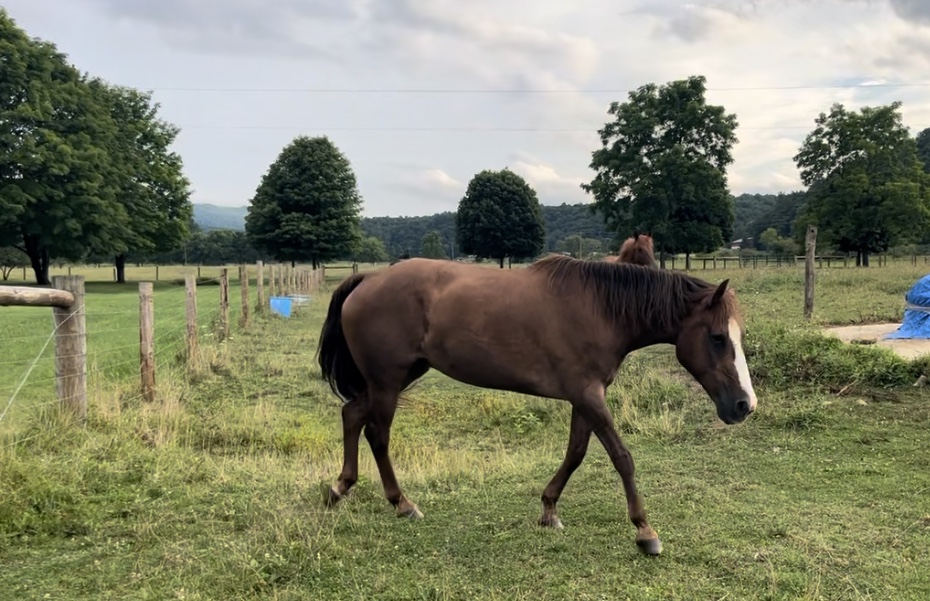
If you have a horse whose head and neck goes up in movement, especially if it needs to be tied down by any mechanical device (or even “held down” by rein pressure), it is highly likely that horse is moving in stress or anxiety and brace of some sort. The effort to tie or hold the horse’s head down as a solution will increase anxiety because the horse now is anxious or tense and also unable to move freely- being literally tied down. A horse who is forced or trained to keep its head down but never helped to understand better how to move in relaxation is going to end up eventually with injury or shortened career than otherwise. The horse may learn to hold that physical shape to avoid fear, confusion and pain, but the tension will be as great or greater than if the head were moving like a giraffe. It regularly amazes me what they are capable of… even in a state of being handicapped by tools and tack. Horses are stunning creatures of strength and grace. Imagine what they are capable of when given the power to move in softness, understanding, and giving willingly in freedom? It blows my mind to consider it.
Khaleesi is Arab, TN Walker, Saddlebred and Racking Horse. This is a mixture of breeds that might suggest a horse genetically inclined to moving with an elevated neck-head position. I asked Harry about this and as he worked with her on day three from authentic curiosity…
Another thing I love about these clinics is there truly is never a dumb question. I have heard questions in these clinics I thought might actually be dumb questions– and every time been amazed by something unexpected in the answer. I’ve learned to ask anything I’m curious or in doubt about.
…The answer to my curiosity about different breeds holding their heads and necks in different angles came out of watching Harry work with K in real time: it was completely clear that when she relaxed her body she lowered her head and neck, when Harry was able to get her to walk off with a forward thought, not in anxiety, her neck stayed relaxed and her body moved in freedom (and significantly more balanced). I think each horse has their own place of holding balance in softness so we are not looking for a particular angle or position, only watching the body to see when the neck gets longer as the muscles release and the movement frees up. Her neck only came up higher (it contracts or shortens when this happens) when she began to worry, get distracted (what was that noise over there? Did a horse call? Is that a deer?), or stress over the request to transition up into a higher gait. Her entire body changed when she switched from relaxation to distraction or stress. It was not a change for the better.

Roughly three to four years back I went through a period where K had intermittent lameness, we were increasingly pulled at endurance rides for mild lameness- often the vet couldn’t really tell where it was coming from, which foot? I never argued about these pulls, I could see she wasn’t traveling right, but I also struggled to sort out how to help her. I had vets do radiographs and nothing in them seemed an obvious problem including sole depth and bone surfaces or angles. I worried about grasses (this likely played a role when she was on too much rich grass and some of the lameness would clear up if I pulled her off the grass and hand walked her a few days). The heaviness on her forehand could have paired with sensitivity from the rich grasses to create discomfort. The lameness would come and go, but in that period it was more recurring especially at the trot (she was almost always sound at the walk) so I spent a year walking her everywhere.
I walked her up the mountain, I walked her down the mountain. I walked her around the mountain, in the woods, through the valleys, and along the river. In this time I did my best to learn about true straightness, better balance, and this began to solve some problems. I got some good guidance from Emily Kemp in these years to bring her into better physical balance and it really helped. She had more stress and anxiety at higher gaits and speeds (this is true of almost every horse), and so by committing to walking everywhere and finding the best balance and straightness possible at that walk (I wasn’t bored and wandering around at a walk, I was active considering my own body, joints, tension, balance as well as hers).
In some part I had inadvertently begun to help her relax and spending so much time walking freely also lowered her stress and anxiety. Stress comes from many places but it is always a condition where the mind and the body are disconnected, and in that case the horse is also disconnected from me. Though I was doing better on the physical front and it made great strides to reversing the mysterious lameness, it would be limited wherever anxiety and tension appears.
Tension in the body is also brought up when the horse is feeling pain (ulcers, joint or muscle soreness, inadequate hoof protections for the horse’s needs, uncomfortable saddle fit, worry about the bit and how the rider uses it, metal clips connected to the metal bit clanging, a particularly tense rider inhibiting freedom of movement…). If my walking work was going well but my saddle was pressing or pinching there won’t be true relaxation available.
Stress is also mental. Leaving home and leaving the herd are often stressful for horses. Confusion and inconsistency in handling is incredibly stressful on horses. Training that uses punishment keeps them always concerned they might do the wrong thing and get swatted by a lead rope, a stick, or chased by a flag. It’s hard to be relaxed when you are worried about what seems to you an ambush by a training tool (and until we are perfect in our communication which I have certainly not achieved, some of this is inevitable if we train in this way).
Fear or adrenaline of unfamiliar or distracting environments are huge factors for prey animals. Because we are high level predators I think we discount how great an impact this is. I’ve seen my share of horses running around at an endurance event who are moving fast, but without their mind present. They are either stressed, distracted, in pain, fearful of any number of rational or irrational things, or have been trained when in doubt go faster which bring on usually more tension in movement. I find my normally calm easygoing horse more alert and hot minded at a ride, especially on the start. Fortunately for me she starts from such low energy that her heightened state is still pretty under control. I am excited to have new ways to seek out relaxation as she presses into her work engaged in what’s going on around her.
So what can we do?
I was amazed at what 20 minutes with Harry Whitney in the saddle in a round pen accomplished. I feel incredibly fortunate because though he was coaching me personally through how to help her relax, be present, and learn a new way of moving he could see it would take me till Christmas in on my own especially because I hadn’t experienced this feeling and was having a harder time building on tiny moments she found it. She had to find it. It can’t be “trained in.” A horse can stick it’s head in a certain position through a training and still not be mentally present or relaxed. This is the rub- to know the difference.
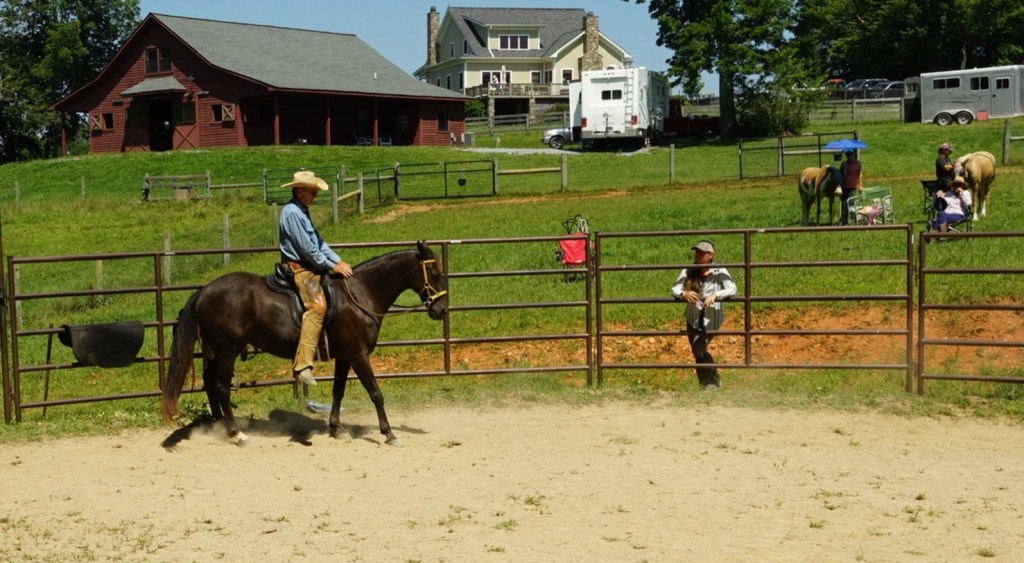
Harry worked with her and then invited me back to feel the change.

Christmas had come.
Moving in relaxation was like a newly greased bearing that could go every direction without resistance. Moving off a forward thought when it happened was like a new German engineered engine was installed. I didn’t even know it was available until I rode it. Now I could feel the difference when it wasn’t there, and that made it easier to say: Hey hey there, we don’t have to go back to that! There’s a better way lets try again and accept only that.
We have not had one questionable vet check in the last two years for lameness. Still, that funky step, that tossing up of her front end on an upward transition or that off balance movement appears like a ghost of Christmases past here and there. I am not afraid of it anymore and treat it exactly like that… a ghost that has no place here. The problem is fleeting, but I know it still lives somewhere in there to rear up in a moment then be gone again.
I was pleased to see it show up in the round pen a few times as we worked in front of Harry. It’s helpful when problems you want to see addressed actually appear in a place to have them seen and considered. Though the mare was clearly NOT lame, she would do a circle looking quite lame and I could hear the murmur of questions from the group watching. I knew what they were considering but only Harry’s reply came clear through his mic: oh that mare’s not lame, it’s tension. When she starts carrying more tension it creates that imbalance of movement.
Sure enough, as we worked out the tension the lame-looking imbalance would dissipate. Also due to the many hours and miles of riding in tension in the nine years she’s been mine, there is a physical imbalance that occasionally means she strikes off with more power on one hind leg than the other. When she does this it also looks like a lameness. Seeing this also fascinated me. Once Harry explained what was happening, again, it was impossible not to miss it.
The beauty of this is now that I have seen it and felt it, and I can’t un-see it or un-feel it, I also can see it from the ground. Now I begin our work, after our connection is established and I become important to her with her focused attention, and I ask her to walk off onto that circle and if she does it soft and relaxed we walk. If she doesn’t, I check the connection (was she distracted? Did I put too much energy into the request and disconnect us with too much or too jerky communication?) and ask again (did she need to remember what it feels like to do it in softness? Longstanding physical habits take many repetitions in a new way to change). I now don’t accept something as simple as walking off with a head popping up, neck contracting, and tension in the body. I don’t have to punish her, I simply say no thanks to that and we try again. If I had to, we could repeat that 100 times until she gets a good one, or a change in the better direction, and reward that. It’s going to feel good to her too which is the beauty of this work.
They key is that as I make it available to her, as I expand her list to know that is possible, she will seek it out more often and search it for herself because it will feel good to her.

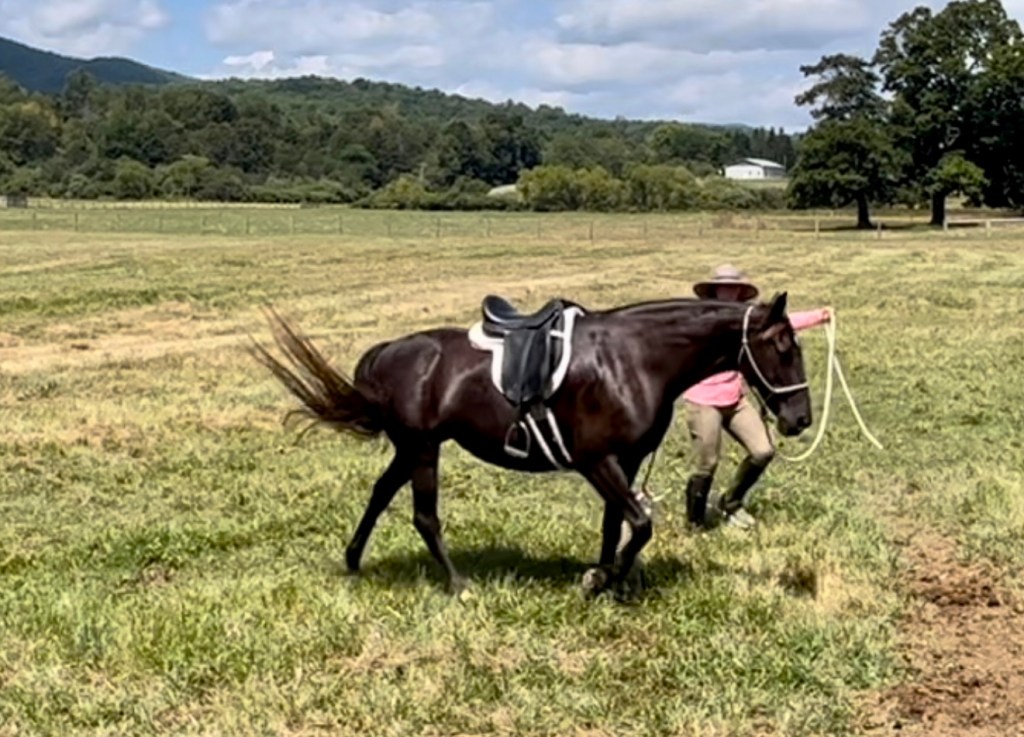
Horse training often does not feel good to the horse. If we are (as Harry says) moving the meat and not the mind we end up with a horse who can look basically right, and do the obedience, yet feels pretty crummy about it all and move about in various levels of tension trying to get their body to do the thing we are looking for.

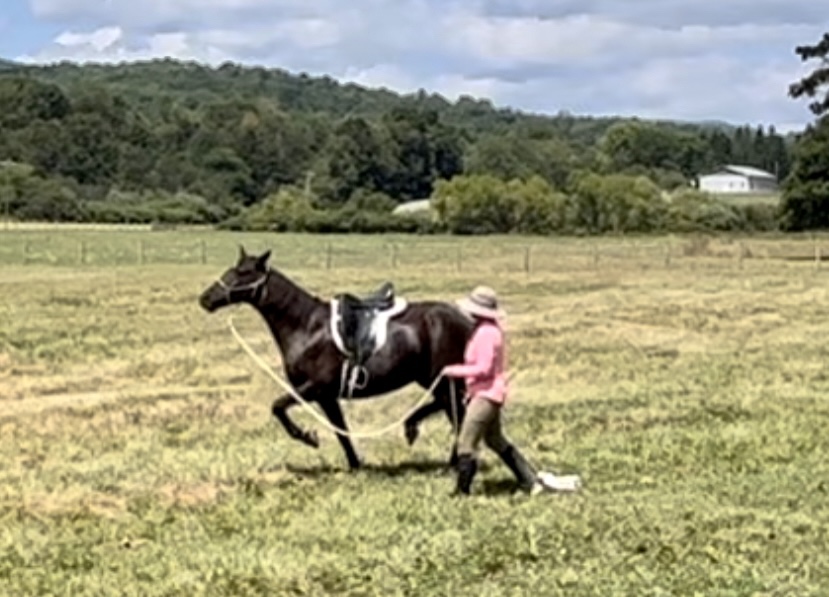
This work focuses first on how does the horse feel? Is their mind centered yet not shut down and zoned out? Are they standing in tension or relaxation to begin? Are they breathing? Are they worried? What can you do to connect with them and help them to feel better first? If they feel better and are relaxed they trust, if they trust they will try. If they feel the freedom to try, to get things “wrong” and have us guide them instead of punish them- and yet be firm enough to keep them engaged when need be, they begin to feel good about being with us. When they begin to feel good in movement, they begin to gain in strength and power in relaxation, this leads to increased confidence in themselves and in us. This is the magic of working from the mind first.


There were many discussions over the week about how exhausting it can feel to be so aware of every moment and every time the mind begins to leave while we are with the horse, every time they take a step in tension and to stop and try again. The demand for consistency in ourselves is incredibly high if you want a horse that moves relaxed in strength. To carry that kind of awareness when you are used to zoning out with friends on a trail ride chatting about everything except what’s actually there in the moment, this is a big shift. How often are our own thoughts not present, and then we would like our horse’s to be. We must be as engaged as we expect them to be. I suppose if you own a horse because you want to go ride with your friends and talk about everything except being there on the horse at that moment in that place is a choice we all have the freedom to make… I’ve ridden many miles like that. But I know the difference now and I find I can’t anymore. Not because it’s “bad” but because what’s available is so much greater. There IS magic in connecting on this level with such a generous and intelligent creature who has so much more to give, but won’t give it to me if I’m mindlessly riding along like a dummy. There is a cost.

I’m hungry for the deeper levels and the higher places we can find together. Especially after Harry helped my horse see what she was capable of and then offered that to me, to us as a gift to enjoy- not to squander or let slide right through the sieve my minds can become if I am not staying aware.
Because of that gift, though I agree it takes more effort at first to be that present all the time, but like anything if intentionally practiced, it gets easier, and in time, becomes a way of life. We get better as we engage. An entire kingdom available to us that begins with a thought. For me and my herd, it seems to require a forward thought.

 Hope Horsemanship
I love your details on Harry’s training and K’s forward movement, and your photos make it even more clear. Thank you for sharing.
LikeLiked by 1 person