

When it comes to any relationship, boundaries matter. I think Danny Silk has some great books out about powerful individuals, the importance of connection, how to love well (even your enemies) and the trap of confusing boundaries and punishment. He has a great book titled “Unpunishable” that addresses what he calls our culture’s addiction to the punishment paradigm and how to let go of this in our human relationships. I’ve read the book. I’ve put effort into understanding and walking this out in my own life.

Then there are relationships with horses. I remember hearing Mark Langley say that boundaries are fixed and they don’t chase you. If you think you have a boundary with your horse but your boundary is in fact chasing your horse then it is not a boundary.
To make a finer point, I’ve heard Harry Whitney give an illustration about electric fences. I’m pretty sure Tom Moats has written about this too, but since I’ve recently read a handful of his books I can’t remember which one it’s in and who might have borrowed it… Harry explains that horses graze peacefully near an electric fence, very close to it, even sometimes reaching under it as far as they can without touching the strand. Most horses familiar with an electric fence are not afraid of it although no horses like the shock of coming into contact with it. Their experience is that the fence will not surprise them, ambush them, or chase them. Certainly the fence can be moved into new positions, but once the fence is fixed, the boundary is firm, clear, and potentially most importantly: not personal. There is no question if a horse gets shocked by the fence it was unemotional and non-judgemental. The fence isn’t angry, frustrated, fearful or otherwise emotionally embroiled in the process. No horse need be shamed or considered a “bad horse” for touching the fence and getting shocked; not very smart, maybe, but evil or bad are not part of the equation. Horses figure out quickly that the shock is a direct consequence of running into the fence and once they do it a couple times, it’s usually enough for them to avoid the strand in the future.

This all makes perfect sense to me.
I thought I understood what a boundary is…
Then I began to press into dangerous territory by interrupting Wyoming’s very strong thoughts — which opened the can of snarky-threats where she began to threaten me with dragon ears and teeth bared. What do I do about the violent threats?
I had to think this through and I regularly found myself changing my position on what to do about it. Clearly this is NOT OK. I don’t care how you feel Wyoming, you cannot threaten to harm a human and continue to live here. In Mark Langley language “That is not available.” And in Harry-land “Let go of THAT thought mare.”
I thought: there is a boundary needed where that behavior is not tolerated and has an electric fence style wire that is tripped when you go there. On the other hand, it’s not as simple as setting up a “snark fence” that sends an electric shock clearly, effectively, and unemotionally at exactly the right time when the snark threat shows up. I have to set and enforce the boundary, and with my human limitations this could easily end up being unclear, questionable on its appropriate firmness, and most importantly could be rife with emotion no matter how hard I try not to be. There is a thin line between a boundary and a punishment, and this particular horse is quite sensitive to knowing which it is, and punishment always makes things worse between us.
In June when I started over once again, I’d see her go volcanically violent when I asked for her attention on me while she was in her stall, and I’d stand still outside her reach as she would snake her ears and snap her teeth a few inches from my face. I’d say: thanks for giving me your attention, this is a start… And she would cuss me out in equine, threatening to chew me up and trample my carcass when she had the chance. But, I reasoned, I had all of her attention in that moment. Of course the hope was to get her to feel better about it, and I don’t think that interaction felt very good for either of us.
The problem seemed to get worse. There were times I would be doing something completely unrelated to her in the next stall and I had to pay close attention to the eyes in the back of my head because she’d stick her nose over the gate threaten me even when I wasn’t asking her for anything. Even my presence began to get under her fur. It seemed to be increasing, so maybe allowing her to have these fits was not the best way forward. If I want to help my horse let go of hard thoughts, I reasoned, I need to find a way to basically say: LET GO OF THAT! When she turns to violence. The violence needs to not work out for her. Right now, I’m not so sure if it is or it isn’t working for her in her mind. So I tried answering the violence with what I hoped was a boundary. If I had my rope, I’d be ready when she circled back to rush the gate with her teeth bared to meet her with the rope as adapt as I could get with my timing in the hope she would begin to think whenever she had snarky-violent outbursts, she ran into something when she came at me and it was not pleasant. Like an electric fence ideally, one that only came on when you have a bad attitude.
I would have to be very consistent, as unemotional as possible, and match her in firmness as closely as I could. I wanted her to learn there is a boundary here and violence will never be tolerated.
I had a couple lucky opportunities meeting her exactly when she came at me but it seemed to only make her more angry and more threatening, and if she backed off it was harder to see a change for her to soften and relax. I could get her to act less on her wish to chew me up and spit me out, but I don’t think it changed the fact that she wanted to. This approach didn’t seem to help her feel any better about being with me. In fact if anything I think she got better at planing quick sneak attacks in the hope she might get through the barrier. I liked the idea that I was trying to clarify that this aggressive behavior was NEVER acceptable, but it didn’t appear I was making real progress with this.
It did not seem to be working out for me.
The next shift back came one day when I was innocently cleaning the middle stall and Wyoming came over the gate with her head and began snapping her teeth at me. I wasn’t looking for her attention or demanding anything of her. This also means I was completely unprepared to meet her violence with what I hoped was a decent attempt at a boundary like a rope or a flag, or any useful tool.
So I just stood there.
I stood there and watched her, inches from my face. She pulled back, did her little ramp up circle, snaked her ears and stuck her nose at me, teeth clacking away. I stood unmoving and completely unemotional, and slightly at a loss. I wasn’t “working” with her, I was just at the barn at that time. I simply observed her and paused in curiosity to watch what she would do thinking that I had screwed up the consistency of meeting her behavior with a clear boundary every time. Now what?
As I watched she repeated the cycle which always included pulling back, doing a little circle, reflattening her ears, and throwing her head over the gate at me, teeth clacking. However, as I stood unmoving and completely curious (not upset, frustrated, angry or afraid) each time was less enthusiastic until finally she threw her head over the fence, froze with no bared teeth, softened her eyes and her ears perked forward. Now it was her turn to just stand there starting at me, curious.

It was this experience combined with the revelation about the cowardly lion who desperately wanted courage, that had me re-evaluate my attempt to “boundary” this behavior by meeting it with a tool of some sort.
First, I realized as I stood quietly out of her reach, there actually WAS a boundary. It was the gate that separated the stalls. That boundary was secure and clear. The truth of this scenario was that she cannot hurt me while the gate stays in place, and it’s screwed to posts with brackets, so it’s not going anywhere.
Second, my attempt to meet her violence with some kind of equal “boundary” with a rope or flag she would ideally “run into” wasn’t the wrong direction entirely, but in reflection I had to be honest with myself: I was meeting her fear with my own fear. I wanted to believe I was unemotional, but though I was decent at stuffing the emotion in the moment, it was there. I was afraid if I didn’t curb this behavior someone (probably me) was going to get HURT. I don’t think this concern was unreasonable or wrong, but regardless it was an underlying emotion. No matter how hard I tried, the boundary I wanted to put in place was smelling to her a whole lot more like a punishment.
Third, though I wanted her to “run into her own pressure” somehow when she came at me, having the rope or flag or stick meet her physically was still “at” her. I started experimenting with creating a big sound instead where she did not like the shock of the noise, but it didn’t hurt. These details are obvious to me now, and really important, but I suppose that’s what a life of learning is about- the mistakes and the fixing of them and the growth from them.
I know that we cannot meet fear with fear and ever find a better place. We can build a wall of self-protection and we can find ways to not get hurt when we meet fear with fear, but we cannot build connection that demands vulnerability and we cannot strengthen relationships. I pondered all that I’ve read and learned about these things and asked myself the million dollar question: so then, what must meet fear to dissolve it and heal the brokenness?
Only LOVE.
Don’t give up on me here as you assume I am about to suggest going into the shark tank with no protection and singing to the creature who has promised me physical harm a refrain of Kumbaya as my only hope. That is not what I mean by love. Love in fact, must have boundaries because connection is worth protecting. I believe Wyoming when she’s told me she is in enough fear to hurt me if I press her, and me being attacked is not good for either me or Wyoming. If I love her and I’m seeking better connection with her, I will not put us in that situation.
Danny Silk asks the question: how many pet rattlesnakes do you have? None.
Because wise people don’t bring dangerous things into our houses- the place we feel safe, can be vulnerable and expect not to be attacked if at all possible. This is a boundary. No rattlesnakes in the house. We can love rattlesnakes and not invite them inside to play. Rattlesnakes can be loved at a distance.
While Wyoming sees me as a rattlesnake and I see her a threatening dragon, we need to find a way to connect without expecting we will be in each other’s vulnerable place. My job is to find a way to connection with her, to answer her fear with love, and ideally have us not get hurt as we work through this process toward more trust. Both of us need more trust in the other. She has learned that I am wiling to drive and punish when I want something from her or when I am afraid, and I’ve learned she threatens violence when she is out of her comfort zone.
During this process something began to change that was helpful. Wyoming went from always trying to kill the flag to relaxing when it touched her. The flag became the first tool she not only started to accept without violence, but if I did touch her with it she immediately quieted and would relax as it rubbed her. If the flag was floating along nearby, that made her nervous, but once it made contact she calmed down and began making suggestions where it might scratch and rub her. This gave me the ability to “pet” her without getting in the strike zone. This enabled me to begin to build trust not to punish while staying across a good boundary which kept us both more safe.

Thus another shift in approach began for me. I kept myself outside her reach and began asking for her attention. When she would circle, turn, pin her ears and come at the gate I would say under my breath to her (in order to remind myself what she needed from me) Courage! and I would give her a hug instead.

Once again, I’m not a total idiot. The hug looked like me lifting up the flag and getting right in there and petting her as close to her head as I could (usually on the neck at first since she wasn’t a fan of the flag strips in her eyes and ears, but that is also changing). I could be a foot out of reach, completely without fear, and only responding with love.
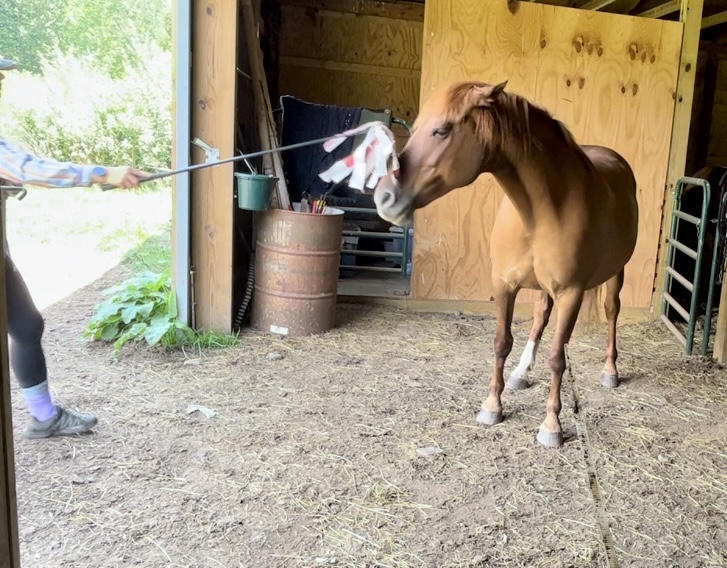
The love was saying: I know you’re afraid and you don’t trust me not to punish you. I know you haven’t felt very good about us working together, and you are like a porcupine walled up with layers of self-protection. It’s exhausting to manage your entire space like this all the time. Let me help you. Give me a chance to try things differently, to connect and care for your needs. And then see if we can work together as a team. Here, I’ll start.

I realized that I have wanted to express that to this horse for years. I wanted her to trust me and allow me to help her. However when I was working with her in the punishment paradigm of direct pressure my words and actions were, to her, incongruent. I wanted to say: I am here to help you and I care about you, but my actions were saying: if you don’t do what I’m asking I will hurt you. I need you to comply with my program regardless of how you feel about it because I am the human and you are the horse and this is how it works.
The flag-hug plan is showing positive changes in our time together. One immediate shift is I can walk around the barn and in her stall again without wondering if she will get flipped to angry-mode even if I’m not paying any attention to her. That was a disturbing phase we went through demanding me to be on high alert (more than normal awareness)— I’ve never been concerned about simply being in the barn with her ever before. I had not trusted being in her space enough since June to trim her feet and they had gotten way too long. Now I’m able to work on her feet and I do it a little each day. I do this without halter or lead rope right now as we are still trust building and she does not trust me yet to feel good about being haltered. For the time being I’m choosing patience on that as we sort out more pressing things.
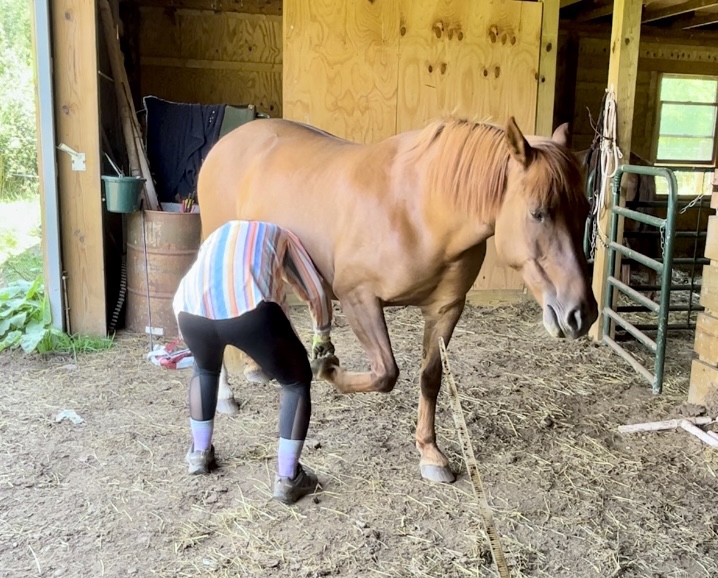
She loves being scratched with the flag so lately, our routine goes like so: I greet her, she comes into the barn “aisle” area on her own and I give her some good scratches with the flag. I do a little cleaning and trimming on each hoof and intermix flag scratching. After I get that work done I switch to using the flag to ask her to do something, take a step forward or backward, move away from me, look a different direction (this is beginning to influence her thoughts when they are softer which is a great step!). These things are very small and the scratching reward for giving me something simple is a part of the way we are building trust. All of this she can do and stay in a good feeling place. Almost no snark-threats come from these activities.

Next I push a little deeper by getting in front of her and ask if she can let go of her vigilance to give me a moment of her attention, center up, and straight on me. I get different degrees of “not really” at this point. I have a little distance, and can effectively block a straight on snark-attack with my flag hug right between the eyes. She doesn’t love that kind of hug yet, and it redirects her to choose a response less violent- sometimes she stays with it and tries again a little softer (she IS trying!), sometimes she chooses to go back into her stall and disconnect with me entirely. That is ok. She gets to make that choice, and it opens the door for me to close the door, allow her the “safety” of her bedroom, and then to stand outside the door and knock so to speak.
Right now this is our most intense level of interaction, but I think it’s also where the most important work is being done. In her stall, with a boundary in place for both of us, I will press in to a deeper ask where I know she’s going to be less comfortable. If we never press into here, she can’t have the experience to see it’s going to be different than she expects. With a horse, one cannot use words to explain, we have to change the experience. I can’t change the experience without creating the situation she is afraid of and showing her it will not destroy her.
I ask for her to let go of whatever else has her attention and give her full attention to me. She reverts to dragon attack, threatens me and doesn’t even stay long enough to bite at me over the gate. She dismisses me immediately and turns her hind end to me going back to the more important thing. At this point I make the biggest slam noise I can with the flag against something (plywood wall, or an unopened bag of shavings is pretty loud too!). She hates this noise but it is not a threat of pain. I am not coming at her, I’m not driving her hind end around, I am staying outside her stall. In essence I’m setting a bomb off right outside her door. I want to be worthy of her full attention. I hope to draw her over because nothing is more important than the sound of a bomb going off right outside your door. Appearing enraged, at first she comes back with her dragon act and each time she dismisses me to turn away I make the sound as full and loud as possible until she realizes this will happen until she makes a different decision. If she threatens, I give her a flag hug. Eventually all I have to do is make a clucking sound with my tongue and she squares up looking directly at me over the gate and each day sooner and sooner she relaxes and looks at me curiously.
Well ok then? What is so important then you need my full attention?
I just want a connection with you. Thank you for that.
Then I pet her on her forehead with my hand as she relaxes there, and I open her gate so she can choose to stay or go- this is the last part of our time together so I want it to end with her feeling soft and relaxed, but also as I am leaving, she can put her attention wherever she likes.
Most often, if I have the horses locked in their stalls, and then I come (not to interact) only to release them, Wyoming is respectful enough to walk past me, clearing my space before she bursts into the field at a full on canter to be freed at last. When I release her after we have connected she stays in place for a time. Sometimes, after I walk off to leave, she will leave her stall at a walk, sometimes she circle back into her stall and munch hay, but she never blasts off, because her mind and her body at that moment are united where we had connected.
This is a place of peace, a place she feels good.
And that is what we both want for her.

 Hope Horsemanship