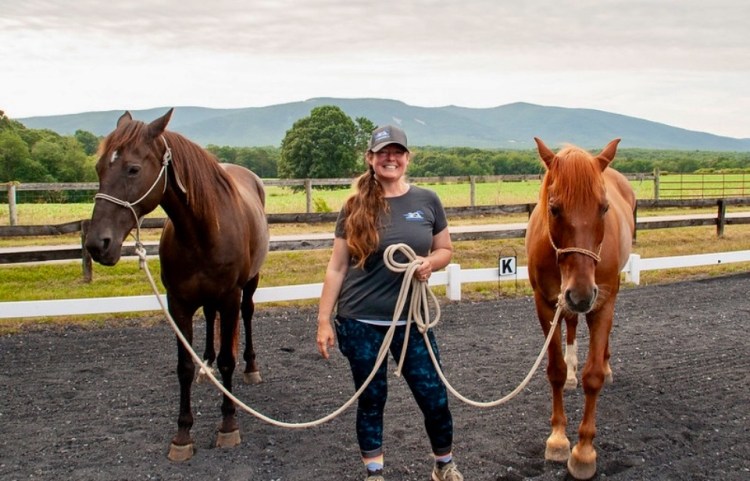
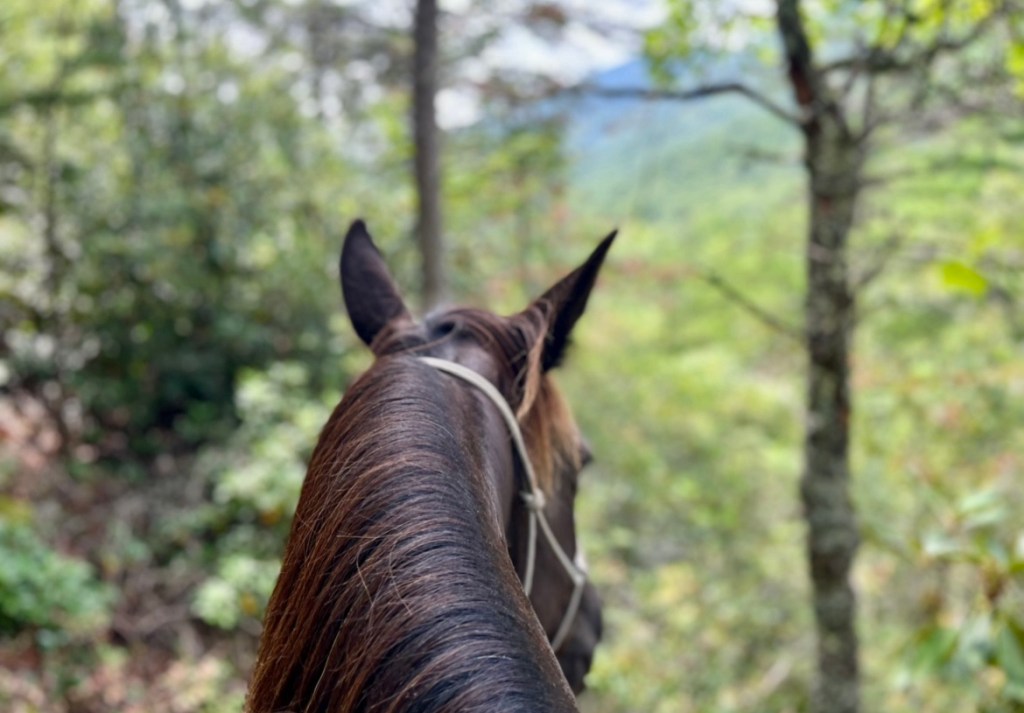
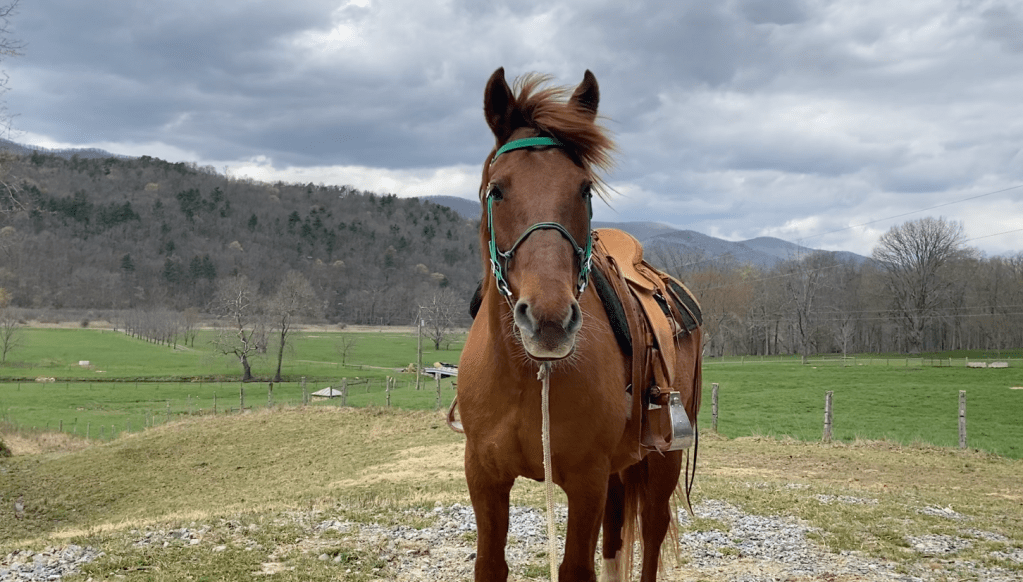
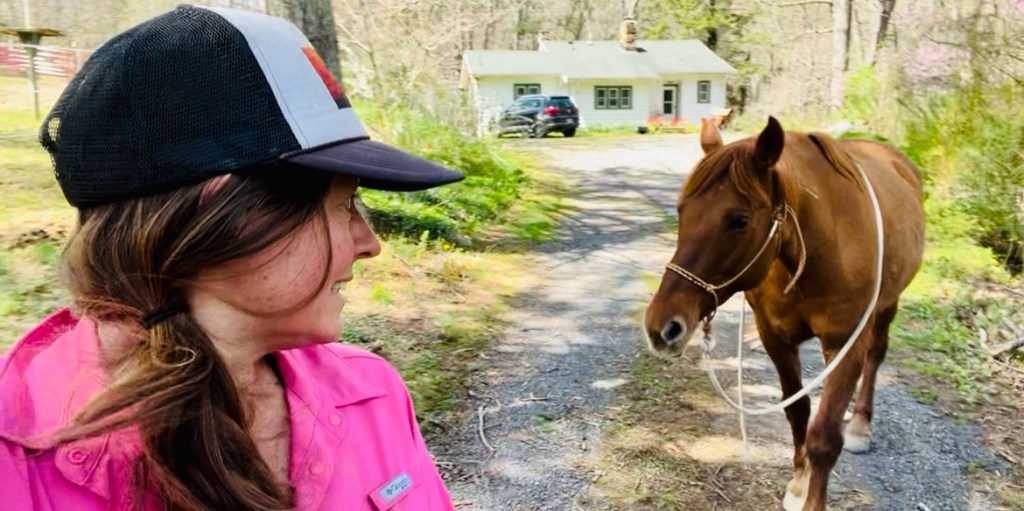
My eyes began to water in the heat of the afternoon as I stood in the large dirt arena watching the scene unravel. I was glad it wasn’t likely anyone would notice. My back was to the onlookers, and Mark was working with the wild mare, too involved in what he was doing to notice. I’m not so concerned about tears in public anymore, though it’s not my favorite, but I was pretty sure anyone who did notice would misunderstand the reason for the emotions gripping me in the scene.
They didn’t come from watching my mare rear violently in reaction to even feather light pressure on the halter. Particularly when she became so reactive she fell on her side in the dirt which was quite dramatic. (She wasn’t hurt).
The emotion didn’t come from worry that Mark was being unreasonable in his approach, creating unnecesary fear and stress, and watching him work with her might upset me. I knew he did not create any of what I was observing, it had been inside her as long as I’ve known her.
What grieved me as I watched Wyoming flailing on that lead rope like a fish on a line was a snapshot I had somewhere in my heart of how many of us go through life or seasons of life like this. We are fighting and we can’t seem to stop fighting. We end up getting hurt, and hurting those around us while we flail and fight against what we perceive as life threatening pressure but what is intended to be a comfort. I saw myself at times. I saw people I love at times. I saw humanity. I saw my beautiful mare react in dramatic fashion as if her life was in danger, unable to let go of her past experience, trauma, and fear to trust the guidance. It touched me in an unexpected way in that moment.
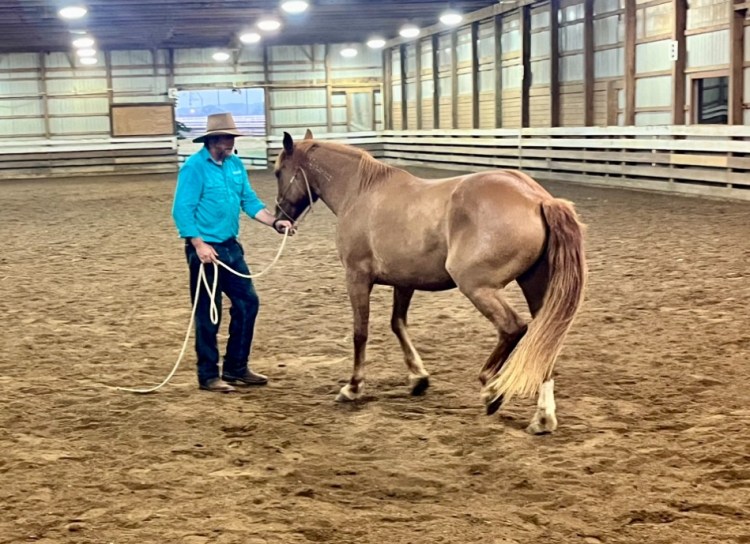
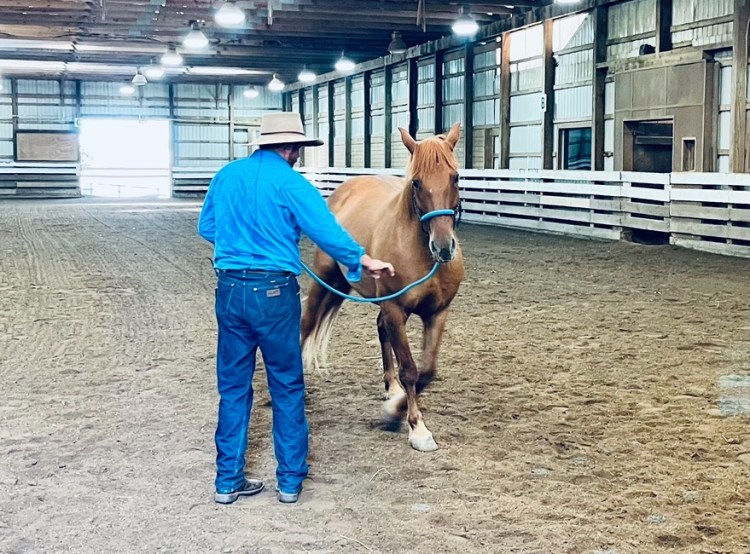
Mark Langley working with Wyoming
Mark Langley, who was instructing the four-day clinic on the last stop of his USA tour, cares deeply for the horses and this thing in her that overreacts to any pressure is a torment she does not need to carry. He was hoping he could help her get through it to the other side of this trouble. There is a physical or mental memory (maybe a combination) in her that was seared into her on day one of her mustang make over competition training.
I was told the history when I picked up the wild mare in Tennessee: the trainer put the halter on Wyoming, the mare reacted in fear and came aggressively toward the trainer, the trainer (in her own words) overreacted, putting excess pressure on the halter, and sent the mare up in the air. Her first experience of education with a human ended in a rear up, back flip, and injury to her neck that took her out of the contest and put her on a trailer to Tennessee to have a slower longer training process through the Bureau of Land Management’s (BLM) Trainer Incentive Program (TIP).
It’s likely with the trainer’s natural horsemanship approach: round pen, energy work and driving to create draw, the mare could be successful and avoid having the feel of restriction of the halter on her head. She became an amazing energy and body language reader. She became a punishment avoiding release hunter. When we picked her up as total strangers, just walking into the small arena, she would hook on to us or whomever it was, and follow closely. It didn’t occur to me that so much draw had been created in this mare that she felt the only good place to be was next to a human in order to avoid being sent out and driven.
Since I’ve had the mare, asking her to back up and out of your space brings pinned ears and stress. It’s a huge feat years later to ask her to comfortably stay just out of your bubble. If I do get her to step back three feet and stand she gets anxious and begins to try to offer a circle or creep back in. She has the expectation that the human is going to ask something of her and she throws out possible options anticipating what might come next. She has learned if she doesn’t comply quickly enough with a request, the enforcing punishment will come via escalating pressure: a lead rope to her hind end, a flag will touch her, the bump on the halter. She lives in the future of what might be coming, and how to avoid it. If she can’t avoid it she feels trapped, gets angry and fights back.
the potential for pull back is serious in a trailer
I stopped natural horsemanship style driving about 18 months ago when I watched Harry Whitney work horses in February of 2023. I think it’s begun to help change some of Wyoming’s experience and reactions, but the deep early formative work with her is still churning away at her core, and when it gets poked it comes out in big reactive displays.
The physical feel is only one thread of the knot which is inside this horse. Many horses comply to driving pressure (I have one who did), but Wyoming was one of the horses for whom the combination created a bit of a Jekyll and Hyde monster. She is either snappy quick, spot on with her reaction to a request or super angry and violent. Additionally in layer of wound up layers, she is a mare who has a hard time letting go of anxious thoughts.
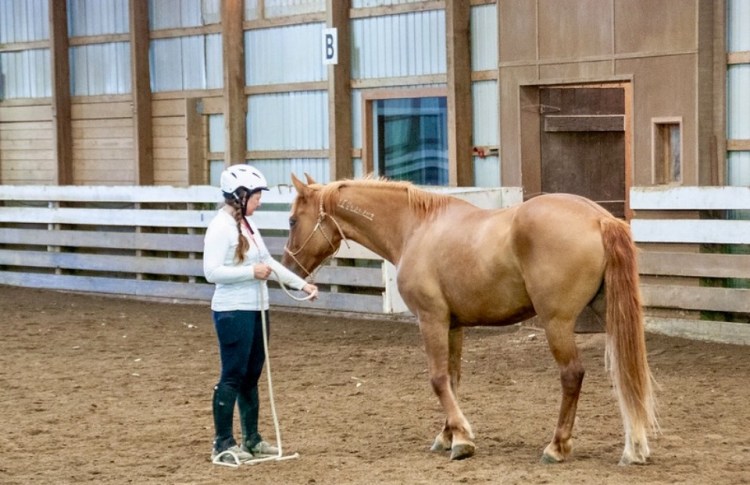
Jaime working with Wyoming during the clinic
Not only is strong drive and draw set into her, but when she is very close to me she can keep track of me physically while keeping her mind out on the larger environment. Asking her to back off three feet also means the human become part of the larger environment and she has to give mental space to keeping track me as well as everything in the next three miles in every direction. She has yet to become truly mentally centered in the way she can let go of the “other things” she holds onto for her survival.
It’s stunning how she can be in this mental, physical, emotional place and still function to the level she does. If we could ever get to the other side of trouble there’s a phenomenal mare in there.
How do we get to the other side of trouble?
If I could answer this definitively I could have helped a lot more people and horses than I have to date. Yet somehow I’m still at this mystery even when I get discouraged. I wonder if I’ll ever know something definitely enough to be of value to a horse- or maybe even some of my fellow humans who are willing to take the mysterious journey into this wilderness of trying to understand how to help a horse feel better and be a more powerful willing partner.
I do believe it is possible and so I don’t give up even when there are setbacks and it gets hard. I do believe with a horse like Wyoming it is a matter of going through to the other side of the trouble and not letting the trouble make her world smaller and smaller until she is afraid of any pressure at all.
It’s likely that Wyoming’s early training taught her that pressure meant she needed to adjust in order to get the pressure to go away. Unfortunately, anytime someone takes a rein in hand it creates a pressure or imbalance that the horse has to respond to – if done well it should bring the horse comfort through guidance, but if they have been trained to avoid pressure and seek release we have lost the ability to guide them through the reins or the lead rope. Very few people work their horses in the real world without reins or a lead rope. Nor do I recommend it as the ideal. Yet this means anytime someone picks up a rein to communicate with their horse, instead of relaxing into a guiding hand, many horses respond with anxiety to seek immediate release of pressure/imbalance which creates brace and tension through the body which works against strength, balance and grace in forward movement.
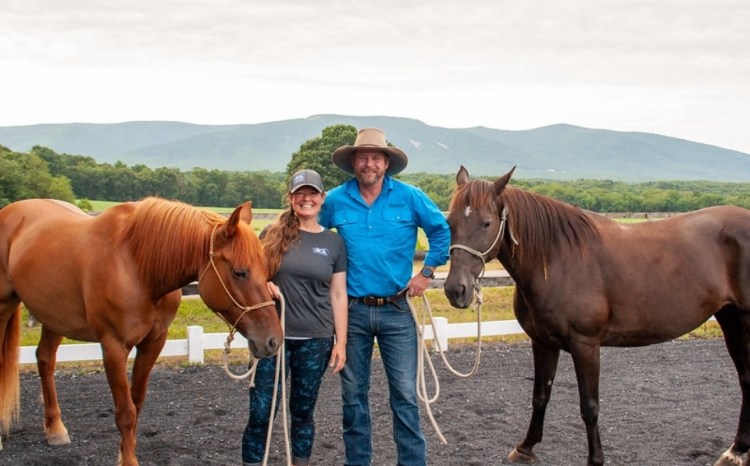
Jaime & Mark with Wyoming & Khaleesi
I have a hope that Wyoming can get through this extreme fear of pressure that was created early in her training (and solidified for a time by me) so she can trust me to guide her. I want her to feel the rein or lead rope guide her into where she will find peace and safety in my leadership. I want her to correct the imbalance she notices and in doing so find she has choices, and the freedom to choose a path of lease resistance that is fairly available to her because I am able to offer that. But I also want her to be able to stay connected at the end of the rope in appropriate balance of pressure like I would hold my dad’s hand to cross the street as a child.
She has to stop fighting first. If she would stop fighting she could follow that feel and see it would not bring her danger or pain, but comfort and safety. I asked myself if this deep sadness that came over me momentarily was indicative that this scene was playing out in my own life, or was a memory now. I’d like to say I’ve learned not to fight against the hand that guides me with strength, kindness and love. I know that my own journey through the wilderness is far from over, and sometimes I don’t even realize that I’m fighting the guidance that feels like pressure and imbalance and sometimes downright life threatening to me.
I’m sure Wyoming doesn’t understand what I’m trying to do in the bigger picture just as I really don’t always understand the big picture of what is going on in my own life while I’m in the middle of it all.
We were not able to get Wyoming to the other side of trouble in the four days of the clinic, but I learned some things that I hope will help me continue to guide her through. As with most worthwhile journeys, I feel like we’re deep into the wilderness, but in recent years I’ve learned something about the wilderness. I’ve learned it’s the place we least want to go, yet it’s the place where the transformation takes place. If we are going to get to the other side of trouble, chances are we have to be willing to be led into the wilderness.
Endurance News Summer Extra just printed this article I wrote, since it’s been officially published I can now share it here for my own readers.
Anyone who’s attended an endurance event has heard the conversation with the rider who has the horse that pulls their shoulders out of joint, determined to run at the fastest speed possible, oblivious to any influence from the human and on the edge of control for the first loop or two. This scenario is common enough to have a name in the endurance world: Race Brain.
I haven’t ridden that horse, but I have ridden the one who wouldn’t leave camp after the first loop without a crop. I’ve known horses who can’t continue in an event if their buddy is pulled. These issues may appear unrelated to many, but I believe they share a common root cause.
Perched on the periphery of a round pen last year, I watched Harry Whitney work a troubled horse. “When the body is in one place, and the mind is in another, there’s trouble in the household,” Harry said, wanting us to understand this anxious horse who was pacing and calling to friends in a faraway stall, had quite literally lost his mind. The owner had brought the horse’s body to the pen, but the mind remained with his friends. The body and the mind needed to be reunited, but there was disagreement on how. The horse was expending great effort to take its body back to its mind, but Harry was determined to bring the mind to be present with the body.
Harry Whitney in Vista, CA
I watched Harry do very little, but at the right time, in the right way, and saw the horse’s mind come present, and peace settled on the scene. I knew this was different but not sure how. Seeking clarity, I asked him a question, and I’ve returned to his answer time and again:
What it comes down to is your intention, are you trying to move the mind or the meat?
What Harry was explaining, is often people determine to mechanically manipulate the horse’s body. But Harry advocates engaging the horse’s mind, so the horse can move himself in a relaxed and willing way. These approaches produce vastly different results, and establish very different relationships between horses and humans.
Any time a human has trouble with a horse, Harry insists, it’s because a human had one plan and the horse had another which he could not let go of. It’s in the solving of this problem we have a myriad of techniques, opinions, and more disagreement!
We know it’s not good for the horse to run inverted and braced against the rider. This is one reason many riders choose to tie down the horse’s head in a martingale. Also, I haven’t met a rider who enjoys riding a horse with a lost mind. These horses run through even severe bits, so that is ineffective for extreme cases. Many horses, (and riders) on race day are high on adrenaline, and that brings excessive strength for the short term, but at a cost. The sympathetic nervous system is intended for quick reaction to life-threatening circumstance, not for hours in a day.
Mark Langley shared a story on his podcast of an endurance horse in Australia that finished in the top 5 in most races. Eventually, this talented horse was breaking down and experiencing muscle wasting. The horse had been competing on adrenaline, which was a factor in his success, and the stress was breaking his body down from the inside out.
The first step in solving any problem is identification. The fact we have the term race brain tells me somewhere we know this is a problem of the mind— we don’t call it race body. I’m not sure why it wasn’t obvious to me in years past, that we can’t effectively solve a problem of the mind with a mechanical approach. Approaching my horse with a view of where her mind is has meant changes to my riding. I no longer carry a crop and I’ve learned ways to bring her mind along with us when we leave camp. In some cases we can force the body to our will, but it puts us at a long term disadvantage. When we add a more severe bit, a tie down, or a crop we might get the job done, but the horse doesn’t move in relaxation, balance, and strength. They aren’t feeling good about the work or the relationship. The horse is running under stress and the effects will show up in the body.
This kind of mental approach isn’t a quick answer training plan; it’s a fundamental shift in my thinking. It’s a practice; a way of life. It’s also endless in possibilities— I get better every time I go learn from good horsemen who are further down the trail in this practice. I am increasingly aware of when her mind is with me and when it’s not, and it’s easier to make changes before the separation is too great. I’ve had to get creative and ask myself: how I can get it done through the mind and not the meat? and I still find myself trying to get things done by force more often than I’d like to admit.
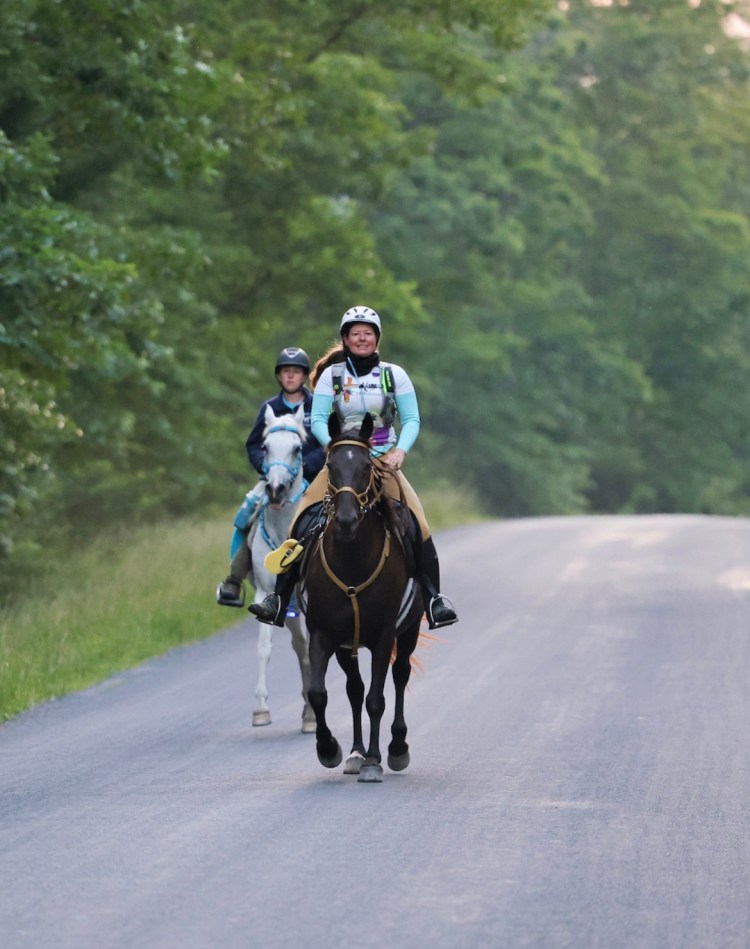
Photo by Becky Pearman: Start of the OD 100 2023
When my horse’s mind comes through and she is present in our work, I see and feel it in her body. Not only is everything more enjoyable, but I’ve seen these changes bring better performance in events over the last year. This is also a key to longevity. A horse moving in relaxation and balance will stay strong and sound over more miles than one mechanically driven. So next time you are problem solving a challenging horse behavior maybe you’ll also start with the question: mind or meat?
Though the ideas here are simple, they can take a lifetime of practice to truly master. What has helped me progress along this journey is finding good horse-folk to observe, learn from, talk with and work under. I’ve been fortunate enough to learn from Harry Whitney as an auditor and in clinic with my horse, invite Tom Moates to work with me in my own neighborhood in our special event roving clinics a few times a year, I’ve spent some time with Ronnie Moyer, and I have a unique opportunity to host Mark Langley on his USA tour in less than two weeks (July 4-7, 2024) here in Virginia! I have heard some other horsefolk thinking in this vein though I know less about them personally: Charlie Snell, Ross Jacobs, and Libby Lyman.
While you have to find Harry in person, he does extensively tour the US and you should be able to get to him in some corner of the US. I flew to California for my first visit with him for a 5-day clinic (auditing) and have never regretted the investment. I could have found him closer to home but I didn’t want to wait the six months until he was teaching in Virginia, but I brought a horse to that clinic and learned a ton.
On the other hand, Tom Moates has a myriad of great books walking readers through his horsemanship journey that are incredibly helpful. He’s also a regular clinician for Hope Horsemanship here in Virginia, so contact Jaime if you’d like to get in to work with him!
Jaime & Wyoming with Tom Moates in Virginia
Mark Langley has a great podcast you find on Apple Podcasts and other podcast players. He also has a solid video library with a very inexpensive monthly membership ($15/month) and answers member questions — and does a pretty good job helping walk people through challenges online, which is tricky!
There’s no other way to fasttrack this kind of shift in human thinking that helps support our horses, than finding someone farther along the trail to learn from. Find the step that most suits your style and give it a go!
And stop in to say hello during Freedom Week at the Powerful Horse Expo and definitely if you’re in driving distance from Greenville, VA come audit the Mark Langley clinic July 4-7, 2024. Mark will give a demo on Friday evening, July 5 and tickets are available here: Mark Langley Demo. I’m still open for a rider spot for the clinic as well, though that could change quickly… but certainly contact me if you’re interested to see if it’s still available!
I am excited to announce to you first officially the first annual POWERFUL HORSE EXPO during what we’re calling Freedom Week. I have been working toward this event for a couple years now am incredibly excited to see it coming to life July 4-7, 2024.
Freedom week is all about helping our horses become powerful equine partners through freedom… We are coming together here to discuss ways our horses can be FREE!
Freedom from pain
Freedom from disease
Freedom from fear
Freedom from force
Freedom from stress
Freedom from confusion
Readers of the blog know HH follows horsemen who consider the mind of the horse first and how it affects the body and emotions. Some known horsemen who do this well and are teaching it include Harry Whitney, Mark Langley, Tom Moates (who also writes about it), Charlie Snell and Ross Jacobs. I highly recommend getting out to visit with some of these guys and see what they are doing to help horses and humans get along better and feel better about the process and become free from fear, force, stress and confusion.
You have a great opportunity to do just that here in Virginia. Mark Langley is on a rare USA tour and will make a stop in Greenville, VA for a 4-day clinic hosted by us here at Hope Horsemanship July 4-7, 2024. We will be at Penmerryl Farm working in the large indoor arena and we have a couple participant spots still available. I haven’t begun to advertise the clinic yet so I anticipate now they will go quickly. If you’re interested send me an inquiry at jaime@hopehorsemanship.com and I’ll get you all the details and registration forms. We are also taking auditor reservations. Auditors will have the ability to interact with Mark and ask questions and those spaces will also be limited each day so it’s a good idea to reserve if you know you plan to come join us!
Mark Langley is also presenting a public demo on Friday, July 5 from 6:30-8:30 at Penmerryl Farm. This is a great way to join us for the weekend events. Mark will work with horses in a live demonstration of his approach to horsemanship and take questions as he goes. Reservations Recommended Link Here.
Mark’s clinic is the anchor for freedom week but on Saturday, July 6 from 10am-5pm we will be holding the Powerful Horse Expo where exhibitors and vendors will be showcasing, offering demos and educational talks with Q&A sessions on topics such as functional saddle fit, forage-based anti-inflammatory equine diets, feeding options for the metabolic horse, rider posture and Alexandar technique sessions, proper balance in functional hoof care, and more! There will be chances to win great prizes from our sponsors including a pair of Scoot Boots!
Advance ticket reservations for admission for the Saturday Powerful Horse Expo are now on sale (click here for tickets) and they will be increasing in price as the event approaches with an at the door price available as well. Reservations are made by name. (We can take a few more vendors at the time of this email as well, contact Jaime@Hopehorsemanship.com for details)
I am so pleased to offer this fun week to celebrate freedom and excellence with our Powerful Horse Partners. Mark your calendars, share the info (download the flyer below), and come join the Powerful Horse Community for a fabulous celebration!
Last year I spent some time with Harry Whitney, read some books by Tom Moates– and invited him to come visit with us here in the mountains, and listened to a fair amount of Mark Langley‘s podcast. I was steeping myself in this way of considering the horse that was a fundamental shift in my approach as much as possible.
I had some nice changes with Khaleesi over the year that I’m loving watching take root into an early harvest this Spring. As we prepare for some events this year, I can feel her new levels of relaxation and adjustability in movement! However Wyoming and I had a rougher go of the changes and trying to sort out how to understand each other in a better way. Last summer there were a fair amount of death threats (probably from each of us) as the lines of muddled communication began to untangle, and sometimes things get looking worse before they begin to smooth out.
Regardless, I knew there was something important in the process so I kept at it.
Then the horses moved home in November which has been a big change for all of us that is settling in nicely now six months into it… and I’ve begun to spend some time working with them again.
The initial work with Wyoming this year has been promising, and in the subsequent sessions, I’ve seen continued progress toward more partnership. Certainly the difference rests mostly in me. Change is possible, but it has to begin with “me” because usually the horse is a perfectly good horse doing what horses are created to do, and usually what the exhibit is in response to the way their environment (mostly human caused) has shaped in them. So regardless of who that human (or humans) were and what it was that did the shaping- that’s not nearly as important as where to go next. The change has been happening in me as I continue to seek and grow and take an honest assessment of my flaws and weaknesses in order to commit to address them.
I’m encouraged by the start of this year, and it gives me hope that there really is change possible for the two of us. I have a sliver of excitement that maybe this could be “the year” for Wyoming and me to begin to function together in a positive way!
Change is possible, but it has to begin with “me”
People have mentioned lately that staying with this dysfunctional situation for over six years must mean I have a whole lot of patience and determination. I suppose in some respects that is a little true. However… I remind them that she had more patience and determination to help me, because she is the one who refused to get on a trailer for that long- and I live in the end of nowhere… which meant I couldn’t move her on if I wanted to and pass her education on to someone else! Unless I was willing to shoot a perfectly healthy horse (which I did consider once or twice, but never seriously!) I wasn’t left with many options but to keep slogging onward. Considering in all those years of lots of sound and fury and threatening, she only once gave me a bruise from trying to bite the halter and grazing my arm, I think she’s been the one to praise. Apparently she never gave up on me.
I won’t get ahead of myself yet. We have a long journey ahead of us, but I think we’ve begun to sort out a better path, and maybe you’ll begin to see some exciting changes in our story this season… stay tuned and see!
Meanwhile, here are two videos that will show more than my words are able how the progress is coming for now.
When it comes to any relationship, boundaries matter. I think Danny Silk has some great books out about powerful individuals, the importance of connection, how to love well (even your enemies) and the trap of confusing boundaries and punishment. He has a great book titled “Unpunishable” that addresses what he calls our culture’s addiction to the punishment paradigm and how to let go of this in our human relationships. I’ve read the book. I’ve put effort into understanding and walking this out in my own life.
Then there are relationships with horses. I remember hearing Mark Langley say that boundaries are fixed and they don’t chase you. If you think you have a boundary with your horse but your boundary is in fact chasing your horse then it is not a boundary.
To make a finer point, I’ve heard Harry Whitney give an illustration about electric fences. I’m pretty sure Tom Moats has written about this too, but since I’ve recently read a handful of his books I can’t remember which one it’s in and who might have borrowed it… Harry explains that horses graze peacefully near an electric fence, very close to it, even sometimes reaching under it as far as they can without touching the strand. Most horses familiar with an electric fence are not afraid of it although no horses like the shock of coming into contact with it. Their experience is that the fence will not surprise them, ambush them, or chase them. Certainly the fence can be moved into new positions, but once the fence is fixed, the boundary is firm, clear, and potentially most importantly: not personal. There is no question if a horse gets shocked by the fence it was unemotional and non-judgemental. The fence isn’t angry, frustrated, fearful or otherwise emotionally embroiled in the process. No horse need be shamed or considered a “bad horse” for touching the fence and getting shocked; not very smart, maybe, but evil or bad are not part of the equation. Horses figure out quickly that the shock is a direct consequence of running into the fence and once they do it a couple times, it’s usually enough for them to avoid the strand in the future.
Harry helping a horse with fear around its ears in a clinic in Vista, CA 2023
This all makes perfect sense to me.
I thought I understood what a boundary is…
Then I began to press into dangerous territory by interrupting Wyoming’s very strong thoughts — which opened the can of snarky-threats where she began to threaten me with dragon ears and teeth bared. What do I do about the violent threats?
I had to think this through and I regularly found myself changing my position on what to do about it. Clearly this is NOT OK. I don’t care how you feel Wyoming, you cannot threaten to harm a human and continue to live here. In Mark Langley language “That is not available.” And in Harry-land “Let go of THAT thought mare.”
I thought: there is a boundary needed where that behavior is not tolerated and has an electric fence style wire that is tripped when you go there. On the other hand, it’s not as simple as setting up a “snark fence” that sends an electric shock clearly, effectively, and unemotionally at exactly the right time when the snark threat shows up. I have to set and enforce the boundary, and with my human limitations this could easily end up being unclear, questionable on its appropriate firmness, and most importantly could be rife with emotion no matter how hard I try not to be. There is a thin line between a boundary and a punishment, and this particular horse is quite sensitive to knowing which it is, and punishment always makes things worse between us.
In June when I started over once again, I’d see her go volcanically violent when I asked for her attention on me while she was in her stall, and I’d stand still outside her reach as she would snake her ears and snap her teeth a few inches from my face. I’d say: thanks for giving me your attention, this is a start… And she would cuss me out in equine, threatening to chew me up and trample my carcass when she had the chance. But, I reasoned, I had all of her attention in that moment. Of course the hope was to get her to feel better about it, and I don’t think that interaction felt very good for either of us.
The problem seemed to get worse. There were times I would be doing something completely unrelated to her in the next stall and I had to pay close attention to the eyes in the back of my head because she’d stick her nose over the gate threaten me even when I wasn’t asking her for anything. Even my presence began to get under her fur. It seemed to be increasing, so maybe allowing her to have these fits was not the best way forward. If I want to help my horse let go of hard thoughts, I reasoned, I need to find a way to basically say: LET GO OF THAT! When she turns to violence. The violence needs to not work out for her. Right now, I’m not so sure if it is or it isn’t working for her in her mind. So I tried answering the violence with what I hoped was a boundary. If I had my rope, I’d be ready when she circled back to rush the gate with her teeth bared to meet her with the rope as adapt as I could get with my timing in the hope she would begin to think whenever she had snarky-violent outbursts, she ran into something when she came at me and it was not pleasant. Like an electric fence ideally, one that only came on when you have a bad attitude.
I would have to be very consistent, as unemotional as possible, and match her in firmness as closely as I could. I wanted her to learn there is a boundary here and violence will never be tolerated.
I had a couple lucky opportunities meeting her exactly when she came at me but it seemed to only make her more angry and more threatening, and if she backed off it was harder to see a change for her to soften and relax. I could get her to act less on her wish to chew me up and spit me out, but I don’t think it changed the fact that she wanted to. This approach didn’t seem to help her feel any better about being with me. In fact if anything I think she got better at planing quick sneak attacks in the hope she might get through the barrier. I liked the idea that I was trying to clarify that this aggressive behavior was NEVER acceptable, but it didn’t appear I was making real progress with this.
It did not seem to be working out for me.
The next shift back came one day when I was innocently cleaning the middle stall and Wyoming came over the gate with her head and began snapping her teeth at me. I wasn’t looking for her attention or demanding anything of her. This also means I was completely unprepared to meet her violence with what I hoped was a decent attempt at a boundary like a rope or a flag, or any useful tool.
So I just stood there.
I stood there and watched her, inches from my face. She pulled back, did her little ramp up circle, snaked her ears and stuck her nose at me, teeth clacking away. I stood unmoving and completely unemotional, and slightly at a loss. I wasn’t “working” with her, I was just at the barn at that time. I simply observed her and paused in curiosity to watch what she would do thinking that I had screwed up the consistency of meeting her behavior with a clear boundary every time. Now what?
As I watched she repeated the cycle which always included pulling back, doing a little circle, reflattening her ears, and throwing her head over the gate at me, teeth clacking. However, as I stood unmoving and completely curious (not upset, frustrated, angry or afraid) each time was less enthusiastic until finally she threw her head over the fence, froze with no bared teeth, softened her eyes and her ears perked forward. Now it was her turn to just stand there starting at me, curious.
An example of Wyoming feeling softer and relaxed.
It was this experience combined with the revelation about the cowardly lion who desperately wanted courage, that had me re-evaluate my attempt to “boundary” this behavior by meeting it with a tool of some sort.
First, I realized as I stood quietly out of her reach, there actually WAS a boundary. It was the gate that separated the stalls. That boundary was secure and clear. The truth of this scenario was that she cannot hurt me while the gate stays in place, and it’s screwed to posts with brackets, so it’s not going anywhere.
Second, my attempt to meet her violence with some kind of equal “boundary” with a rope or flag she would ideally “run into” wasn’t the wrong direction entirely, but in reflection I had to be honest with myself: I was meeting her fear with my own fear. I wanted to believe I was unemotional, but though I was decent at stuffing the emotion in the moment, it was there. I was afraid if I didn’t curb this behavior someone (probably me) was going to get HURT. I don’t think this concern was unreasonable or wrong, but regardless it was an underlying emotion. No matter how hard I tried, the boundary I wanted to put in place was smelling to her a whole lot more like a punishment.
Third, though I wanted her to “run into her own pressure” somehow when she came at me, having the rope or flag or stick meet her physically was still “at” her. I started experimenting with creating a big sound instead where she did not like the shock of the noise, but it didn’t hurt. These details are obvious to me now, and really important, but I suppose that’s what a life of learning is about- the mistakes and the fixing of them and the growth from them.
I know that we cannot meet fear with fear and ever find a better place. We can build a wall of self-protection and we can find ways to not get hurt when we meet fear with fear, but we cannot build connection that demands vulnerability and we cannot strengthen relationships. I pondered all that I’ve read and learned about these things and asked myself the million dollar question: so then, what must meet fear to dissolve it and heal the brokenness?
Only LOVE.
Don’t give up on me here as you assume I am about to suggest going into the shark tank with no protection and singing to the creature who has promised me physical harm a refrain of Kumbaya as my only hope. That is not what I mean by love. Love in fact, must have boundaries because connection is worth protecting. I believe Wyoming when she’s told me she is in enough fear to hurt me if I press her, and me being attacked is not good for either me or Wyoming. If I love her and I’m seeking better connection with her, I will not put us in that situation.
Danny Silk asks the question: how many pet rattlesnakes do you have? None.
Because wise people don’t bring dangerous things into our houses- the place we feel safe, can be vulnerable and expect not to be attacked if at all possible. This is a boundary. No rattlesnakes in the house. We can love rattlesnakes and not invite them inside to play. Rattlesnakes can be loved at a distance.
While Wyoming sees me as a rattlesnake and I see her a threatening dragon, we need to find a way to connect without expecting we will be in each other’s vulnerable place. My job is to find a way to connection with her, to answer her fear with love, and ideally have us not get hurt as we work through this process toward more trust. Both of us need more trust in the other. She has learned that I am wiling to drive and punish when I want something from her or when I am afraid, and I’ve learned she threatens violence when she is out of her comfort zone.
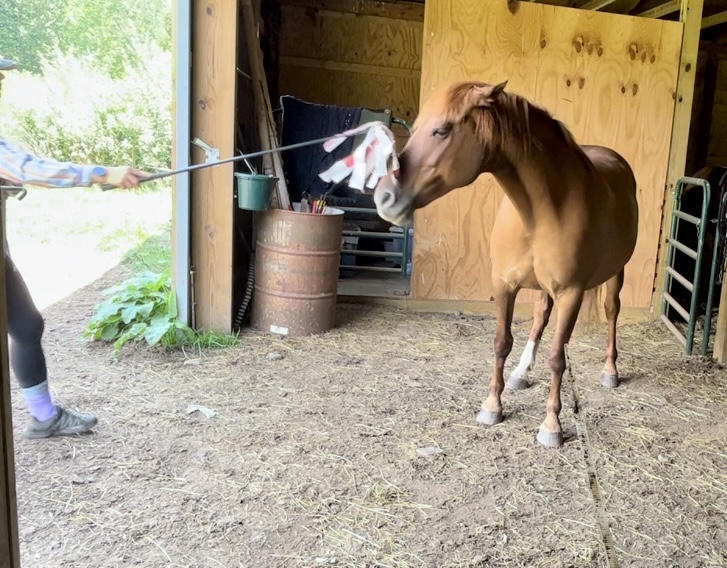
During this process something began to change that was helpful. Wyoming went from always trying to kill the flag to relaxing when it touched her. The flag became the first tool she not only started to accept without violence, but if I did touch her with it she immediately quieted and would relax as it rubbed her. If the flag was floating along nearby, that made her nervous, but once it made contact she calmed down and began making suggestions where it might scratch and rub her. This gave me the ability to “pet” her without getting in the strike zone. This enabled me to begin to build trust not to punish while staying across a good boundary which kept us both more safe.
Response to me asking her to give me her attention…
Thus another shift in approach began for me. I kept myself outside her reach and began asking for her attention. When she would circle, turn, pin her ears and come at the gate I would say under my breath to her (in order to remind myself what she needed from me) Courage! and I would give her a hug instead.
Me offering the ‘hug’ as a response while staying at a responsible distance for us both.
Once again, I’m not a total idiot. The hug looked like me lifting up the flag and getting right in there and petting her as close to her head as I could (usually on the neck at first since she wasn’t a fan of the flag strips in her eyes and ears, but that is also changing). I could be a foot out of reach, completely without fear, and only responding with love.
She considers my response…
The love was saying: I know you’re afraid and you don’t trust me not to punish you. I know you haven’t felt very good about us working together, and you are like a porcupine walled up with layers of self-protection. It’s exhausting to manage your entire space like this all the time. Let me help you. Give me a chance to try things differently, to connect and care for your needs. And then see if we can work together as a team. Here, I’ll start.
She softens as I refuse to meet her fear with my own fear and choose not to punish
I realized that I have wanted to express that to this horse for years. I wanted her to trust me and allow me to help her. However when I was working with her in the punishment paradigm of direct pressure my words and actions were, to her, incongruent. I wanted to say: I am here to help you and I care about you, but my actions were saying: if you don’t do what I’m asking I will hurt you. I need you to comply with my program regardless of how you feel about it because I am the human and you are the horse and this is how it works.
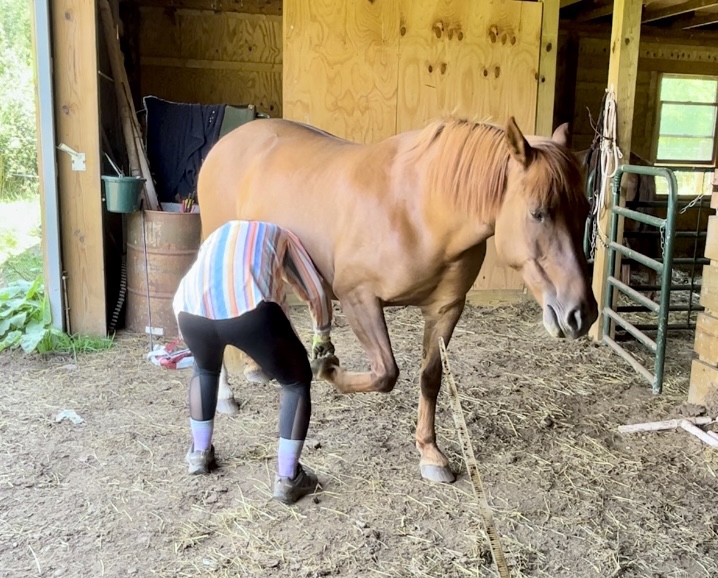
The flag-hug plan is showing positive changes in our time together. One immediate shift is I can walk around the barn and in her stall again without wondering if she will get flipped to angry-mode even if I’m not paying any attention to her. That was a disturbing phase we went through demanding me to be on high alert (more than normal awareness)— I’ve never been concerned about simply being in the barn with her ever before. I had not trusted being in her space enough since June to trim her feet and they had gotten way too long. Now I’m able to work on her feet and I do it a little each day. I do this without halter or lead rope right now as we are still trust building and she does not trust me yet to feel good about being haltered. For the time being I’m choosing patience on that as we sort out more pressing things.
She loves being scratched with the flag so lately, our routine goes like so: I greet her, she comes into the barn “aisle” area on her own and I give her some good scratches with the flag. I do a little cleaning and trimming on each hoof and intermix flag scratching. After I get that work done I switch to using the flag to ask her to do something, take a step forward or backward, move away from me, look a different direction (this is beginning to influence her thoughts when they are softer which is a great step!). These things are very small and the scratching reward for giving me something simple is a part of the way we are building trust. All of this she can do and stay in a good feeling place. Almost no snark-threats come from these activities.
Next I push a little deeper by getting in front of her and ask if she can let go of her vigilance to give me a moment of her attention, center up, and straight on me. I get different degrees of “not really” at this point. I have a little distance, and can effectively block a straight on snark-attack with my flag hug right between the eyes. She doesn’t love that kind of hug yet, and it redirects her to choose a response less violent- sometimes she stays with it and tries again a little softer (she IS trying!), sometimes she chooses to go back into her stall and disconnect with me entirely. That is ok. She gets to make that choice, and it opens the door for me to close the door, allow her the “safety” of her bedroom, and then to stand outside the door and knock so to speak.
Right now this is our most intense level of interaction, but I think it’s also where the most important work is being done. In her stall, with a boundary in place for both of us, I will press in to a deeper ask where I know she’s going to be less comfortable. If we never press into here, she can’t have the experience to see it’s going to be different than she expects. With a horse, one cannot use words to explain, we have to change the experience. I can’t change the experience without creating the situation she is afraid of and showing her it will not destroy her.
I ask for her to let go of whatever else has her attention and give her full attention to me. She reverts to dragon attack, threatens me and doesn’t even stay long enough to bite at me over the gate. She dismisses me immediately and turns her hind end to me going back to the more important thing. At this point I make the biggest slam noise I can with the flag against something (plywood wall, or an unopened bag of shavings is pretty loud too!). She hates this noise but it is not a threat of pain. I am not coming at her, I’m not driving her hind end around, I am staying outside her stall. In essence I’m setting a bomb off right outside her door. I want to be worthy of her full attention. I hope to draw her over because nothing is more important than the sound of a bomb going off right outside your door. Appearing enraged, at first she comes back with her dragon act and each time she dismisses me to turn away I make the sound as full and loud as possible until she realizes this will happen until she makes a different decision. If she threatens, I give her a flag hug. Eventually all I have to do is make a clucking sound with my tongue and she squares up looking directly at me over the gate and each day sooner and sooner she relaxes and looks at me curiously.
Well ok then? What is so important then you need my full attention?
I just want a connection with you. Thank you for that.
Then I pet her on her forehead with my hand as she relaxes there, and I open her gate so she can choose to stay or go- this is the last part of our time together so I want it to end with her feeling soft and relaxed, but also as I am leaving, she can put her attention wherever she likes.
Most often, if I have the horses locked in their stalls, and then I come (not to interact) only to release them, Wyoming is respectful enough to walk past me, clearing my space before she bursts into the field at a full on canter to be freed at last. When I release her after we have connected she stays in place for a time. Sometimes, after I walk off to leave, she will leave her stall at a walk, sometimes she circle back into her stall and munch hay, but she never blasts off, because her mind and her body at that moment are united where we had connected.