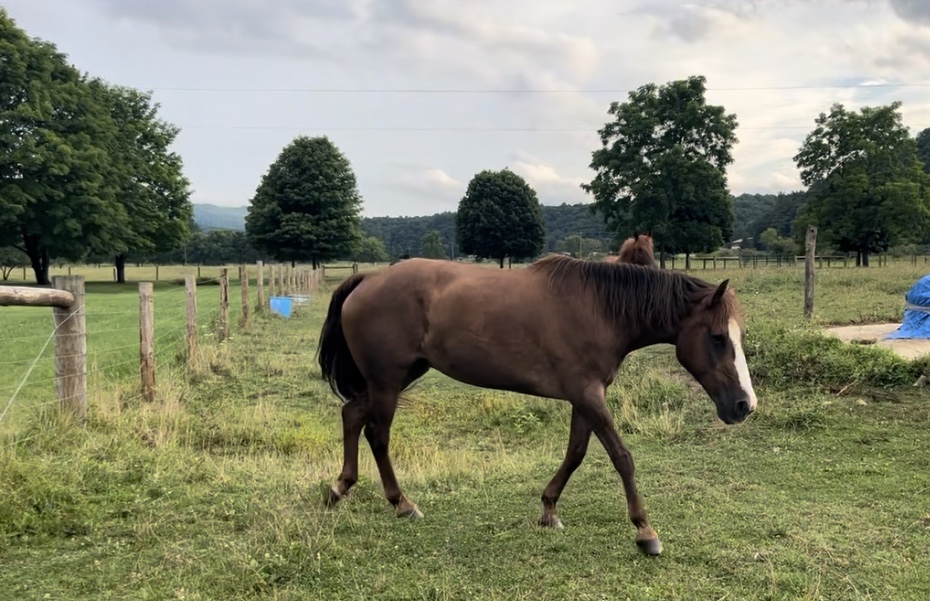
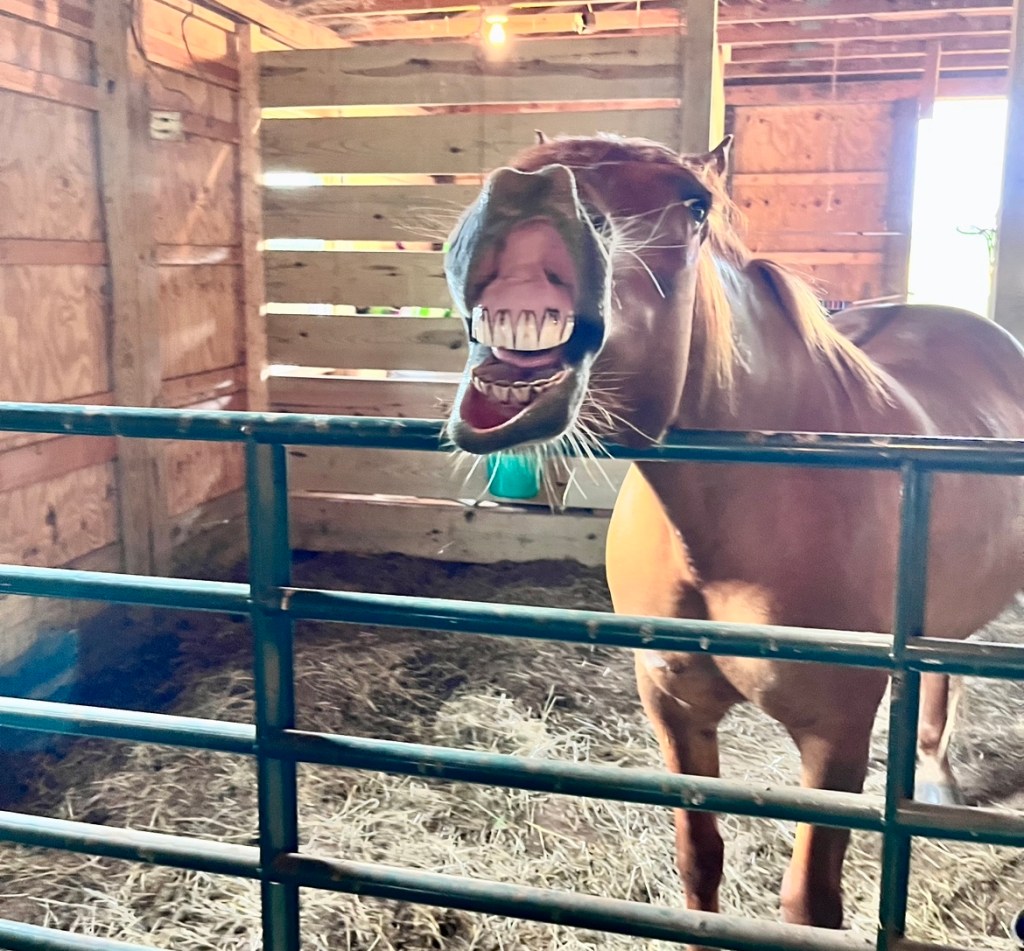
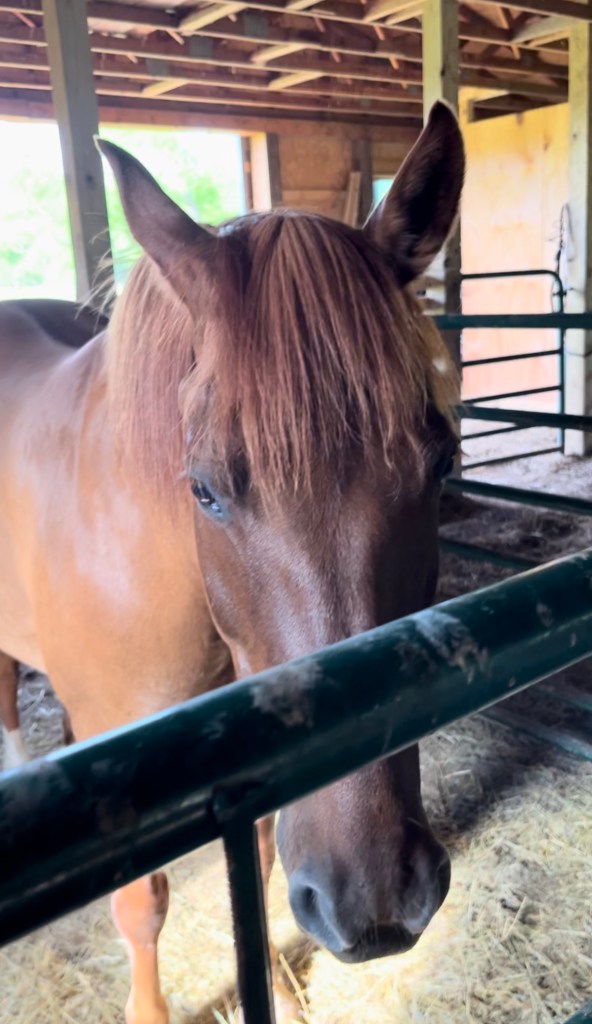
Last year I spent some time with Harry Whitney, read some books by Tom Moates– and invited him to come visit with us here in the mountains, and listened to a fair amount of Mark Langley‘s podcast. I was steeping myself in this way of considering the horse that was a fundamental shift in my approach as much as possible.
I had some nice changes with Khaleesi over the year that I’m loving watching take root into an early harvest this Spring. As we prepare for some events this year, I can feel her new levels of relaxation and adjustability in movement! However Wyoming and I had a rougher go of the changes and trying to sort out how to understand each other in a better way. Last summer there were a fair amount of death threats (probably from each of us) as the lines of muddled communication began to untangle, and sometimes things get looking worse before they begin to smooth out.
Regardless, I knew there was something important in the process so I kept at it.
Then the horses moved home in November which has been a big change for all of us that is settling in nicely now six months into it… and I’ve begun to spend some time working with them again.
The initial work with Wyoming this year has been promising, and in the subsequent sessions, I’ve seen continued progress toward more partnership. Certainly the difference rests mostly in me. Change is possible, but it has to begin with “me” because usually the horse is a perfectly good horse doing what horses are created to do, and usually what the exhibit is in response to the way their environment (mostly human caused) has shaped in them. So regardless of who that human (or humans) were and what it was that did the shaping- that’s not nearly as important as where to go next. The change has been happening in me as I continue to seek and grow and take an honest assessment of my flaws and weaknesses in order to commit to address them.
I’m encouraged by the start of this year, and it gives me hope that there really is change possible for the two of us. I have a sliver of excitement that maybe this could be “the year” for Wyoming and me to begin to function together in a positive way!
Change is possible, but it has to begin with “me”
People have mentioned lately that staying with this dysfunctional situation for over six years must mean I have a whole lot of patience and determination. I suppose in some respects that is a little true. However… I remind them that she had more patience and determination to help me, because she is the one who refused to get on a trailer for that long- and I live in the end of nowhere… which meant I couldn’t move her on if I wanted to and pass her education on to someone else! Unless I was willing to shoot a perfectly healthy horse (which I did consider once or twice, but never seriously!) I wasn’t left with many options but to keep slogging onward. Considering in all those years of lots of sound and fury and threatening, she only once gave me a bruise from trying to bite the halter and grazing my arm, I think she’s been the one to praise. Apparently she never gave up on me.
I won’t get ahead of myself yet. We have a long journey ahead of us, but I think we’ve begun to sort out a better path, and maybe you’ll begin to see some exciting changes in our story this season… stay tuned and see!
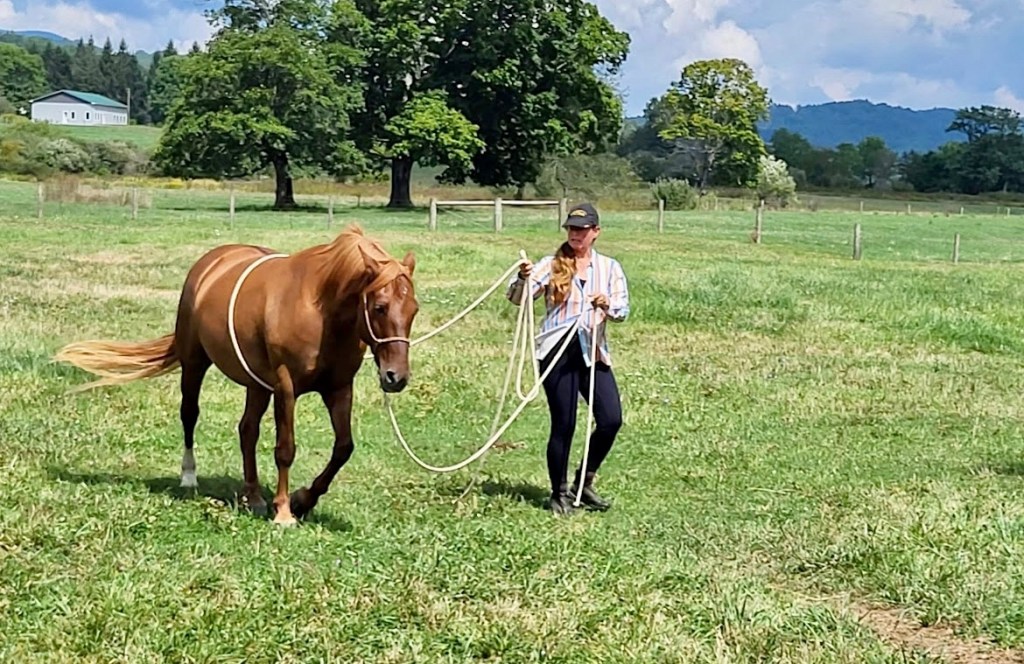
Meanwhile, here are two videos that will show more than my words are able how the progress is coming for now.
I scrolled through a video recently where Mark Langley was leading a distracted horse around an arena at a clinic, and whenever the horse attempted to blow past him instead of correcting the horse, he simply changed direction and the horse found himself right back slightly behind Mark (where he preferred the horse positioned). He did this with such grace and softness that it didn’t feel as though the horse was being tricked or punished. Mark played to the onlookers as if he had possibly forgotten something the other direction, or maybe dropped a coin and needed to step back to find it, or was otherwise distracted himself. This mental state was meaningful because the scene playing out didn’t carry any weight of correction. It was a human and a horse navigating around an arena where the horse kept finding himself in exactly the place the human wanted him to be — without judgement.
The horse began to take interest in what was happening with the human at the end of the lead rope, this began to become more engaging than the worry about his environment, and eventually the horse stayed in the zone Mark wanted him. It was as if he had figured out the puzzle instead of being trained or corrected into place. I heard Mark say (this is a paraphrase):
This horse came in here distracted and fearful of this new environment. In this case, with this particular horse who tends toward fear reactions, if I were to harshly correct or punish him for his distracted pushy behavior, I would be increasing his fear reaction by making him more afraid of me than the environment.
The kind of horsemanship I’m interested in is not formulaic, and when posing a question to anyone worth their salt content, the most likely answer will probably sound like a variation on: it depends. The sticky wicket is that a real solution means understanding the root cause and usually a good horseman needs to see what’s going on with their own eyes to notice things that many of us don’t see unless pointed out. They then interpret it with a best guess, and usually after that comes trying something to see if the guess on the right track, and then how the horse responds will determine the way forward for that particular creature in that scenario. Anyone who claims can fix problem X, Y or Z with a three-step, five-step, or any set rubric is selling snake oil, and oddly enough, even snake oil works for a percentage of things….
Mark does a pretty decent job of explaining what his approach is and allowing for the “it depends but you might consider trying….” Which considering we can’t all get to Australia (or Virginia!! We have spaces still available for his USA tour 4-day clinic in Greenville, VA, July 4-7, 2024) can give some ideas to people with fewer resources close to home. So, to clarify, the scenario I watched was not the one and only best answer to a horse who blows past a handler in leading. It was a unique scenario where this response from Mark taking into account the circumstance and the horse’s personality and what Mark had to offer helped to support a struggling horse and bring peace and a present mental state.
This is probably not what my go-to with Khaleesi would be if she was not leading well. However, as I watched, I connected some dots to Wyoming, who is also a fear-reaction-type horse that is on hypervigillance most of the time. I am certain my past training in correcting behaviors I did not want to continue, created in her more fear and anxiety than supporting her confidence and certainly did not bring her peace and a present state of mind. Considering this is what I think about moving forward with her I made a mental note and thought I might play around with that idea when we had some time.
Then Monday came, and I had some time.
My goal was somewhat nebulous: Work together in a way that gave her the least amount of ill feeling possible.
Wyoming packs around some baggage and isn’t entirely cooperative to my plans most days. I was toying with what it might look like to not “correct” her when we begin to diverge in plans.
Could I work with Wyoming in a way where she doesn’t feel wrong, but can I renegotiate to make things work out together better for us both? Can I adjust to keep us at least loosely on my plan for the day and… somehow set it up so that she simply lines up with what I’m doing almost naturally?
In the past, I’ve corrected Wyoming in ways that have been, in her opinion, overly harsh and unfair. Can I help Wyoming make choices that work out better for us without her having ill feelings about the work? How can I shape her behavior patterns without her feeling negatively about our relationship and disconnect us (and not descend into complete positive reinforcement either– we’ve gone there for a time and it’s is missing some components we need for a strong connection)? Can I find ways for us to cooperate and her to become increasingly willing to work together? Can I change her mind about what to expect from me? What would that look like?
I took the halter out to the yard and she eyed me suspiciously. I am sure they know what color halter has their name on it! Also, I probably don’t hide very well who I’m most focused on. That’s ok, I also have given up trying to manipulate my way too intelligent mares by tricking them. That erodes trust. None of my horses were born yesterday.
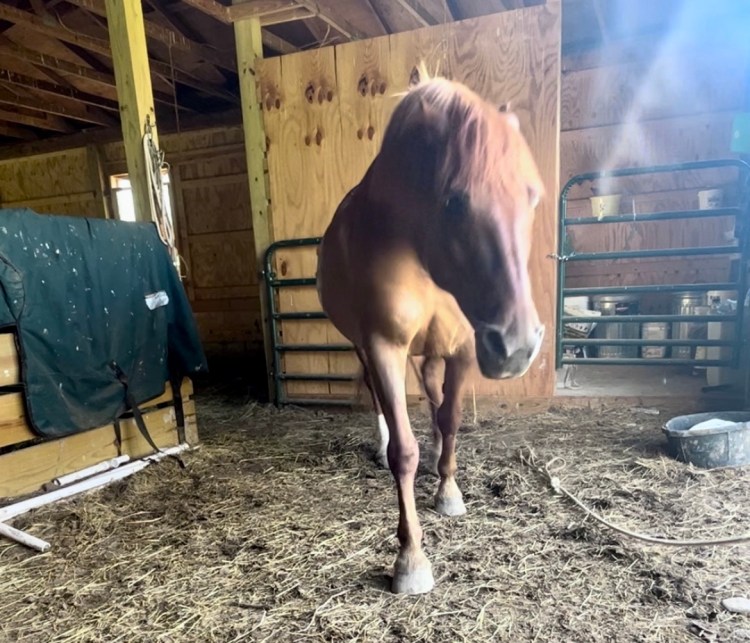
She knows what I’m doing there with the halter, and so I offered it to her. I’ve never had a mare who comes running to me and dips her nose in the noseband begging me for a work session or a ride… That being said, considering in seasons past she has occasionally all but threatened my life when I offer the halter, she showed pretty mild levels of disinterest instead of dragon ears and nipping at me, and though she had the entire yard to walk away, and she did not. She stayed with me as we negotiated the terms of our connection for the day. Eventually her nose went in the band with minimal fuss and I was able to tie a good knot as she tentatively decided to give me a chance today.
Upon walking out the first gate, through the “front yard” I played the make direction changes against my straight line nature and we made arcs and loops around the yard in the general direction of the second gate. I liked this exercise for the moment. Not only did it stop her from getting ahead of me and cutting me off (don’t take me away from my herd please) but I didn’t have to correct her with a flag swish or rope bump- I simply changed direction and she found herself always positioned just in the right place to follow my lead. She didn’t get frustrated or worried, instead, she seemed curious and she kept herself within a certain boundary to me (I never had to adjust my lead rope) and figured out the game which was emotionally neutral.
When we made it to, then through, the second gate, I rewarded her with some fresh spring grass and hand grazed her a minute or so.
So far so good!
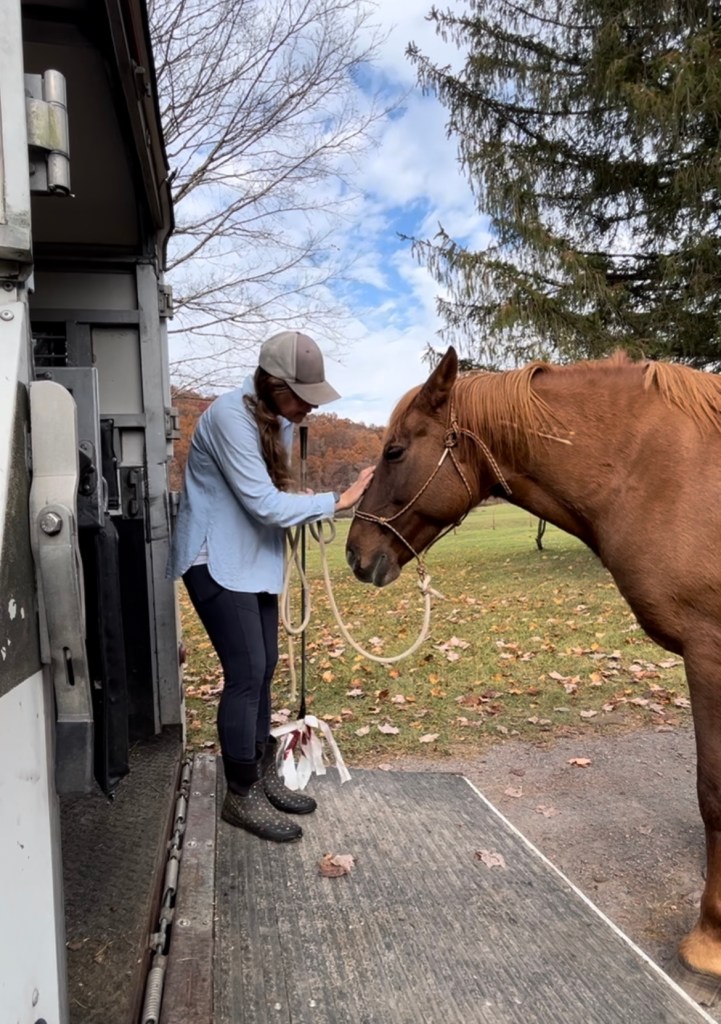
Next, I decided to open the trailer and see where we were since November. The divider is currently out which means its a more open feeling box. I walked on and didn’t do much more than that. Again, as Tom reminds me, she knows what’s going on here. We’ve been playing with trailer loading in this very trailer since she came her years ago. She considered, took a moment at the end of the ramp, and I paused to wait. She came right in, then backed out, came back in, backed out calmly, asked me a few questions, and without ever having to make it “uncomfortable” with the flag, she found the relaxed space in the box with me and never became worried or agitated. I walked her off to hand graze and then went back about four times and each time she was less concerned being in the adventure box.
Loading practice
That was a great first day back in the trailer!
Next I walked her up the driveway to the front of the house where the saddle was set out. I also have some grass in my front yard as a bonus! I groomed her minimally for mud and a layer of shedding fur, and tacked her one step at a time, taking a little circle walk or hand grazing in between and found she never had that ill feeling surface. Only in tightening the girth did she turn her head with a hard eye… I kindly asked her if she might just keep her head straight and “look over that way” if she’s going to give me the stink eye, while I do this, and she relented without much fuss. I also tightened in increments and gave her a little walk circle or a moment to graze in between that as well.
I had not believed I could get to riding before things would fall apart on this day one back in work, but here I found myself. How might I ride her around the yard without bringing up the ill feeling she had gotten in riding previously? I thought it over and decided I would set up a little game… In front of my house was the patch of grass she’d been enjoying off and on, what if I got on her a ways down the driveway and encouraged her to walk toward the house and grass patch? Motivation and purpose can be incredibly helpful.
And so I took the mounting block down the driveway and stood on it. I reminded myself as I’d done the whole session, just like the halter, the trailer, she knew what we were doing here. In the past, when I asked her to line up with me to mount, she nipped and showed concern, but today I waited a moment while she walked in an arc trying to negotiate her position. I simply stood still and let her sort herself out. She eventually put herself in the perfect position. I put a foot in the stirrup, said a little prayer for grace, let my breath out, and sat in the seat. She stood calmly while I rubbed her and waited a while….
I made the intention not to be in a hurry. I rubbed her and relaxed, thought about where I wanted us to go, then sat up, opened my arm out with the lead rope and tried gently to bring up some energy. Wyoming is incredibly sensitive and if I bring up my energy sharply she feels it like a rude slap in the system. So I dialed up the volume of “walk” in me until I felt her begin to shift. She only took a couple steps but it was a start and she did it without ear pinning or offense. I continued to ask her to take a few steps at a time toward the grassy patch and when we finally made it I dismounted and offered her a moment of grass. We repeated this cycle a few times.
The second time I saw a remnant of that past bad attitude and as I gently tried to direct her (probably at this point erring on the side of not enough clarity which is also super annoying to a horse like Wyoming) she reached toward the stirrup and made an attempt to bite my toe. Thankfully I have metal wrapped western monels for her to make contact with and I didn’t have to do a whole lot to redirect her (not even horses like making teeth contact with metal). A few more circles than last time and we made it back the grass. This time she did not try to eat. I think she was more engaged with our activity which is not a bad thing.
We did a third time toward the house and it was a mixed bag of wandering, but it was complete success if one is looking for absence of ill feelings from either of us, and I decided three times was enough for a Monday afternoon and I took off the tack.
On the way back to the herd I stopped at the trailer and we diverted back inside the box for a moment and it was relaxed and easy. Then we wandered slightly circuitous toward the inner gate to the herd. After entering I walked a few steps and removed the halter from a very quiet mare.
After setting her loose she stood there with me in no rush to disconnect. This is a good sign. We must have done something of value for her to decide to stay close once she’s turned loose.
Looking back, I was pleased with this session. One reason I’ve waited so long to take time to work her outside the yards was because I haven’t felt ready to take on the battle the work with her can become. This approach put a check in the positive column and considering we have some baggage and negative past experiences, that is not a bad thing.
And yet…. as I processed the session with Tom, he reminded me that this mare still gets offended at being asked to do anything not in her play book at the moment. When she’s asked to “let go” of her own thought and “come along with me” she chooses to fight about it and has learned to hang on to those thoughts with much more force than is reasonable for an equine companion.
This is true.
Sometimes one has to get big enough to break loose that hard thought and come out the other side feeling better about it, and yet I’ve gotten into those situations with her where I try to get bigger and actually, I can get pretty big, but even though I can prevail, I’m not certain she feels any better for having complied in the end. Our relationship has not improved for that experience. I don’t believe this is because the work Tom is referring to isn’t important and necessary, it’s more that I don’t always have the ability to bring it to positive on the backside. We just end up in a fight, that I kind of win (if you can call it that) and that’s not what he means when he talks about getting big enough to make a change for the better. And without more experience actually doing that work, I am not likely to magically get better at it either.
This is where I sit in the journey, where things are murky and less clear than I like. This is where a formula would be fantastic and I understand why people prefer that kind of horsemanship. The kind that gives an answer.
I was glad to have a day where the relationship was on a positive feel between us and I still got done what I had hoped for. It is never a bad thing to have a good feeling day with your horse. In fact, I think I might could use to rack up some good feeling times together where we both feel successful and neither of us had to deal with fear. In truth, I do have to sometimes deal with fear with the dragon mare (though I try not to allow it to rule me), and I believe that she also faces fear when I take her out of her comfort zone and take away her ability to self-determine her reactions to anything that might come our way.
This is why we can’t go together into the real world yet because I can’t promise a perfect conditions bubble out there, and we don’t have the tools to come together if things go sideways without a bit of a wreck. The positive feeling day did little to seek out the hard resistant places inside her and help heal and release them either or work on tools to get through a mess without it being a wreck. This stuff still lurks down there and will show up again no matter how good I get at helping her “feel” good about our work.
A good relationship is not one that thrives as long it is always kept in happy, predictable, safe places. That is actually a very weak relationship. A good relationship is one that can withstand challenges and unhappy feeling, that can stand firm in fear and stress even if it’s not pretty. A good relationship won’t disconnect in the messy unpredictability of real world circumstances.
Wyoming having a session with me where she was never directly confronted or corrected I believe had value for us. But the short of it is, it won’t be the way we work every day. We have some things to expose that will demand some confrontation of what’s going on deeper down. We don’t have to tackle all of it in a day though.
Looking forward, I get to consider how to approach our work, and thankfully my friend, author and horseman Tom Moates visits semi-regularly (contact me if you want to come on board and join us on our 2-day roving clinics!) and it’s nice to have someone farther along the trail to help poke the places that will bring about the fight to help us move through them without getting stuck there or disconnected. I still need some help with her gaining the tools to keep the connection even when things go sideways.
The beautiful thing about this all, is I believe we can continue to improve. We can open up some of those old places that have gotten scar tissue and some infection, created disconnection, and we can, in time, get better. This solid relationship doesn’t happen by accident. It happens through working out challenges together and coming out the other side still able to trust each other. The only way it can get stronger is to be tested.
I am grateful for the people who have gone before me on this road to “better” who help me see things I wouldn’t otherwise see, and help me to grow. In life as well as horses, we should all consider who is it that we are looking up to? Who are we following behind and learning from intentionally? What do they look like and would I be honored to think someday I might resemble them? And who is coming up behind us that we are investing in with what we have to offer?
That, more than anything else, is what this whole thing is all about. That is the stuff that will last.
I took some clips of the work from the day this blog was composed and spliced them into a short highlight video. Watch below:
Last fall we had a significant transition and the herd moved to my home property. After the move and then with life naturally slowing down for winter, I haven’t had much of general interest to share. Basically, we all went into transition, survival, and finding the new normal mode — trying to negotiate the challenges of moving a small herd to a smaller than ideal place. Not only is my land on the small side for the horses, but my storage spaces inside and out are about non existent. This means that tack, equipment, feed and hay storage have been a puzzle to navigate. As with most things you think will be the worse case, the truth is usually not nearly as bad as the fears. At the end of the day I’m finding ways to make it all work, and as we settle in, things are lining out.
Logistically, we finished a pretty cool shelter building this month to give the mares a place out of the weather. Also, with some corral panels in place, it will give me some management options that will make a big difference on a small property. I’ve had a fair amount of variety in management scenarios to work with, as my horses have lived on a a range of properties — all with different levels of experience, resources, styles, and values in horsekeeping and land management. More often than otherwise, I’ve struggled with the very real issue of “too much of a good thing.” Wyoming has been on the unhealthy side of overweight on and off since relocating with me to Virginia and we are simply not in enough physical workload to ignore her sugar (grass) intake and not pay a price for it as the years accrue. Khaleesi has had bouts of intermittent lameness from borderline laminitis and pulling her off grass to “dry lot” her has solved the problem every time it’s reared itself. Since those episodes (which are eye opening and grave) I’ve tried to manage her access to abundant, healthy grass. Sorting this odd problem over recent years has been a number one challenge.
Though a smaller than ideal space for the herd presents a fair amount of new complications for me to solve, this is one thing I finally won’t have to worry about. At the moment, I’d call my property a dry lot, but considering all the winter rain we’ve had, it’s not been dry very often.
In November, after the chips landed in their places and the options laid out, I had about a week to prepare my home for the herd arrival and that included the bare basics: fencing (mostly electric), cleaning up any potential safety issues, and sorting out water and feeding protocol. Getting a shelter in place took a little more time, but I’m pleased to report that the new (metal built) shelter building is basically a three stall length (34 feet long x 12 feet deep) and I will be creating small pens from the corral panels so that the horses don’t have to be completely enclosed in a single stall when I need to restrict them. This gives me options for keeping them off the grass areas possibly allowing for limited pasture time in spring/summer.
I suppose it’s good that I have a learning approach to life. Looking back, I’ve been pressed into situations I might have avoided, where thinking creatively (especially when you aren’t the decision maker) becomes survival, and that’s not always a bad place to be. When you don’t have unlimited finances or access to resources, you have to become a bit more creative and scrappy to thrive in adverse conditions.
Though I have avoided bringing the herd home because of serious space limitations here at this property, I’m finding after we’ve begun to settle in there are some real benefits! I don’t think this particular place is forever for us all, however having them right outside my kitchen window and in my backyard has been a joy I’m trying to savor because I don’t know if they’ll always be quite this close- even if they continue to live on property with me. I do love making my coffee in the morning and looking in my kitchen window to see a friendly face looking in, waiting for a few flakes of first thing in the morning hay.
View out the kitchen window
I am learning there are things I can do that make this workable, and what seemed impossible, or like a pretty bad idea, has been also a gift in more ways that I can write in this article both practical and personal. I’ve been humbled in the ways God has shown up with provision and resources that have made this process not only workable, but even a joy. It has been a further education in how generous God is and how he shows up to walk things out in unexpected ways. Overall this season has the feel of transition to me more than arrival- and I’m excited to imagine where the next steps will lead!
In fact, I’ve got some pretty cool things already brewing this year and I look forward to making some fun announcements soon! I don’t know all of the amazing new opportunities and adventures that this next season holds, but some of them are coming into focus. So stay tuned- we might have gone into a bit of hibernation this winter, but spring is just ahead… followed by Summer which promises to have some exciting activities this year!
As I look out the large window over the sink I see a rainy winter day with sweet little Hope voluntarily tucked into a stall and munching hay. I see Khaleesi going deeper into a stall for a bite then turning to stick her head out and look around the yard monitoring the environment as she is prone to do, and Wyoming who likes a little rain now and then in the larger yard picking through some old hay piles. Everyone is content and seems to be doing well in their new home. It isn’t perfect… but it is a season, and it is good.
Anything will give up its secrets if you love it enough. Not only have I found that when I talk to the little flower or to the little peanut they will give up their secrets, but I have found that when I silently commune with people, they give up their secrets also – if you love them enough.
George Washington Carver
George Washington Carver revolutionized agriculture in the South after the Civil War. Working with children of ex-slaves in a land exhausted by cotton and a painful history, his hope was to “improve the lot of the man farthest down.” He made it his purpose to find ways to renew the land and teach farmers about self-sufficiency and conservation. An article from Tuskegee University revealed that: Dr. Carver took a holistic approach to knowledge, which embraced faith and inquiry in a unified quest for truth, believing that commitment to a Larger Reality than ourselves is necessary if science and technology is to serve human needs rather than the egos of the powerful. His belief in service was a direct outgrowth and expression of this.
This resonated with me. I also am on a unified quest for truth in each part of my life with a commitment to a Larger Reality (a creator God) who gave us an orderly world to be studied and deep truths uncovered that hold true in many different applications. I also believe if we seek in honest humility and the heart to love and serve other instead of self we will have more clear vision and understanding.
In other words, in the language of Dr. Carver:
Anything will give up its secrets if you love it enough.
This quote came at a time when I had begun to see what appeared to be positive changes in my progress with Wyoming, and I had been considering what was bringing about the change after so many years… It is always likely the change is more in me than she (my wild mare is already just about perfect at being herself) but what was the change in me? I knew it was a deeper level of serving her needs above my own, which coincides to a deeper love for her than I’d been walking out previously.
I am also a violinist and I’ve played more weddings than I could count. There was a local Catholic priest who always had the same wedding homily. He would talk about love. I remember him saying we throw the word around for too many things— we love chocolate or coffee or wine or soccer or traveling or staying home… we love people to death (what does that even mean?) in English we have one word and we use it to speak of our favorite sports team in one minute and our “till death do we part” spouse in the next. I don’t think I completely followed him to what this meant about marriage, but the point that our language falls dreadfully short in expressing more accurately what we feel-choose-carry in the way of affection.
I have always said, and believed, I love my horses. More than chocolate (anyone else humming along to that lyrics your love is better than chocolate… better than anything I think I’ve tried….) But what did it really mean to say I loved my horses, and was it true? Could it be truer?
What I propose in this meandering ponderance of truth, love, and deep secrets, is that a shift came in me that brought new levels of improvement between Wyoming and myself. I really do like her- even as she has been unable to cooperate with me in any way that could be seen as successful from any angle for about seven years (that’s a long time to have and try to work with an uncooperative horse I think for most people…) and regardless of her performance I have been dedicated to staying in the process with her. Yet though I’d say I love her, I realize how I saw her was a problem/project to conquer. This summer, gradually, I began to see her less as a complicated mystery to untangle, less a representation of my current failure to work with an equine I’ve had in my care for many years… and I began to see her.
As I was able to release more of my ego, to let go of my need to fix things and solve problems, I began to have a more authentic compassion for her, how she feels, and what her experience was in all of this. The filter I’d been seeing her through which created some minor distortions was disintegrating, and the more I truly loved her (instead of what I might be able to do with her, or how she could perform for me, or even what she could teach me) the more I had clear vision of what was happening in the moment between us.
Wyoming has been challenging, but I often related to her strong willed, fiery spirit and refusal to go along with a program that was not working for her. The mare in all these years has never given up on me, and I haven’t given up on her. We’ve gotten in a few near wrecks, and yet she has always come back to reconnect with me and try again. For a mare that occasionally threatens my life, she actually has a lot of grace.
But did I love the horse? I wanted to. I thought I did, and maybe I did in part, but not the way I have come to recently.
I didn’t understand: what was it that kept her from walking in the compliance I could extricate from Khaleesi? What on earth did this horse have to fret about? She didn’t want for any necessity, including pasture, a stable herd to depend on, shelter, non-invasive but attentive health and nutrition care… I’ve never been able to ask much of her- so her life is pretty ideal it seems from my human point of view. I could not wrap my head around why on earth she could be so snarky and grumpy at every interaction that wasn’t custom fit to her short sighted equine demands. I’ve had her checked out physically on just about every level. This inability to understand what could possibly be so bad that she’d threaten to take me out when I try to work with her has been mystifying.
This is not happy to see me…
Then I began to work with Tom Moates, who has been a Godsend for getting an outside pair of eyes on us and guiding me to work with her within the truths he has picked up from years of close work with Harry Whitney. His regular visits to help us sort out a better path have been a game changer to chipping away at the trouble we seem to get into.
That doesn’t mean it’s been roses and sunshine. Honestly, it has looked on the surface like everything was getting worse, yet I sensed something was different this time. I felt that deep tuning fork reverberate, telling me that we were going deeper in, digging out some wounds, some history, some infection, some sewage, but if we could face these things together and try to release them without fear, maybe this time we might get to a new place. So I kept trying.
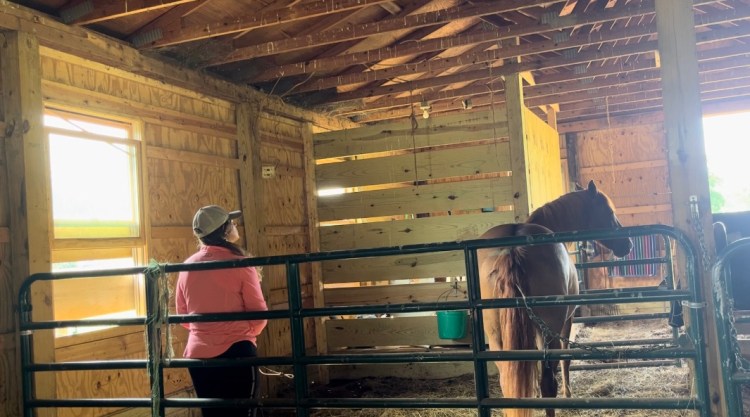
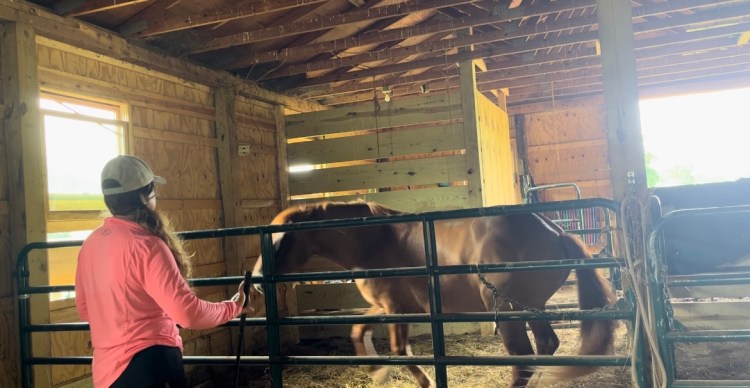
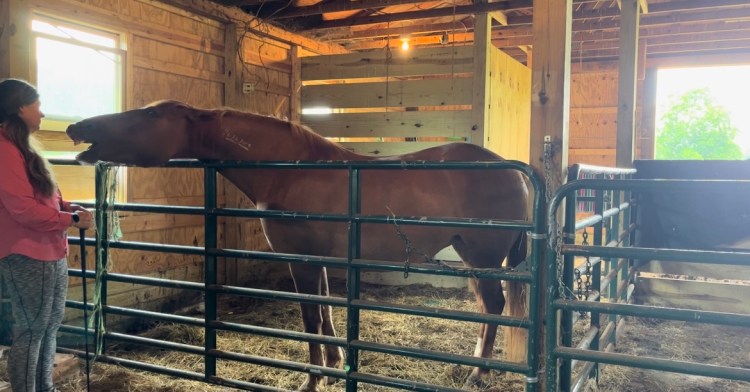
Over the summer, armed with guidance from Tom in person and via email/video, I spent many hours a week trying to find common ground. Wyoming’s stall (aka the shark tank) has been my classroom this year.
The halter has always been sticky to some extent. Though for years I have been able to get her head in the rope halter (and she will comply), I have always sensed that it was not ok. My gut tells me this is a key: the halter is a basic loss of her freedom, and it takes a lot of trust to volunteer to submit to anyone in that way. I am still not on her list of trustworthy enough to relinquish that level of control.
It is worth considering that putting a halter on a horse- a very small piece of equipment- takes away almost entirely their ability to self govern. There are limits, horses can jerk a lead rope out of a human’s hands, or I’ve had Tom tell me I looked a bit like a kite as she pulled me right off the ground in retreat, but once we have the ability to control the somewhat delicate head with all those nerve endings and the soft tissue places around the nose, we have a powerful level of force over them, especially if tied secure to a post with a strong rope.
Over the years I have tried to find better ways to use the halter than force, and last year when I heard Mark Langley talk about guiding horses instead of driving them it impacted me as kernels of truth tend to do when I hear them. Being prey animals, horses can be driven into things especially if we have a halter/lead rope that prevents real escape. I have driven her over the years to do a lot of activities, but she has never felt good about it, and no matter how pretty and snappy she looks trotting or cantering around me, she is not relaxed or happy.
I didn’t not love her. I wanted what was best for us both, which is a cooperative relationship with her humans. She lives in a human world now. The wild life is not all it’s cracked up to be so I do not agree that she would be better off left on the range. There’s starvation, drought, predators, and extreme weather there. I doubt she would be less fearful than she is here when she goes into high alert when the deer roam through at night.
Still, I didn’t know how to help her or me, and I flailed around with various levels of success and unsuccess and the mysteries remained out of reach.
As I continued to regress this summer to the most basic fundamentals, I once again asked: can you be ok with me putting the halter on you? I found myself summoning the courage (thank you Tom for being the guinea pig and flag man) to open the stall gate and stand in the gap, vulnerable to attack,and offer the halter to her knowing she could choose to take me out. But oddly enough, if I came in with too much self-protection, she felt the fear brace in me, she would brace right back against me, and we could not breach the impasse. I had to make the choice to risk being hurt and show up with a white flag (actually no flag) instead of a weapon. With some basic safety in mind, I would hold out the halter from one knot away from my body so the noseband draped open and allowed her to make the choice to put her nose in on her own.
I did not encourage her to bite at the halter. It’s not good manners at the minimum, and I don’t want her nipping at my tools to “work out for her” but the other problem is, her reaction to that piece of equipment is actually that strong so I also had to acknowledge that without punishing her. I don’t want her to spend her life thinking it’s ok to bite at my equipment- or at me, and I don’t want to send the message that I don’t want to know what she’s thinking or feeling. It was a very fine line, how to express ones thoughts and feelings in an appropriate way! I’m sure I did not always successfully navigate this delicate balance and it takes impeccable timing. She must think it’s her action of nipping at the halter that creates the reaction that might be a poke from my finger at her cheek, but that she has control of not being poked (try not nipping at the halter!). The right instant timing is action-reaction; just a moment too soon in anticipation is picking a fight; enough delay becomes punishment (which we NEVER want). However, as I began to care more about how she felt and helping her, than getting my task done without being injured, something shifted.
It seems that letting go of what I really wanted was the path toward actually receiving what I really wanted.
Harry and Tom both talk about creating an imbalance that the horse will work to correct. Take for example how a bit works. When the human takes “hold” of the bit in some way, it creates an imbalance that the horse will move its entire body around to fix, which is how we can control so many things along a huge animal’s body with a small piece of metal carried in the mouth.
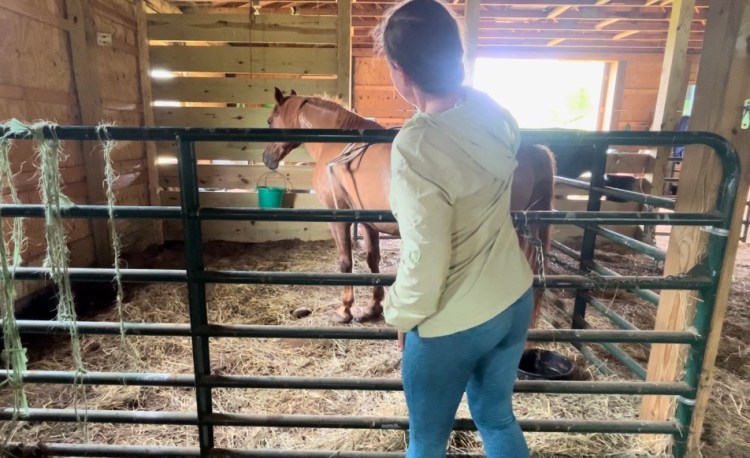
I had come to see that just my presence creates a strong imbalance for very sensitive Wyoming. I can stand in Hope’s stall doorway a very long time before she bothers to find out why I’m there. I might need to make some noise to get her to care at all. With Wyoming it’s different. Even without the halter, just standing at her stall gate, it did not take long before she stopped munching on hay and began to move. She looked out her window… but she was not unaware of me, she was trying to find peace, and if she could send her mind out the window it might help, but, as I waited I saw it did not work for her. My presence was still too disruptive even if I did nothing but stand there.
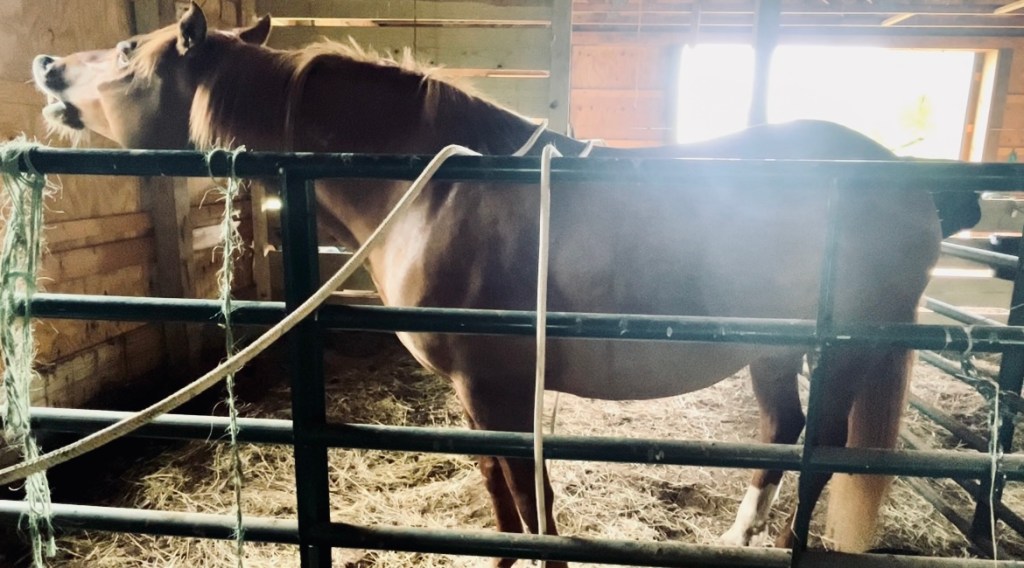
I added the halter and this was even more disruptive without making a sound. The same looking out the window was her first try to make things right, then she would look at me, then look back out the window, then look at me again. Then she would take a step in a circle toward me, and pin her ears giving me threatening dragon face. Maybe she could scare me away. Nope. I just stood there with the halter held out. She would step toward me and nip toward the halter, I would do various things to discourage that without picking a fight. Then she would stand with her nose over the half wall/gate to khaleesi’s stall, a position that would be very hard for me to force the noseband on her. And I would still wait. Someday, I hoped she might choose to allow the halter. If she would choose, it would change everything.
In the process of this I could see the depth of how disturbing this was for her. It didn’t make sense in my human brain, but I could not disregard what was in front of me. I began to be intensely curious toward this dynamic. She did not go back to eating hay. She would occasionally cycle back to the window, but never for long. For most of the time she would stand very close to me, I could touch her with the halter on the neck, or other parts of her body, but she did not want that noseband to capture her. In all this I did nothing to force her to participate, and yet participate she did, in the all the ways she could.
I had begun paying more attention to what the truth was for her, as strange as her truth seemed to me, than what I was trying to do or get done.
Gradually I was able to halter her with increasing relaxation. This process wasn’t a dramatic moment where she chose as I hoped to put her nose in the halter voluntarily. It started with a shift in position where she seemed to suggest: I cannot bridge this gap yet, it’s too much for me, but if I stand here quietly you can put the noseband up my nose and I will try not to fight you.
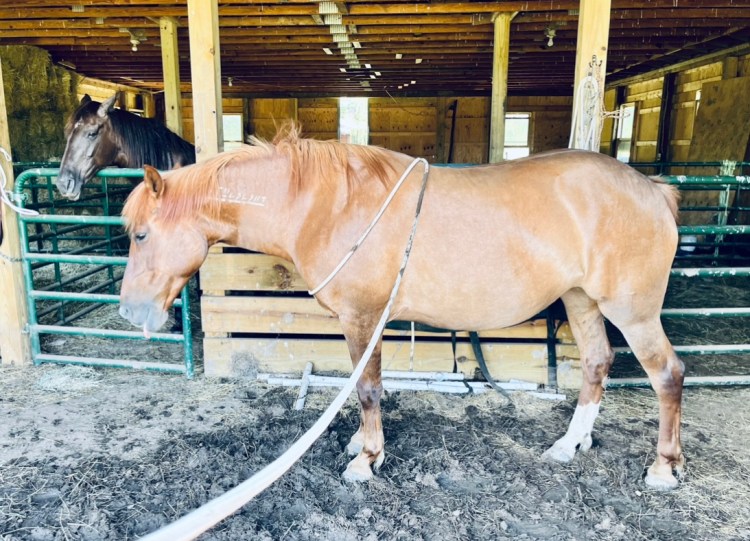
The reason I believe this is accurate, is because when she did begin to position herself allowing room where I could put on the noseband, she had minimal nippy reactions, and once the halter was on and tied she began to relax there in the stall with me. This is a time when I would stand there in the stall with the halter on, rub on her, scratch her, breath deep, and make it a really nice place to be together. It was here I began to notice just how much tension she carries in her neck. She has such a level of self-protection about her it’s no wonder she feels terrible.
Some of the work this summer staying in tune to how she is feeling in the work
As summer melted away to fall, I had a shift in routine that meant I had to bring the horses in and out of the barn across the yard to a remote pasture which meant I had to halter them. I knew this would come and it concerned me- having to take my life in my hands to manage the wild thing did not sound fun (in the summer I could get the halter on or walk away and it didn’t really matter, now I had to get this job done in order to move her). However the foundation we built through the summer set us up for success.
At first I’d move the herd one at a time. I liked spending the time and attention on Hope solo, who is slow, as we did the walk together. Khaleesi is pretty manageable at whatever pace or need, but Wyoming benefits from focus and clarity in everything we do, so walking her alone was preferable. This meant some days I would start in the barn and take Khaleesi into the remote field. When I returned Wyoming was already becoming stressed because of the imbalance in her environment (herd separation). She is smart enough to realize that it was the halter that was her pathway to rebalancing in rejoining her lead mare. Instead of a mess or violence I would step into the stall and she would come to me and dip her head at the noseband (very willing) and I had to ask her to slow down and not revert to autopilot with her brain already in the other field and her body stuck with me (this the the condition where a horse has lost her mind). In this way she began to invite the haltering process because it had meaning attached to it she wanted to engage in. Similarly in the large field where I worried I might never catch Wyoming again, she was usually the first one who came to me and agreed to the halter to go back into the barn for breakfast and a break. This new routine I worried might get one of us killed actually helped us establish some good patterns.
One of the days I moved them all at once for necessary efficiency…
Looking back however, it was one of the days I was rubbing and scratching the mare in her stall trying to help her see she could let go and relax and trust me even with the halter on, that the rock hard muscles in her neck simply would not relax. Even as her eyes began to soften and she was reveling in the butt and underbelly scratches she was getting, the tension was rooted deep, and it was here that something broke loose inside me.
Harry Whitney says it would really help horse people if they could learn to recognize the motions that go with good emotions, and the motions that go with negative emotions. As I stood next to this wild creature who has lived with us for seven years, I realized looking back how much tension and brace this horse carries all the time. Tears stung my eyes as I considered the depth of the worry she carries around, and I felt overwhelming compassion for her.
I have not loved her like this before.
I didn’t want to fix her issues. I didn’t want her to have safer “manners” for all the human interactions that would be required of a normal horse. I didn’t want to know I could get her on the trailer… I didn’t want to solve the problem of why I’ve had this horse seven years and can’t ride her still. I didn’t even want to know I could halter her without her nipping at me. (Although I did want those things, they became highly insignificant)
I wanted to know how on earth I could intervene in her world in a way that could help her let go of some of what she was packing around, and that she would feel better about her life. I found myself begging for the insight that would help her to feel good for maybe the first time in her equine life since being rounded up on the range all those years back.
This is when something began shifting anew.
What changed?
Me.
I have always loved this horse, I thought.
But not like this.
George Washington Carver was knows for his humility and service. He cared so much for the people that were struggling, forgotten, rejected, or oppressed, that he went into his lab with the peanut and love poured out of him. A kind of love that opened up the secrets of the soil, the peanuts themselves, and in that place revelation came and revolutionized agriculture forever. Crazy and unscientific as it might seem, it was in his posture of love and not ego or fame or self-interest, the secrets were revealed.
I had a glimpse that day in the barn with Wyoming, when my heart broke for the years I’ve seen her gallop across the field with tension through her body brought on by stress, neck raised and stiff, instead of that beautiful fluid movement that comes with relaxation and a stretching out of the muscles and joints, and I grieved that I hadn’t yet figured out how to help her. Not for my ego. For her.
Hope Horsemanship carries a verse instead of a tagline or motto. It is Jeremiah 33:3 Call to me, and I will answer you, and will tell you great and hidden things that you have not known. I then pondered another truth in the same big book of wisdom: If I had a profound understanding of God’s hidden secrets… but have not learned to love, then I am nothing.
We are not worthy of the deep secrets, we are not trustworthy of them, if we don’t love first and foremost.
Wyoming, and most people around us- know the difference between saying we love and having that love authentically pouring out of us. You cannot fake what is in the heart. Not to a horse at least. Until she knew that love coming through me authentically, her secrets were kept under a tough braced up shell. She couldn’t trust me with vulnerability. This is a road. I have not arrived. Still, I can see progress.
Wyoming trusts enough to willingly ride in the trailer for the first time.
I wanted to say she didn’t have much choice, as a horse she couldn’t choose another owner. But the truth struck me that I also didn’t have much choice! Considering she wouldn’t get on a trailer to save her life, I didn’t have much opportunity to sell or give her away either! We have been bound together for some greater purpose. Now she appears to be at least somewhat loadable, but it’s too late to go back now. I am hers and she is mine. Hopefully the mystery will continue to reveal and it will be a good story when it’s all told.
Things here in Hope-town this fall have been packed in with some unexpected twists and turns.
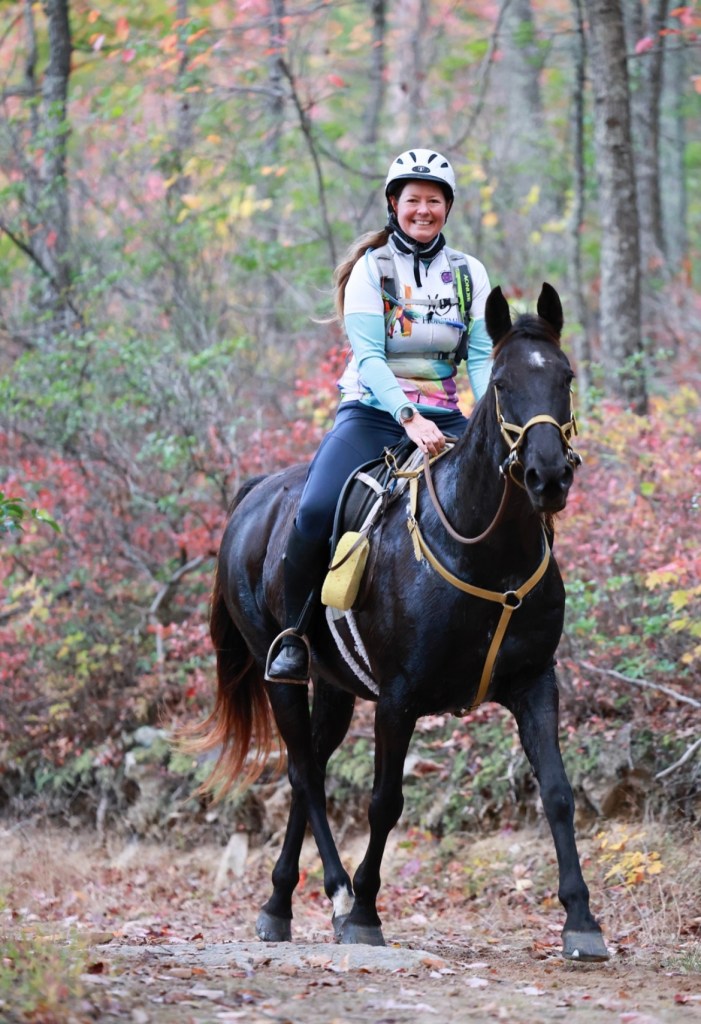
This little post is to share the ride video from the Fort Valley 50 on October 20, 2023. This was our scheduled final ride of the season and looking back I could not be more pleased.
Photo: Becky Pearman
I like to hold my event plans loosely through the year and leave room for recalibration. This year not only did my tentative ride calendar run as it developed in early Spring, we added the fall Biltmore ride to it for a total of 5 rides this season. I believe this could be our first year for 100% completion on all rides we entered.
We completed over 300 miles this season and the rides for 2023 were:
(OD) No Frills 55
Biltmore 55
(OD) Old Dominion 100
Biltmore 50
(OD) Fort Valley 50
Of course this was also the year of our first 100 mile completion, and our first season of finishing all three Old Dominion (OD) series rides which earns our first triple crown award.
I could not be more pleased. For those who have followed us any length of time you will know it’s been a long road that was not always certain to have this kind of success. But I do believe in the long process and building up a powerful horse over a long road it’s taken many puzzle pieces, team members, and trial and error to put it all together so she is truly running in her strength now.
The Fort Valley ride had nothing particularly special about it. It was what we in the Harry Whitney circles like to call a ‘non-event event’ — meaning it just worked like you’d hope. Maybe it was the ride I didn’t learn anything in particular, we just celebrated and ran along with joy!
Meanwhile there are updates about Wyoming who is really coming along into a new connection and we are truly becoming friends. So the next updates will be for the fans of Wyoming’s journey.
As for the endurance plans… I have come to a good place, and I’m certain there will be new mountains to climb next year, but it’s too far away to get wrapped up in that story yet… there are stories in between that need engagement first. Khaleesi is on a well deserved break for now with her herd.
Enjoy the show… and ride along our last ride of the season with us:
There was a time when a beautiful day was not complete if I couldn’t ride my horse. If I had to work or was otherwise occupied it was hard to not imagine myself in the woods with my mare and be sad about whatever it was that kept me from that experience. My work is pretty great. I run a rural area music education program teaching K-12 age violin students. I am also on faculty at a local college teaching violin and chamber music. So it wasn’t about having a dead end job that was torture to log hours at. It was about where my mind was, how it became mysteriously separated from my body on particularly nice days, and about the tension of having a mind and body in two different places. I had quite lost my mind and was struggling to function without being present in the good work I had in front of me because of it.
I currently have this island of misfit toys herd that I adore. I jokingly tell people I have a good horse, a bad horse, and a sick horse. It’s an oversimplification, and thus isn’t entirely true, but it makes for good conversation.
Anyone who follows my writing can connect the dots: my good horse is Ireland’s Khaleesi, the mare I took in as a feral four-year-old in 2014. I started her for better and worse, learned with her and grown alongside her. She is my endurance horse, and in June we finally conquered the single-day 100 mile race on one of the toughest courses the sport offers. I can get done just about anything I need to and she fills in for me a lot. She is a highly confident leader and makes me look pretty good much of the time. She is a beautiful gift to me and I enjoy her constantly. My challenge with magnificent K is I’m decent at getting things done with her in the natural horsemanship direct pressure style of working together that has left places our relationship can improve. The hard part that requires some vision is going back to learning new pathways together when things “work out pretty good” the old way. I know there’s more for us, but it’s going to take some time creating new experiences.
The lovingly identified bad horse is Wyoming the wild (by the way I also have a bad dog I adore, so this seems to be a pattern for me!). She of course, is not at all a bad horse, she is my complicated challenging horse who does not fill in for me, who is not confident in herself or my leadership, and has required a lot of consideration, thought, growth, experimentation, and help in order not to give up on her and find some wilderness area to release her back into and wish her good luck. She’d probably survive; she has the skills. In fact, all she thinks about is her own self-protection and survival since she doesn’t trust it to me, yet. And why should she? Truthfully I haven’t proven adequate of that trust to her yet, and so I refuse to give up and am determined to keep growing into the kind of leader a horse like her requires. She is constantly demanding I get better. She has been a valuable gift to my development.
The horse I hate to label but truthfully, in fact, IS the sick horse is darling Redemption’s Hope. She’s a discarded quarter horse that went through many hands before ending up in my barn. I took her knowing she was a shut down tangled mess, without realizing how big a mess was really in there. My plans for her were to help her feel better, learn the world of humans wasn’t such a terrible place, and voila, she would be a sweet natured horse kids or adults with less developed skills could get to know horses and learn to work with safely. She did that work about a year while her health devolved into such places where I have more than once been certain she would not survive. She has been the most expensive horse I’ve ever owned through vet bills and nutrition supplementation and support care in general.
I have come to see the gift she has brought me is an opportunity to love and support a creature who has zero ability to give back, and for an extended period of time. We are entering a third year of her very slowly coming into some kind of stable health, but due to the neurological signs from the EPM (I believe), she may well never be ridable, or even a horse who can physically respond to a request in a normal way again. I simply don’t know yet. Only time will reveal what little Hope’s redemption story will be.
Loving Hope has cost me emotionally and financially. I am limited with my herd, at the moment I cannot expand to more than three horses and she is taking up valuable real estate. She has taught me the long process of showing up every day to what often feels like a hopeless situation and staying engaged. She has taught me what it is like to invest and care and love with no reliable expectation of gaining from that relationship. How often are we given such an opportunity to love in that way? I haven’t always seen it, but recently it shines of a glory I cannot fathom, how did I get so lucky to have this horse come to me and teach me this important lesson? The lesson of showing up even when there seems to be little hope, to love anyway. This does not come naturally to me. I needed some help, and she came.
All of this came to mind recently as I rode my good horse around a local recreation area along the Jackson River. I am fortunate to live in a pristine and beautiful area that is still so rural and unpopulated we have not one traffic light in the entire county, the animals outnumber the people, and our pubic national forest land is somewhere like 75% over private property. I am insanely blessed, and also quite intentional about living here. I went out solo, rode about 7 miles around this beautiful park and in the couple of hours never saw another human. It was exquisitely perfect and I reveled in it not taking one moment for granted. It was perfection in the experience of riding a fabulous horse, on well kept trails, in a place of untouched beauty.
As I pondered this, I realized something has happened to me over time.
I enjoyed this ride, however, today it occurred to me that I equally enjoy the time I spend working with Wyoming the Wild, even when a decent percentage of our time together she is threatening me because I’m pressing her comfort zone (necessary to give her the experience of seeing she can trust me and her life is not actually in danger). I am helping bring her lost mind back to the present reality in order to help her feel better about her life, and about our connection. At the moment in our re-started education program I have begun again at the point of not being able to put the halter on her without her feeling threatened. So I don’t. If one cannot halter a horse reliably I think that reveals just how far we are from being a riding partnership.
I don’t know what will become of Wyoming the Wild one in her education. I am stubborn and I generally refuse to accept that a horse cannot come to an understanding and work with a human- there are just ones where the bar is set too high for many (sane?) humans to consider reasonable… I am considering that she could be one of these special creatures. The alternative, which is also possible, is I’m just not skilled enough… but each year I’m finding that less and less likely the root problem. Let me assure you no pride in my skill level… She certainly has required I gain experience and understanding in order to succeed in helping her. I know how much I have to learn is deep and wide, but my hunger to grow covers a multitude of sins in the process. I don’t think it’s only my inexperience anymore. She’s a unique and complicated horse. How have I gotten so lucky to end up with her? I don’t believe in coincidences, I know she is just as much a gift as the good horse is.
I have found that anymore I do not care nearly as much that I’m able to ride this horse as that we come together. I do want to be able to ride her, but I have found I love the time I spend with her, learning to show her she does not have to protect herself from me, that I am here to help her, and she is just perfect just the way she is, right now today. We will simply keep spending time together until things come right and then we will see what that looks like.
I thought of the time I spend with Hope now, every day walking her slowly and intentionally, watching how she struggles to lift her front end and thus her front legs paddle around not to drag the ground. How can I help her to think about lifting first even her eyes off the ground and begin to think lighter in the the front? How can I help her start to rebuild her atrophied muscles that would support her body in better balance? We do tiny weight shifting requests just to begin the form of thinking the change that someday will mean she can walk normally again. How can I work with her so she isn’t stressed out which is when she begins to panic and her feet begin to cross over unnaturally like a horse who has neurological damage (she doesn’t do this if she is not in a panic).
What creates this panic state for her? Her life has given her the experience that humans will demand things and then punish for non-compliance. Somewhere along the way I believe this horse wasn’t saying: No, I won’t… but she began to have physical limitations that meant No, I can’t. And when that happened her reaction leads me to guess she was punished. Now when I begin to ask things of her I can see the stress and worry set it. She either completely shuts down and is non responsive, or she begins to offer up anything she can muster getting her limbs all crossed and in a pretzel. The answer is not to quit asking anything of her (though I basically did this for almost a year thinking she needed the rest and recovery which may or may not be true), but instead to begin to ask her things she can do and to give her the time to think and do it, and not to punish her when she takes a long time to get there. She has been taught not to think but only to respond and quickly- my hope is that I can teach her she can think, she must think, and I will help her along the way.
What I am realizing is I am finally beginning to find the real gift in being present in the reality of each horse, and asking how I can help them. My own mind is letting go of the idea that I have to have a riding (or teaching) goal for each horse and each day we do not get significantly closer to that goal brings frustration or irritation. As I let go of that way of thinking, I find not only peace in the process but a deeper joy in every moment we share. Even the struggles of which there are many right now. I am able to see opportunities where there were only roadblocks. I am curious about things instead of annoyed by them.
I recognize fairly quickly when I am getting all twisted up again.
I have riding goals for Khaleesi. These are good. I believe the road I am on with Wyoming will include riding her again- and successfully – as well. I have a goal that Hope will someday have a body that works again in balance and be able to help humans to learn more about horses in some way.
I think having goals is important.
Sometimes we have to adjust the goal.
With Wyoming, I had the goal to be able to safely trail ride her including loading her on the trailer to transport. This year I’ve seen that she has way more deep anxiety that if I don’t address, none of that is going to function in strength. I’ve done the “grown up” thing and adjusted my goals to honor her needs…
This is where it gets so dicey and on a good day I can laugh about it…
I adjust the goals to helping Wyoming get feeling better working with me and pat myself on the back for being such a highly developed horse person who truly puts the needs of my horse first and is willing to patiently work with them in the way they need.
And then I find myself occasionally frustrated and annoyed when we have an “off” day and she comes at me with more violent snark than the previous day… or I had gotten to lay the rope over her back and she relaxed, whereas now if I stand in her zip code with the rope in hand and she pins her ears and threatens.
Why? If my only intent was truly to help her, there would be no frustration. Frustration comes because I’m not getting my way and that reveals that I’ve made the new goal the central thing and I’ve once again gotten all twisted up around the good thing that isn’t supposed to be the ultimate thing and now I’m frustrated that she isn’t getting better!!! I am not making clear progress toward the goal of her getting better so help me mare you MUST GET FEELING BETTER WHAT IS YOUR PROBLEM!?
Lord. Help me. Every. Day.
I still get twisted up.
Do you ever get frustrated? I heard that a prey animal’s basic job is to frustrated a predator. Think about this… Predator wants a meal, so it chases the prey animal. Prey animal wants to live so it does all it can to evade and outrun the predator. The very definition of being frustrated.
Frustrated: feeling or expressing distress and annoyance due to inability to change or achieve something.
When we feel or express frustration we are acting like a predator. In the human world the definition of predator is: a person who ruthlessly exploits others.
This is not the dynamic I want in my barn. This is not the dynamic I want in my life. Therefore I have sought to become more aware of when I feel that frustration rising in the dark space of my heart and it is now a warning signal: you have become twisted again. Stop. Regroup. Begin again and ask: how can I help?
The good news is we are all given a certain amount of self-control and if we begin to use it, we can strengthen it! Each time that twist shows up in my relationships I can notice it and make a decision to change myself and my approach. I can decide not to be a frustrated predator.
Not controlling another (horse or human) to manipulate or force into what goal I have that day is a much slower road to my goals, but it is the only way to my ultimate goal. I know there are many who won’t understand (why take the slow way of freedom and love? It’s incredibly ineffective), but when we get there it’s a million times sweeter, and the roads and detours are more peaceful and full of life.
When it comes to any relationship, boundaries matter. I think Danny Silk has some great books out about powerful individuals, the importance of connection, how to love well (even your enemies) and the trap of confusing boundaries and punishment. He has a great book titled “Unpunishable” that addresses what he calls our culture’s addiction to the punishment paradigm and how to let go of this in our human relationships. I’ve read the book. I’ve put effort into understanding and walking this out in my own life.
Then there are relationships with horses. I remember hearing Mark Langley say that boundaries are fixed and they don’t chase you. If you think you have a boundary with your horse but your boundary is in fact chasing your horse then it is not a boundary.
To make a finer point, I’ve heard Harry Whitney give an illustration about electric fences. I’m pretty sure Tom Moats has written about this too, but since I’ve recently read a handful of his books I can’t remember which one it’s in and who might have borrowed it… Harry explains that horses graze peacefully near an electric fence, very close to it, even sometimes reaching under it as far as they can without touching the strand. Most horses familiar with an electric fence are not afraid of it although no horses like the shock of coming into contact with it. Their experience is that the fence will not surprise them, ambush them, or chase them. Certainly the fence can be moved into new positions, but once the fence is fixed, the boundary is firm, clear, and potentially most importantly: not personal. There is no question if a horse gets shocked by the fence it was unemotional and non-judgemental. The fence isn’t angry, frustrated, fearful or otherwise emotionally embroiled in the process. No horse need be shamed or considered a “bad horse” for touching the fence and getting shocked; not very smart, maybe, but evil or bad are not part of the equation. Horses figure out quickly that the shock is a direct consequence of running into the fence and once they do it a couple times, it’s usually enough for them to avoid the strand in the future.
Harry helping a horse with fear around its ears in a clinic in Vista, CA 2023
This all makes perfect sense to me.
I thought I understood what a boundary is…
Then I began to press into dangerous territory by interrupting Wyoming’s very strong thoughts — which opened the can of snarky-threats where she began to threaten me with dragon ears and teeth bared. What do I do about the violent threats?
I had to think this through and I regularly found myself changing my position on what to do about it. Clearly this is NOT OK. I don’t care how you feel Wyoming, you cannot threaten to harm a human and continue to live here. In Mark Langley language “That is not available.” And in Harry-land “Let go of THAT thought mare.”
I thought: there is a boundary needed where that behavior is not tolerated and has an electric fence style wire that is tripped when you go there. On the other hand, it’s not as simple as setting up a “snark fence” that sends an electric shock clearly, effectively, and unemotionally at exactly the right time when the snark threat shows up. I have to set and enforce the boundary, and with my human limitations this could easily end up being unclear, questionable on its appropriate firmness, and most importantly could be rife with emotion no matter how hard I try not to be. There is a thin line between a boundary and a punishment, and this particular horse is quite sensitive to knowing which it is, and punishment always makes things worse between us.
In June when I started over once again, I’d see her go volcanically violent when I asked for her attention on me while she was in her stall, and I’d stand still outside her reach as she would snake her ears and snap her teeth a few inches from my face. I’d say: thanks for giving me your attention, this is a start… And she would cuss me out in equine, threatening to chew me up and trample my carcass when she had the chance. But, I reasoned, I had all of her attention in that moment. Of course the hope was to get her to feel better about it, and I don’t think that interaction felt very good for either of us.
The problem seemed to get worse. There were times I would be doing something completely unrelated to her in the next stall and I had to pay close attention to the eyes in the back of my head because she’d stick her nose over the gate threaten me even when I wasn’t asking her for anything. Even my presence began to get under her fur. It seemed to be increasing, so maybe allowing her to have these fits was not the best way forward. If I want to help my horse let go of hard thoughts, I reasoned, I need to find a way to basically say: LET GO OF THAT! When she turns to violence. The violence needs to not work out for her. Right now, I’m not so sure if it is or it isn’t working for her in her mind. So I tried answering the violence with what I hoped was a boundary. If I had my rope, I’d be ready when she circled back to rush the gate with her teeth bared to meet her with the rope as adapt as I could get with my timing in the hope she would begin to think whenever she had snarky-violent outbursts, she ran into something when she came at me and it was not pleasant. Like an electric fence ideally, one that only came on when you have a bad attitude.
I would have to be very consistent, as unemotional as possible, and match her in firmness as closely as I could. I wanted her to learn there is a boundary here and violence will never be tolerated.
I had a couple lucky opportunities meeting her exactly when she came at me but it seemed to only make her more angry and more threatening, and if she backed off it was harder to see a change for her to soften and relax. I could get her to act less on her wish to chew me up and spit me out, but I don’t think it changed the fact that she wanted to. This approach didn’t seem to help her feel any better about being with me. In fact if anything I think she got better at planing quick sneak attacks in the hope she might get through the barrier. I liked the idea that I was trying to clarify that this aggressive behavior was NEVER acceptable, but it didn’t appear I was making real progress with this.
It did not seem to be working out for me.
The next shift back came one day when I was innocently cleaning the middle stall and Wyoming came over the gate with her head and began snapping her teeth at me. I wasn’t looking for her attention or demanding anything of her. This also means I was completely unprepared to meet her violence with what I hoped was a decent attempt at a boundary like a rope or a flag, or any useful tool.
So I just stood there.
I stood there and watched her, inches from my face. She pulled back, did her little ramp up circle, snaked her ears and stuck her nose at me, teeth clacking away. I stood unmoving and completely unemotional, and slightly at a loss. I wasn’t “working” with her, I was just at the barn at that time. I simply observed her and paused in curiosity to watch what she would do thinking that I had screwed up the consistency of meeting her behavior with a clear boundary every time. Now what?
As I watched she repeated the cycle which always included pulling back, doing a little circle, reflattening her ears, and throwing her head over the gate at me, teeth clacking. However, as I stood unmoving and completely curious (not upset, frustrated, angry or afraid) each time was less enthusiastic until finally she threw her head over the fence, froze with no bared teeth, softened her eyes and her ears perked forward. Now it was her turn to just stand there starting at me, curious.
An example of Wyoming feeling softer and relaxed.
It was this experience combined with the revelation about the cowardly lion who desperately wanted courage, that had me re-evaluate my attempt to “boundary” this behavior by meeting it with a tool of some sort.
First, I realized as I stood quietly out of her reach, there actually WAS a boundary. It was the gate that separated the stalls. That boundary was secure and clear. The truth of this scenario was that she cannot hurt me while the gate stays in place, and it’s screwed to posts with brackets, so it’s not going anywhere.
Second, my attempt to meet her violence with some kind of equal “boundary” with a rope or flag she would ideally “run into” wasn’t the wrong direction entirely, but in reflection I had to be honest with myself: I was meeting her fear with my own fear. I wanted to believe I was unemotional, but though I was decent at stuffing the emotion in the moment, it was there. I was afraid if I didn’t curb this behavior someone (probably me) was going to get HURT. I don’t think this concern was unreasonable or wrong, but regardless it was an underlying emotion. No matter how hard I tried, the boundary I wanted to put in place was smelling to her a whole lot more like a punishment.
Third, though I wanted her to “run into her own pressure” somehow when she came at me, having the rope or flag or stick meet her physically was still “at” her. I started experimenting with creating a big sound instead where she did not like the shock of the noise, but it didn’t hurt. These details are obvious to me now, and really important, but I suppose that’s what a life of learning is about- the mistakes and the fixing of them and the growth from them.
I know that we cannot meet fear with fear and ever find a better place. We can build a wall of self-protection and we can find ways to not get hurt when we meet fear with fear, but we cannot build connection that demands vulnerability and we cannot strengthen relationships. I pondered all that I’ve read and learned about these things and asked myself the million dollar question: so then, what must meet fear to dissolve it and heal the brokenness?
Only LOVE.
Don’t give up on me here as you assume I am about to suggest going into the shark tank with no protection and singing to the creature who has promised me physical harm a refrain of Kumbaya as my only hope. That is not what I mean by love. Love in fact, must have boundaries because connection is worth protecting. I believe Wyoming when she’s told me she is in enough fear to hurt me if I press her, and me being attacked is not good for either me or Wyoming. If I love her and I’m seeking better connection with her, I will not put us in that situation.
Danny Silk asks the question: how many pet rattlesnakes do you have? None.
Because wise people don’t bring dangerous things into our houses- the place we feel safe, can be vulnerable and expect not to be attacked if at all possible. This is a boundary. No rattlesnakes in the house. We can love rattlesnakes and not invite them inside to play. Rattlesnakes can be loved at a distance.
While Wyoming sees me as a rattlesnake and I see her a threatening dragon, we need to find a way to connect without expecting we will be in each other’s vulnerable place. My job is to find a way to connection with her, to answer her fear with love, and ideally have us not get hurt as we work through this process toward more trust. Both of us need more trust in the other. She has learned that I am wiling to drive and punish when I want something from her or when I am afraid, and I’ve learned she threatens violence when she is out of her comfort zone.
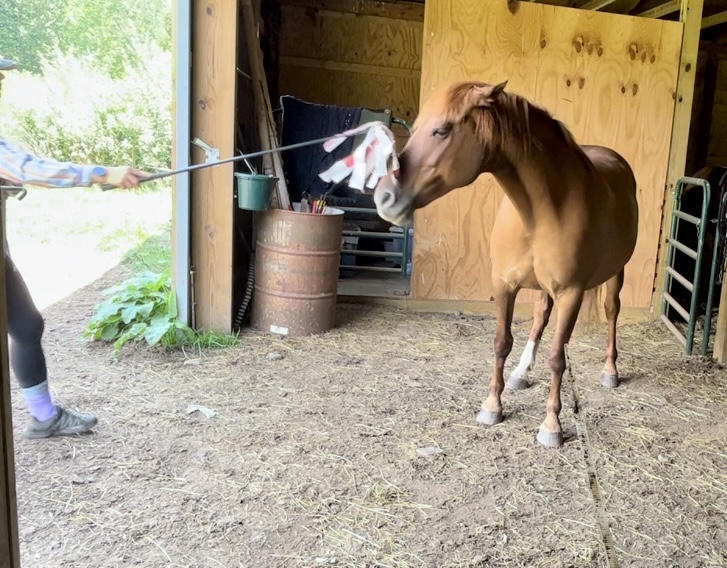
During this process something began to change that was helpful. Wyoming went from always trying to kill the flag to relaxing when it touched her. The flag became the first tool she not only started to accept without violence, but if I did touch her with it she immediately quieted and would relax as it rubbed her. If the flag was floating along nearby, that made her nervous, but once it made contact she calmed down and began making suggestions where it might scratch and rub her. This gave me the ability to “pet” her without getting in the strike zone. This enabled me to begin to build trust not to punish while staying across a good boundary which kept us both more safe.
Response to me asking her to give me her attention…
Thus another shift in approach began for me. I kept myself outside her reach and began asking for her attention. When she would circle, turn, pin her ears and come at the gate I would say under my breath to her (in order to remind myself what she needed from me) Courage! and I would give her a hug instead.
Me offering the ‘hug’ as a response while staying at a responsible distance for us both.
Once again, I’m not a total idiot. The hug looked like me lifting up the flag and getting right in there and petting her as close to her head as I could (usually on the neck at first since she wasn’t a fan of the flag strips in her eyes and ears, but that is also changing). I could be a foot out of reach, completely without fear, and only responding with love.
She considers my response…
The love was saying: I know you’re afraid and you don’t trust me not to punish you. I know you haven’t felt very good about us working together, and you are like a porcupine walled up with layers of self-protection. It’s exhausting to manage your entire space like this all the time. Let me help you. Give me a chance to try things differently, to connect and care for your needs. And then see if we can work together as a team. Here, I’ll start.
She softens as I refuse to meet her fear with my own fear and choose not to punish
I realized that I have wanted to express that to this horse for years. I wanted her to trust me and allow me to help her. However when I was working with her in the punishment paradigm of direct pressure my words and actions were, to her, incongruent. I wanted to say: I am here to help you and I care about you, but my actions were saying: if you don’t do what I’m asking I will hurt you. I need you to comply with my program regardless of how you feel about it because I am the human and you are the horse and this is how it works.
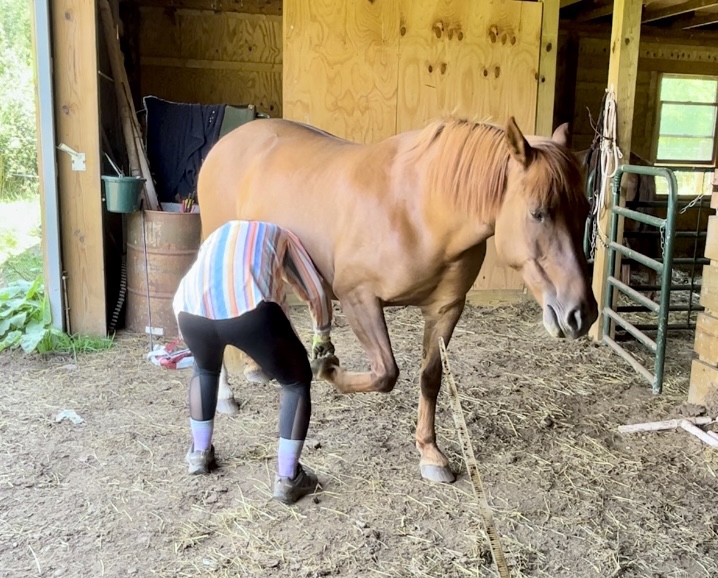
The flag-hug plan is showing positive changes in our time together. One immediate shift is I can walk around the barn and in her stall again without wondering if she will get flipped to angry-mode even if I’m not paying any attention to her. That was a disturbing phase we went through demanding me to be on high alert (more than normal awareness)— I’ve never been concerned about simply being in the barn with her ever before. I had not trusted being in her space enough since June to trim her feet and they had gotten way too long. Now I’m able to work on her feet and I do it a little each day. I do this without halter or lead rope right now as we are still trust building and she does not trust me yet to feel good about being haltered. For the time being I’m choosing patience on that as we sort out more pressing things.
She loves being scratched with the flag so lately, our routine goes like so: I greet her, she comes into the barn “aisle” area on her own and I give her some good scratches with the flag. I do a little cleaning and trimming on each hoof and intermix flag scratching. After I get that work done I switch to using the flag to ask her to do something, take a step forward or backward, move away from me, look a different direction (this is beginning to influence her thoughts when they are softer which is a great step!). These things are very small and the scratching reward for giving me something simple is a part of the way we are building trust. All of this she can do and stay in a good feeling place. Almost no snark-threats come from these activities.
Next I push a little deeper by getting in front of her and ask if she can let go of her vigilance to give me a moment of her attention, center up, and straight on me. I get different degrees of “not really” at this point. I have a little distance, and can effectively block a straight on snark-attack with my flag hug right between the eyes. She doesn’t love that kind of hug yet, and it redirects her to choose a response less violent- sometimes she stays with it and tries again a little softer (she IS trying!), sometimes she chooses to go back into her stall and disconnect with me entirely. That is ok. She gets to make that choice, and it opens the door for me to close the door, allow her the “safety” of her bedroom, and then to stand outside the door and knock so to speak.
Right now this is our most intense level of interaction, but I think it’s also where the most important work is being done. In her stall, with a boundary in place for both of us, I will press in to a deeper ask where I know she’s going to be less comfortable. If we never press into here, she can’t have the experience to see it’s going to be different than she expects. With a horse, one cannot use words to explain, we have to change the experience. I can’t change the experience without creating the situation she is afraid of and showing her it will not destroy her.
I ask for her to let go of whatever else has her attention and give her full attention to me. She reverts to dragon attack, threatens me and doesn’t even stay long enough to bite at me over the gate. She dismisses me immediately and turns her hind end to me going back to the more important thing. At this point I make the biggest slam noise I can with the flag against something (plywood wall, or an unopened bag of shavings is pretty loud too!). She hates this noise but it is not a threat of pain. I am not coming at her, I’m not driving her hind end around, I am staying outside her stall. In essence I’m setting a bomb off right outside her door. I want to be worthy of her full attention. I hope to draw her over because nothing is more important than the sound of a bomb going off right outside your door. Appearing enraged, at first she comes back with her dragon act and each time she dismisses me to turn away I make the sound as full and loud as possible until she realizes this will happen until she makes a different decision. If she threatens, I give her a flag hug. Eventually all I have to do is make a clucking sound with my tongue and she squares up looking directly at me over the gate and each day sooner and sooner she relaxes and looks at me curiously.
Well ok then? What is so important then you need my full attention?
I just want a connection with you. Thank you for that.
Then I pet her on her forehead with my hand as she relaxes there, and I open her gate so she can choose to stay or go- this is the last part of our time together so I want it to end with her feeling soft and relaxed, but also as I am leaving, she can put her attention wherever she likes.
Most often, if I have the horses locked in their stalls, and then I come (not to interact) only to release them, Wyoming is respectful enough to walk past me, clearing my space before she bursts into the field at a full on canter to be freed at last. When I release her after we have connected she stays in place for a time. Sometimes, after I walk off to leave, she will leave her stall at a walk, sometimes she circle back into her stall and munch hay, but she never blasts off, because her mind and her body at that moment are united where we had connected.
Once in a while I get an odd song stuck in my mind. It comes without a reminder (as in, I haven’t heard it in a very long time). Lately I’ve found that the more annoying the song is, and the more inclined it is not to leave, I should pause, and ask… why?
A recent example of this was before the Old Dominion 100 I kept hearing over and over on my walks with the dogs (which I use for deep contemplation and so was frustrated to be constantly interrupted by this tune) “She’ll be coming around the mountain when she comes…” Finally I paused to ask… why?
As I entered in instead of trying to push it away the song quit being so annoying and seemed to bring me encouragement about coming around that big mountain loop: the OD 100. The song began to give me hope of success of finishing the ride and also that, I’d come when I came, which would be a foreshadowing that we were not going to be coming around on any fast timeline, we’d come when we’d come. I wasn’t riding six white horses, but the imagery of being successful was built into it for me. Once I smiled and said thank you, I appreciate the encouragement to have confidence in this big mountain I was about to circle ‘round, the song wasn’t quite so plaguing.
Last week a new song, on my same walks entered the scene. As always I began with an eye roll and asked it to please go away, I have important things to process and contemplate. The lyrics refused to bend “We’re off to see the wizard! The wonderful wizard of Oz…” (I’m sure you can continue the tune, sorry about that). Once I realized it was happening again, I gave up and entered in… why?
The answer I drew from the question as I walked was to contemplate what Dorothy was doing. What’s the general plot, the “moral” of the story so to speak, and more importantly the point seemed nag at me: consider her companions on the journey.
So I did. I even spent a few minutes researching because I only vaguely remembered. Except for the Cowardly Lion (who could forget him?) I had to do a search to find who else joined her and what they were seeking from the wonderful wizard of Oz, who as I remember was not so wonderful at all.
In a quick google dig and the memories from childhood, I recalled that this little troupe was seeking someone to solve their problems, but it was actually in the journey, in the process, that the pieces they needed came to them. It was a story about love and kindness and helping others along the way, and about good triumphing over evil I think (the wicked witch of the west and all…). I need to watch the movie or read the book if I’d like to get more serious, but for today that’s what I’ve got.
What did the companions need? When I pondered this at first, I couldn’t sort out why it mattered in my life right now, until the next time I visited the barn and it hit me like a house in a Kansas tornado.
They line up with my horses.
My classroom this summer is the barn. And my teachers all have different subjects. It was blaringly obvious to begin that Wyoming is my cowardly lion. She is afraid of just about everything on some level and she roars in threats of violence if she can’t for some reason run away, but I don’t think she wants to fight. Who were my other two then?
She’s so ready to threaten when she is uncertain.
As I pondered it was plain. Hope is my scarecrow. The scarecrow wanted a brain.
This is not to say Hope is a dummy in any sense, but I have held a hypothesis for a while now, that part of the deep damage in her, and part of the hang up in her healing, is her almost complete shut down to the world outside of herself. That’s in fact one reason I wanted to take her on, because I wanted to see what it might be like to help a horse that was so shut down. I think over her years previous, her thinking center had been shut down so severely that she was trained not to think or use her brain but only respond to cues. Thinking takes a little time and some training doesn’t allow for time so any delay is punished. This teaches a horse that thinking is going to get you into trouble, act, and act fast if you want to avoid the rope popper, whip, crop, or spurs. I have seen Hope in a desperate panic if she doesn’t know how to respond. She will try to just freeze and disappear internally then if you insist she stay present, she will throw out all kinds of varied things in order to just DO something. She has a brain, but she has been trained not to access it. She is deeply disconnected. Also one issue the True North folks helped her through is evidence of EPM (Equine Equine Protozoal Myeloencephalitis, if you’re interested you can click here for details on this: EPM in Horses) EPM attacks the horse’s neurological system crossing the blood brain barrier. She still shows lingering effects of loss of stability and balance from this that I hope in time will continue to diminish as she heals. I don’t know if her health issues will resolve (at all actually, I hope they do now that we’ve done about what we can for her acute issues), but I believe they won’t be resolved if I don’t help her dig down and begin to trust her brain and give her the time and patience to try.
That leaves Khaleesi who is, of course, the Tinman.
Years ago in looking at personality types I pegged her as a typical “metal” horse so this makes a lot of sense to me. A “metal” horse tends to take time to develop a skill, but once they get it, it’s solid as a rock and they tend to be very dependable creatures. They seem to take a pride in a job performed solidly if not with flair the way a “fire” type horse might. They tend not toward the fancy, not toward the fastest and most competitive like a “wood” horse. They are your solid good citizens though not as laid back as an “earth” type. They don’t carry a lot of fear like a “water” type horse, and they don’t need constant motion either. They tend to be thoughtful and dependable. This is my beloved K. The one I can always count on to be there for me and consistently carry out her task.
The Tinman wanted a heart. Of course Khaleesi has heart! She has a ton of heart in there, but the one thing I sense we don’t have is that deep trust connection. She seems to carry a lot of weight on her shoulders. She trusts the job, she certainly trusts me for everyday things, but I have felt there is something down there she keeps walled off as she dutifully does her work. This is not a problem I have to “fix” and it’s not exactly “wrong”. I don’t have to get every to part of her horse mind, body and spirit… however could I do better? Definitely.
The driving and direct pressure/punishment paradigm I trained her with my best intentions have created an environment where there is a limit, I think, to our connection. She is my super star right now in the barn, but she gives me an opportunity for grad school. There is more we can do and be together if I will grow into those places, maybe she will still have the dependability of a job well done, but also engage that great mare heart she has in our connection, and maybe I can be more worthy of that part showing up, maybe I can carry some of her concerns and free her up to shine.
So serious and so reliable, my metal horse Khaleesi.
Coming to the barn-school with this imagery has shifted my approach in a slight way that I think has been helpful. Certainly with Wyoming who is the class I spend the most time in lately. Certainly every horse has basic equine needs, being a good leader for the horse has some fundamental pieces that are necessary for all horses to thrive under. Yet horses like people have unique needs as well depending on their personality and their experiences. It would be much easier if there truly was a three-step program that always succeeded to have a happy thriving powerful horse, I have found even in my small herd it’s simply not realistic to think that way.
All horses need the space to access their mind in training, have emotional control and stability, and be supported physically toward good health. I suppose a good horsewoman or man is adept at seeing where the broken parts are, which system has the greatest weakness, and finds ways to bring strength there, walking the horse toward ever more complete wholeness. Maybe along the way we can also find our own way to being more whole. Maybe we can find our way back to Kansas…
The story of Wyoming and me seeking a better place hasn’t been easy for me to update very often because there isn’t much of a clear line path to tell. Some days I have sight lines toward an island in the sea… and some days I think we (or probably just I) will drown out here with not a ship or speck of land in sight… and then… what are we doing out here in the middle of the ocean?
I am getting pretty good at avoiding the deep end of the pool. I am also fairly decent at navigating the deep end of the pool with a horse I have some connection with if we get there by some twist of the current. However with Wyoming, I look around more times than not and see the wild ocean swells and wonder if we’ve come out here to die together or to rise up out of the stormy seas like crisis friends knit together forever.
Maybe that sounds dramatic. It seems pretty matter of fact in the barn at least a part of most days. More real I’m pretty sure, than it would be for someone with the experience that brings expert timing and feel, accurate instant reading of what’s about to happen which leads to meeting the action perfectly instead of just behind it (or missing things altogether). But everyone has to learn somewhere and in learning- we must necessarily do what we do not know, or it isn’t learning, it’s practicing.
Ideally for some, the lessons can be planned more graduated into bite sized steps. That hasn’t usually been my way, and so why would this be any different?
I was listening this morning to an interview with Molly Sanders and Russell Higgins on A Learners Journey. I highly recommend the pod, and Molly has a great inquisitive nature seeking out interesting guests to discuss the facets and layers of horses.
In this interview (link to interview here: Youtube interview Molly Sanders & Russel Higgins) Russell shares a metaphor where a person is climbing a mountain and is only 2/3 of the way up and looks around to see the route has ended and there is no way to continue forward. There is a feeling of disappointment and decision there, and looking down the mountain there are many more people who stopped around 1/3 way up and decided that was quite far enough. They’ve set up camp and have no interest in continuing higher up. Well one reasons… I’ve gotten farther than those people at least. But the one on a quest is determined to get higher up the mountain with the hope of seeing the vista from the top, and cannot be bothered with comparison and the uselessness of that story. So she has sorted out that the only thing to do next, is to go back down to the bottom and take a different path. That means going past the people below to begin again. How humbling it feels to have risen to a certain height only to find once there it’s limited and doesn’t take you where you had hoped. Starting from the bottom again can feel demoralizing, and yet with the experience of the mountain you’ve gained, the next path you choose with more knowledge and hopefully it will bring you closer to where you hope to go.
This resonated with me as it is a great illustration of my life with Wyoming. I’ve often climbed up to some figurative low-level trails that have dead ended with her. There were no good camping spots there however, and I often slid back down even if I tried to hold my footing. This particular round of seeking a better place and full of hope, has taken us so far back down the mountain I might have even tunneled underground with the dwarves for a bit in order to find a better starting place for us on the next attempt.
In the three weeks of working every day, I have taken a horse that I was managing around pretty acceptably for the most part, and uncovered an animal that had been harboring deep concerns and layers of self-protection that certainly has me questioning at times if I am actually creating a monster or helping to dissolve one.
I have had to get creative and am almost exclusively working with her without a halter and in various states of freedom. I’ve spent days working from her stall, the open design being very helpful. I’ve locked her out of the stall so she’s been in the slightly larger open space of the front of the barn (with the barn door wide leaving her lots of options to leave which she never does). I have played with the flag which, in the “positive” column, has gone from an item she was intent on murder every time she saw it, to something that helps her find peace when I rub her with it. In fact she really loves it when I scratch her belly or butt with it from time to time and melts into a puddle of horse-putty (only to harden again when I change the activity at all).
This is an ocean of new wild territory for me most days and I don’t exactly know what I’ll do when I show up at the barn. It has been suggested to me that my logical “straight line” (ahem, predatory?) thinking, will not serve me so well here. If I want to see progress I’m going to have to work on things from different directions. Humans do have the eyes that focus forward, straight line toward the prey or the goal! Horses have eyes that do the periphery well, and you can see them grazing gradually in arcs toward things they are unsure of, though they can set their mind toward a thing and walk straight to it when they are relaxed and comfortable about it (or as I’ve had happen last week when they are calculating the probability of actually taking it out with a direct attack…)
This reiazliation that I have to learn quickly to come at things less directly came from the logical human clarity that I cannot get her to accept the halter willingly and without worry, so if I’m going to do anything with her I should at least get that settled… only with Wyoming that has not been an easy first step. I spent practically a week straight line sorting out HOW TO DO THAT. This resulted in my smaller goal (get the halter on comfortably) disproportionally larger than the true big picture (to get the horse “feeling better”), so hammering toward the halter question was within a day, counter productive to my actual aim.
I was getting in my own way. Again.
The balance of this is important. Not having any goal is a road I have traversed and I don’t recommend it. It only circles around the low paths meandering through brush never going anywhere of any use and often retracing spider webbing tracks with no useful destination and not helping the horse or the human much. However, the flip side is deciding I’m heading to the peak and trying to make a straight line there over boulders, through thickets of thorns, and cliff faces without the intelligence of seeking out the more winding navigable trails that the animals before me have worn lightly in. This way always leaves me banged up and you can never actually beat the mountain this way. I’m learning to accept that sometimes a detour can appear to be a mistake and in the end take you round the back way, faster and with less danger than being stiff necked enough to insist on climbing the sheer rock face.
I didn’t have to make the choice to head back down the mountain this year to try again. We had slid down the rocky ground we had gained which wasn’t ever that far, right past curious onlookers, and we had been stuck down at the base for a time already. This path I’ve heard from others is a promising one for the kind of needs this horse has. Yet it’s not been a clear cut thorn free journey. I’m packing a trail saw and leather gloves, and it’s been somewhat slow going hacking through some rough layers.
At the moment it looks considerably worse than it did two months ago while we languishing in base camp trying not to disrupt the surface much. Today I hold the opinion that this mess was always there, it was buried by our truce. The truce where I learned over time how to enjoy this mare without asking anything that could bring up her ill feelings and concerns, or threaten her self-protective mechanism that I hadn’t actually seen were so thickly built by now. They were always down there, and as a core they don’t leave her in a very good place for a life to exist. That’s what I think. By the time this is over I might have to adjust these thoughts, but I only have the experiences I have for the moment to work with.
Though her threats at violence are coming out more regularly and I have in wisdom sought out ways to work with her that keep me with some boundary (a fence, a gate, a flag, etc) that she can express that deep ill feeling she carries and it can come out so volcanically that it helps for me to have something in between us to block it in case I miss the lava flow. This also allows me to to observe her and try to see what is really happening without only having to focus on the potential I might need get out of the way quickly or block the dragon’s rapid fire. She is in a mode right now feeling more exposed and vulnerable, where she’ll shoot first and ask questions later.
These outbursts are still connected to letting go of hard thoughts, but also as I ask her for anything- right now the major request I have is one soft step, it could be forward or backward, with whatever tool I can work with that day. It could be to the side. One step. Some days she seems ready to take me out over one step in a relaxed state. She is deeply convinced that is worth going to war over. This is no way to live.
I have a fair amount of emotional control, and I am quite wary of her seriousness but not afraid of her either. I don’t punish any of her outbursts no matter how violent, but try to block as equally as I can and as timely as I’m able. I try to make my requests as soft as possible, as clear, and wait as long as it takes for her to think and try something- rewarding the slightest try that is soft and not a try to take me out because that will make the request stop too (if I’m incapacitated!).
So it has become a dance for me to learn of blocking with boundaries that are clear and just as big as the enmity she throws at me, and to immediately return to calm soft request, or recognize when she needs to simply have a moment to think, to give her an opportunity to make a better choice and see if she will seek it out (sometimes she does!) or to see she can wait softly and nothing bad is happening. I’m sure I don’t have it all synced up properly and some days I might make it worse.
Some days I find a better place! Within the violent snarky outbursts there are moments where Wyoming thinks her way through something and finds a place that has peace. There are moments she relaxes all the muscle tension and her eyes grow soft and I can pet her and she lets go and can breathe maybe for the first time truly freely. I always hope for that before I leave the barn. Some days we get there, some days we just get “not so bad” and that place is so much better than the “really bad” we were at 45 minutes earlier that I’m glad for a place we can truce for the day and try again the next day.
Here is what I have observed recently.
Every time I drive up, if she is already relaxing in the barn she stays there. If she is in the field she comes running in. I don’t think this is the the action of a horse who wishes I would never return, not the actions of a horse who hates the work we’re doing. I’m amazed at how she is so engaged to come interact with me- even when it seems only to release that venom she is carrying around. It is tricky for me because part of her interaction right now is sorting out her violent feelings, and so though simply being in the barn has not yet shown her aggressive with no cause toward me, I still am more aware than ever that she is in a season of sorting out deep things and may not always have appropriate time and place filters so it’s my job to stay alert. It’s like once in a while the thing that triggers her she has almost little control over until it’s done. More times than I can count she turns toward me in the work (when I am ready to put up a boundary or behind a gate) with snaked ears and flashing eyes only as she gets closer to me seems to decide she can let go of that on her own and by the time her nose is over the gate her ears flop and her eyes are soft and she just looks at me. It reminds me of a trigger that gets hit and then in the process of attack she realize it’s actually not necessary and melts back to normal. Talk about Jekyll and Hyde.
Many days I work with her free to leave the barn and go out to pasture, eat grass, and disconnect altogether. She has never done this. When she works in her stall it is because she chose to go in there. Currently I sometimes lock her out of the stall so we don’t get stuck in the stall work. What is fascinating to me is that her brain in the beginning was in the pasture, and her body in the stall. Now that she has the opportunity to join the two by going into the pasture- she does not choose to do that.
The flag has come around to being a tool I can use to defuse now yet still create a boundary she is respecting. The rope however is still in the death category, and as over time I would like to be able to work with her in halter with a rope attached, I had to sort out how to approach her with a rope and not get my arm chewed off. The flag I can touch her with at a distance and even if she bites at it I’m still a safe few feet away.
I took the halter off the rope to start this process and grabbed my 22’ line. I began in the stall tossing the line up in the air to land across her back or neck and then reeling it in. None of this is painful, but she acted as if her life would end and she had to kill the rope. She has been on a lead rope for eight years worked in a halter. I cannot believe I created this fear of ropes in her this week.
Is it possible that she had been internalizing these concerns from being driven with (I have never tied her bodily up with a rope but I cannot know that no one did in the “gentling” process before me) the rope and halter are certainly able to force her to do things she wouldn’t prefer- like run in circles around a human or get on a trailer. I’ve spent years driving horses with the end of a lead rope if they didn’t do the task.
I wondered if her fear of me and the punishment (being driven with a tool for non-compliance) had been enough to create reasonably obedient behavior for the past handful of years. I always knew she wasn’t right, wasn’t relaxed and unconcerned, but I hadn’t thought her deep fears could be this violent.
So I went ahead with the rope toss because I saw with the flag that once she came to experience enough times and believe for now the thing was not going to attack her, she became calm with its presence. I have to get there with a rope too. Only this one seems even more ingrained.
I experimented with a few things because I’m learning. One thing I did was the tossing and bringing back the rope so she could see it would not hurt her and it would leave. She eventually slowed down her attack of the thing and began to get more curious. Curious is good, you can’t be curious and terrified at the same time I’ve read that at least… She began to sniff and follow the rope as I pulled it back along the ground. Then sometimes I’d leave it on her and then send a loop to gently bump the rope up or down her body, when it was on her back or rump she began to take more calm steps and was able to walk out of the rope. If it was on her neck she began to drop her head and let the rope fall to her ears, then she learned how to release it to the ground. She was beginning to become empowered.
A next step I tried was coiling up a shorter lead rope and holding it out to her with my hand at the bottom in case she tried to bite the rope- and see if I could touch her with that, it was not looking good so I thought a bit and zip tied the coil to the end of a stick and string stick so I could rub her with the rope from a distance. This also seemed to help make some change of her worries.
Tom suggested that though my tool work is helping her to see the tools themselves might not punish her, they still need to press into the realm of directing her (without pain) and then back to rubbing or not directing. That will be a really important distinction.
This has been a real challenge for me. I often start with the presence of a tool, or just my own presence, and her concern shoots up and self-preservation kicks in, so I begin with the message: hey, you can relax, I’m not going to hurt you and neither is the tool. I can get some softness there, but it’s not really where we need to go because I am going to need to direct her, influence her thoughts, and work together. This has to happen if she is going to continue to live in my herd for both our safety and her well being. I cannot take care of her needs if she is a threatening wild animal and there could come a point when I determine I won’t keep her in that state. (We are far from there now, but that is the long truth of this story).
As soon as I begin to interrupt a thought (like the last post explains) or heaven forbid ask her to work together with me toward a direction (take a step without threatening to harm me) she changes back to porcupine. Thus I must help her find peace, but also we have to find peace together, not only in her own shell behind her own walls learning that the tools and myself are not only not a threat but we will never ask anything of her. I mean you can’t have a healthy teenager who has a fabulous good attitude when you give them all they want, leave them to do whatever they want, and they carry no responsibility to the family- or to your better judgement of when they might need their hooves trimmed or to have health concerns attended to.
What the balance of this is, well, I’m learning that I hope. Trial and error style.
Currently I’ve been working with the rope now that we’ve gained enough ground that she accepts the rope as less threatening, but she’s not so keen on me using it to suggest a request… I try to get her to leave her stall and work her in a larger area with the rope loosely looped once or twice around her shoulders/neck area. To give somewhat a picture my “goal” is not to allow the rope to be tight and claustrophobic but only as potential for light feel and some direction. I can’t really control her with it, and it’s a 22’ line so I have a lot of rope to give her without it getting tight. What I don’t like about this is it’s hard to be entirely clear about a request, so my aim at the moment is she gets a gold star for ANY try to move herself with a rope ask, any try that is not including lunging toward me or threatening violence.
The other day, a particularly challenging day, one of the only times I have seen her calculating, straight on facing me in a hard stare, just what the cost might be to take me out (this is rare) and I wondered if I had gotten myself into a vortex of ocean current I wouldn’t be able to swim out of… I kept asking for that ONE soft step with the rope only loosely draped around her, not secured with any knot that either one of us could get too caught up in, she came through.
I was truly about to bail that day thinking I had gone too far with this direction, pushed her over to the point she was going to kill or be killed and giving up- sending her back into the stall and leaving her alone might be the way we live to try another day. But I am stiff-necked and I knew if I did that- yes, we can keep working and it is not the end, but it would have been a terrible setback teaching her that kind of intense behavior DOES work out for her purposes which would turn that into a tool she would pick up more and more readily, which would mean some more serious concerning work ahead possibly more intense than I wanted to have to go through. So I prayed quickly for wisdom and I stood in there asking as confident and calm as I could be and ready to put in the boundary (but not holding it in place when she wasn’t threatening because then I am the aggressor…) and held my ground with the simple non-threatening as possible request.
When she did take the step and relax somewhat I was relieved and that was a day that though I won’t say she came complete to a soft peaceful state, it was pretty darn good all considering where we’d been. And I led her over to her stall door, got one back up step when she began to crowd me at the door (and she quietly complied!) I softly let her in… then went home to wash my big girl panties so they’d be ready for the next day.
After a few other chores, I opened up the gates and let all the girls out to graze. Two walked out and found some grass, but not Wyoming. She walked out then trotted to the water trough (she also has water in her stall bucket), and then as I was out of the barn in the front, getting ready to leave she cantered around and back into the barn alone. I walked back to peek in a window to see her in her stall, alone, standing quietly, the rest of the mares out in the pasture.
Has that become a place she’s found peace due to the work we’ve done in there? I don’t know. Not yet. But I observe and I continue to take notes, I hope in time there will be more clarity as things settle in to more distinct patterns.
Meanwhile I keep in touch with Tom Moates who is a saint to read my detailed descriptions, occasionally see video clips, observe pictures, and offer me encouragement and ideas to consider. The encouragement I particularly appreciate because there are clearly moments I think “I am now, or have by now, ruined this horse.” Tom seems to be able to find the phrase or moment I shared that he sees as the little crumbs of positive progress.
Down deep, I do know everything I am seeing comes out of that volcano I knew was there in some form, often smaller eruptions, before. I am not creating them today. I am however determined to expose them hopefully in non-lethal increments if I can be so wise, but not so small they do not have any value at all and only create a kind of low-grade illness.
I have heard a saying: What is revealed can then be healed. There is a lot being revealed this season. Certainly I’ve done things that might have inflamed or created experiences she could use to dig more solidly into her position, but this mare, in being left alone while I knew I didn’t know how to help her, has nursed and tended the poisonous garden and it has gotten more firmly entrenched by the very fact it hasn’t been exposed sooner. In other words, I think doing nothing has caused more harm than I realized.
These couple weeks have been messy, sometimes downright ugly, and also tiny glimpses of peaceful and sweet. I am glad for the time I’ve been given this summer for this work, and the relative privacy for us to feel our way up the mountain on a newer, not so well worn track. There are signs along the way that give me hope we are going the right way, but they are still faint.
That’s another observation I’ve come to in life: the really clear well worn paths often do find dead ends and many people camp out, unwilling to leave the ground they have gained for a place higher up the mountain. The paths that take one higher are usually less traveled and they look more overgrown and treacherous in the beginning parts, but after a time, once you’ve invested because of what you’ve come to know and not how you feel about it, they begin to open up into wider spacious places, and there are brooks along the way, and some stunning scenery. But they are never for the faint of heart.
I spliced together a few minutes of examples of some of this work as a little bonus video here for anyone who made it through the blog!
Note: I want to clarify that I am attempting to walk a pretty fine line for me where I am not “desensitizing” Wyoming to my tools or to me. I don’t want her “bomb proof” or shut down in order to cope with scary things. I think some of this work can look similar if one isn’t being quite conscientious, or if one doesn’t truly understand the difference. I don’t think I always get this right, but one of the main distinctions I’m trying to get clear is that the “answer” to Wyoming finding peace is not to hold still under the pressure, or to “act right” on the surface (like don’t come at me with your teeth) although it would be lovely if she can stand quietly and relaxed and I don’t want her to approach me with violent intention. I want her to be able to move and walk with the rope, the flag, or my hand touching her. In Wyoming’s case one of her “shut down” reactions is to drop her head to the ground; when she does this I know she is feeling so much pressure she is checking out. I don’t want her to check out, so in those cases I need to notice it’s too much and find a way to back up a touch, or sometimes I need to add more pressure so she HAS to come back to me and face the scary thing and come through to see it WILL be ok and she doesn’t have to hide. This takes understanding and wisdom. I at least know what I want to do, even if I don’t always do it perfectly. The bottom line is in the intention. I don’t simply want her physical body reaction to look right, I want her to feel better after facing the thing seeing that it doesn’t have to hold her in terror. There is a difference, and I think most people I’ve talked to struggle to see it at first, or even to believe it exists. When one can see it, the difference becomes important.
I sometimes hear horse-folk say the most important thing we can do for a horse is to train it to be a good citizen. They have rational reasons behind this, especially like: “I may not (God forbid) be able to have this horse it’s entire lifespan.” Implying a horse that is not a good citizen is more difficult to re-home (which is true… most horses are tricky to re-home, throw in any complication — physical or behavioral — and this becomes exponentially more challenging). Then there is the embarrassed owner who finds the equine health professional’s life in danger just trying to help… In the end there is great agreement (which is actually rare in horse-folk) that anyone should be able to handle a good citizen with no trouble at all. I usually smile and nod along, because to disagree makes you seem like an idiotic crazy person. I mean how could one disagree on the one thing everyone generally agrees on? Just ruin world peace while you’re at it why don’t you?
My “not so” good citizen
It’s not so much that I disagree as I’m fuzzy on the details. I think a more interesting conversation would be had about what the definition of a good equine citizen actually is. It’s easy to nod and assume we agree on a proper way to handle a horse in the first place, but that is far from true. I’m pretty sure I don’t want a horse that “is obedient” to a request from everyone exactly the same way. I’d bet the farm that no one is going get hurt handling Khaleesi no matter what you do with her… however, how you ask, and your ability to read a horse and interact appropriately is going to impact what you get out of her. Shouldn’t it be that way?
I have an illustrative story of a farrier years back who tried to help me out by checking on a lost shoe one day when he couldn’t get in touch with me, but was in my area. He was trying to do me a favor by grabbing a halter and going to see if he could tack the shoe back on for me. He left a message I got later, quite frustrated that no matter what he did including bringing a bucket of grain, he couldn’t catch her. Stupid mare. (I think she thought he was a stupid person thinking she would be lured by food!) I am pretty sure if you asked him, even today, he’d say my horses are not good citizens. But K never trusted him, and he used fear and intimidation with horses, telling me more than once that a good horse (his definition of a good citizen) has a healthy fear of humans and that’s the way it should be. He was considered one of the best farriers around, but we had to part ways. And I was glad he couldn’t catch her that day.
I thought this blog would expose my disagreement with the good citizen idea, but as I process, I see that it’s more the definition that separates us all. My ex-farrier thought a good citizen has fear of humans. Some call their horse a good citizen and then say things like “you can’t do anything with the horse on the ground but once you get on them it’s all just fine…” What I’ve been coming to see is the most important thing (as I’ve heard Harry Whitney say) to teach a horse, is that they can let go of a thought.
Over the two weeks I’ve been working daily with Wyoming to help her feel better, a simple truth has begun to rise in a new clarity. This mare has gotten good at hanging on — with a death grip — to her own thoughts.
There was a time I observed: you can get along just fine with Wyoming as long as you never require anything of her. If you exist with her on her own terms you can be best buddies. She’s friendly and fun, and the life of the party. However if you require something of her, she switches pretty quickly to what Tom calls “snarky.”
A day with some visitors, Wyoming put herself dead center of all the attention… life of the party!
Regardless if my definition of a good citizen aligns with the general horse community, a horse willing to fight over something like “will you please take a step backward” is absolutely not acceptable. And yet… now what? We have already established in the last two entries that she doesn’t feel very good about her life. That’s what I’m trying to address.
In over seven years, by no one’s definition, has she been transformed into a good citizen no matter what kind of training I’ve practiced from harsh (becoming more scary than her threats) to compassionate (free choice and positive reinforcement). In all the places I’ve searched, so far I haven’t been able to break through for a real change.
Now I’m getting better at understanding where the horse’s thought is, and how they are feeling. Currently I am going in deep to see if I can change Wyoming’s experiences to change her thoughts, and then get a change in how she feels.
Begin at the begining?
A soft moment during our R+ phase…
The halter. I have worked on getting her to accept being haltered willingly from many angles over years with her. I can put the halter on, but it doesn’t take a horse whisperer to know she is tolerating, but not relaxed or willing. I love linear rational thought: If I can’t get her to willingly accept the halter, is it a wonder the rest of it is like poison fruit of the tree? I wanted to go back to the source and work from the root.
When I walk into Wyoming’s stall she immediately comes to meet me at the gate. I offer the halter and she will grudgingly allow it to be pulled up over her nose. Gradients of messy depending on the day, but I get it done.
Something I found interesting is Khaleesi will not come to me in the stall and put her head in the halter, yet I never have a problem walking right up to her and offering the halter and she will dip her nose dutifully. (We are experimenting with this but that’s a different story right now) Wyoming coming to the gate to meet me, which on the surface seems “better” than having to walk over to halter K. However, actually putting on the halter is a totally different experience. Khaleesi is willing to cooperate, Wyoming tolerates and sometimes gives little threatening nips at the rope with her lips.
I began to grasp something that I had not thought through before: Wyoming was not connecting with me by walking over to meet me at the exit gate. If one was only reading action it looks pretty cooperative. Where was her mind? With me? Not at all. Her mind already left the stall. This is not good if one misreads the situation to think we’re working cooperatively. What I can get away with because it’s actually Wyoming’s plan isn’t going to give me accurate information about what’s going on with her. And if I don’t have accurate information we are going to eventually run into trouble.
The truth will set us free.
So being the truth seeker I am, I decided to try something different. I walked into the stall. She came over to me. Then I walked to the adjacent corner of the stall. This was going off script. She stayed at the exit. Standing with me in a stall corner, was not on her list of plans so she did not join me.
I made a light shuffling with the lead rope to get her attention and encourage her to consider coming over to me. Just think about it? I was asking her to add me to her list, maybe bump me up to a higher position there. She pinned her ears and looked over at me with a warning.
Nope. Not gonna do it. Don’t ask.
Interesting. The ear pinning threatening behavior I thought was reserved for asking her to put out effort. Simply coming two steps over to me in the stall did not seem worth the fight she was threatening. But somehow, to her, it was.
I paused and considered, if she was already threatening violence, maybe I needed to find a safer spot from which to press this issue. Her stall has an exterior barn wall, a partial wood wall with a four foot exit gate, then two farm gates that separate her from Khaleesi and from the other half of the barn which is storage for hay and equipment.
pondering climbing out of the stall completely before we begin…
From this position, I asked again with more insistence: I see your brain is already out in the field. Let go of that for the moment, bring your brain back here to the stall, and find a place of peace with me.
I walked over to what makes the back “wall” of the stall which is a green farm gate, and climbed up to sit a moment. It seemed like a better place…but as I sat there now looking at her rear end (with her head still pointed out the exit), I realized that when I began to push the comfort zone there seemed a decent chance of getting a chunk taken out of my leg. And so I climbed over the gate into the safe zone of the barn outside her stall. With the open plan of this particular make-shift stall, I had great access to her with the ability to stay out of reach.
Let’s freeze frame a moment.
Before I get into the action to come, let’s walk through the present snapshot of the story. Wyoming is not at peace with her brain out in the pasture and her body in the stall. In order to find peace she has to reunite her body with her brain. She thinks she would prefer to put her body out in the field where her brain is. I must show her that since it is not always possible to get her body where she sent her brain, she can choose the real option to bring her brain back and engage in the present. She can find peace this way.
This is not so different from human experiences. Anxiety, which is at an all time high in the world today I’ve heard, happens when a human allows their brain to go places their body cannot. Sometimes into the future to worry about things they cannot control or even deal with because they are not yet real. Sometimes to a place they cannot actually be, to try to control things there. This is always a losing game, and it creates sickness in the mind and the body. We hear more often than ever the importance of becoming present where and when we are. Find something that can return you to the reality of the present, where it turns out, most of the time… you actually ARE ok.
Trauma, I think, without going out of my own depth which is not much here, is when you DO come back to the reality of the present location and time and find out indeed… you are NOT ok. Acute trauma usually has an end point, but the effects linger. If we don’t address it (which is painful), we will continue to suffer- which is more painful.
It’s a pretty good bet this horse has experienced trauma. She was wild for at least two years in Wyoming before being rounded up. She might have lost herd mates in that time to starvation or predators, or injury, or random barbed wire fence lines or suffered some of these herself. Being rounded up and penned is traumatic to a wild animal. In her first training-gentling experience she was traumatized by the halter, bit her handler, reared up, and flipped over. Some horses do not get so traumatized by being haltered the first time. I wish I could say her life has been carefree and perfect since she found her way to me, but that’s not true either.
I thought I was getting a green-broke mustang who was doing well under saddle and needed some consistency and mileage. Perfect for me! Instead, looking back, I brought home a traumatized animal whose personality was more fear based than most and I did not have the tools then to even recognize what was happening forget what to do about it. I delved into natural horsemanship type work and began driving the creature to her fight/flight mode in order to work with her and certainly added to her experience of trauma in the hope of helping her. The same work that created a pretty good citizen in Khaleesi by most definitions, did not create the same thing in Wyoming.
And so, armed with new understanding and some rough tools, we are back in the moment with the horse gazing out of her stall, with her mind out there and her body in here. She is not at peace. My presence was upping the ante on this and it didn’t sit well with her at all.
I’ve moved away from driving pressure, so my plan was to create a kind of “indirect pressure” in her environment that would not scare her to have to fight or flee, but to be big enough eventually that she couldn’t block me out or ignore me anymore. I wanted her to choose to put me on the list, because I knew her being present would bring her peace. Peace is what she wants more than anything, but she’s stuck in her patterns and doesn’t know how to get there alone. Now I had to be ready to not add to her fear/flight/fight system, but make it so her other choices to stay stuck didn’t work out so well anymore. Then, when she did come check in with me, I had to be ready to offer a place that felt better than she felt in vigilante mode. I had to find a way to offer her rest, security, and peace in my presence. It had to be real.
I made a noise with the rope. She turned her head and death glared at me, snake ears and flashing eyes. Then turned back to her field.
I made a larger noise. Same reaction but faster and more intent.
I swung the rope to hit the wood barn wall next to me with a bang. She swung herself around, dipping her head low and raising it like a dragon, ears flat against her neck and came at me over the top of the gate with her teeth bared threatening me that this demand for her attention was worth fighting to the death over.
Well, I wanted the truth.
This is what’s been in there the whole time. I was now poking at it from a safe place in the hope what I stirred up and revealed, maybe… maybe we could release it and make a deeper change for the better.
Here I saw it more clearly: It is not that Wyoming is offended by any request to do a thing. This horse has a fear-based natural bent already, and has gotten a self-preservation life and death grip on the thoughts she manages about her environment and her herd. If you want her to let go of those, she is convinced her very survival is at stake. And though I believe that Wyoming basically “likes” me, she doesn’t look to me highly enough to let go of her survival mechanisms to give me her full attention (yet). If I ask her to let go of the other thoughts she is managing and put me in the center of her mind, she is kind enough to warn me that I’m stepping into a dangerous place. If I continue to press this, she threatens… I don’t think she wants to have to kill me. But in the end, if she believes its her or me, right now she would follow through to whatever extent she could in order to get me to understand and back down.
And so I began to press into Wyoming’s self protection mechanism. I don’t do it because I need her to become a “good citizen” (though I would love that to be an outcome). I don’t do it because I need her to become an obedient riding horse (that would be awesome, but I already have one of those). I am doing it because somehow this horse has come into my care, by ignorance, mistake, or willful stubbornness by the grace of God, she’s here now and we are going to have to find our way to a better place.
The truth (sometimes ugly when it comes out of the dark) is what will set us free.
I continued this basic program of making just enough noise to break her loose from her other thoughts and have to focus on me at least for a moment. I left a lot of time in between for her to search out this puzzle and to process it. I am not trying to use fear to manipulate Wyoming, the tool (whatever it is) will not come after her, just make enough noise and fuss to have my thing bigger for the moment than the other thing she’s trying to hold on to when she gets stuck.
When I did get her attention, it came with her best dragon impression. Today I wanted her to be “rewarded” for checking in with me even if it was with a massive wave of what looked like murderous rage.
Oh, thanks for giving me your attention! Good job!
Video clip of one of the times she realized she didn’t have to feel bad about being present in the process.
I don’t know if that was the best response or not. I’m kind of in the wild myself here with her now. I’m learning by trying and trying not to get hurt in the process. When she comes at me with that kind of face, it does not feel good for her, but she has momentarily had to let go of that other thought, and she is present. The truth, it appears, is she is convinced being present will feel bad. I say that because as she would come at me with murder in her eyes, as the time went on, she would hang there a moment with her snakey ears pinned and eyes flaring and I just stood there two inches out of her reach and then we’d pause for just a moment, and she would begin to soften. She would look at me and start to relax, her ears would float back up, and I would be still and breathe evenly with as much peace as I could muster, trying to translate from every pore: I know you’re ready to fight, but I love you, you are mine, and we are going to get better together in time. I am here to help you.
She would stand there and everything in her body would begin to soften until her lower lip would drop slightly and she would let go of the entire weight of the world she was used to carrying. The first time this happened in entirety, she stood in as much peace as I’ve seen her maybe ever, then she had a big release reaction. She shook her entire body and neck, she went into yawning that twisted her head both directions and her tongue would come out of her mouth in all directions.
It took two hours to come to this place where I could reach out and touch her on her forehead and she stood relaxed and peaceful, no fight in her. Not a hint of trying to send her mind out the gate or window.
Finally peace.
I know this made a deep change in her, because after I walked away to do some things in the barn she began to eat hay. That might seem normal for a horse. However, I left the horses in their stalls for which is normal this time of year for a few hours a day. Khaleesi eats the most hay in these periods. Hope eats the next amount but less because she spends a portion of time laying down resting as she is not fully well. Wyoming always ate the least.
When I returned later to release the horses from their stalls, Wyoming had eaten every almost every blade of hay which is highly unusual. I always suspected it was because she was distracted with checking out her window and stall door, but she never paced or pawed or showed bigger signs of stress. She always went into the stall voluntarily. I think she would choose the stall because her herd was inside, so that’s where she needed to be- but her brain was in fact roving the field still on guard for danger.
As I worked with her for the two hours, not only did she gaze out the exit door, but there is a smaller window. She would cycle her mind out that window, to the exit, then with Khaleesi in the next stall. Those three places were all on her list to cycle through making sure all was in order. At some point she must have added in eat some hay to the list, because she did eat some of her hay. She’s not lacking for calories, has never shown sign of colic, and drinks her water, so I never concerned myself with addressing her low hay consumption over the 6-9 hours they would spend inside.
Now, if the herd is put in the barn, she eats all her hay and I keep adding more. This reinforces to me that the work I did with her over those two hours convincing her to let go of her thoughts to be present in the stall with me did not ONLY give her a few moments of peace while I was there, but she learned that she could find peace being present in the stall even when I was not there. She was finding more peace even on her own now.
That is a very big deal. That is a very big why to continue to try.
I wish I could say that in this first big day of finding a place of relaxation that we now have solved her issues and all is well!
Not quite. The journey has only begun, and so far this one promises to be one of plot twists, steps forward and sideways, and sometimes backward… one that will require patience, and the ability to notice the smallest things as landmarks along the way. However I am seeing evidence that teaching a horse they can let go of a thought truly is one of the most important things to helping them live as good equine citizens.
Right now, asking Wyoming to let go of a thought feels to her like an attack on her self-preservation and tips her into fight mode. In other horses, it is a reason they bolt, flee, buck off a rider, or try to kill the vet. If a horse can let go of a hard thought they have a better chance at working together with us in our own thoughts – like you need hoof care, or to come safely with me as I lead you somewhere you aren’t sure you want to go… These are things most people could agree a good citizen would be able to do.
Stay tuned as I process the days I spend with Wyoming. The ups and downs of that journey will be the focus for now, and I’ll be back soon with another installment!