Author: Jaime Hope Blees

  • Sacred Cow BBQ

    Sacred Cow BBQ

    Note Added July 2023: This post is an authentic part of my horsemanship journey, I was seeking a way of working with horses that honored them, that offered freedom, but also encouraged good connection. For now I’ve decided to leave this post in the record, but added a few updates that a year later I would look at differently.

    Danny Silk in his book Culture of Honor explains that coming to place of real transformation is hard for most people because one cannot do it without a sacred cow BBQ.

    Just last week I went to the barn early with a limited timeline and a plan to take a mountain walk for both the horses and the dogs to get some exercise before I had to take a couple days off from horse work. My horses need the exercise. And that day so did the dogs as I was dropping them off to a friend and I wanted to leave tired good citizen canines.

    I’ve seen some pretty amazing ground taken in my freedom work in the herd this year, and it’s not uncommon for me to take a saddle or bareback pad out to the field and tack up K with no halter in the field. To me this is a pretty big level of cooperation from her. It wasn’t a huge stretch for me to grab the bareback pad after feeding and walk over to her in front of the barn and toss it on. And so I went to do so.

    She walked off before I even had a chance.

    I pursued her asking again- hey will you work with me?

    This often is all it takes, ask again… ask a different way… insist, that yes, this matters to me and I’m going to give you the choice, but also I’m going to keep asking.

    That day she was adamant. 

    No

    She never went very far, but she clearly blocked the on-side to toss the pad, and if I tried to toss from the offside she trotted off.

    I said No!

    I spent about 10 minutes in this pursuit and could see I was only losing ground. Also not usual. I didn’t particularly have a lot of time that day, and I had to make a decision.

    1. I could walk back into the barn, get a halter, and take control of her.
    2. I could keep pursing this until she relented and decided it wasn’t worth the effort.
    3. I could acknowledge her “NO”, honor it, and leave.

    I didn’t like any of these options.

    The first one overrides her freedom completely which I will do but I am very choosy about what circumstances I will use force. The bar continues to go higher and higher for using force and a mountain walk is not important enough for me to use force for.

    The second choice to pursue her until she changes her mind also overrides her freedom in a way, but it still gives her a technical choice. I make her original plans to graze in peace with her friends less possible if she insists on choosing not to cooperate. I don’t cause her pain or fear, I just keep asking until she recognizes I’m not going away and I’m willing to outlast her and she’s not going to have much peace until she works with me. Instead of forcing, I consider it convincing. But this one was going to take time that day I could not spare. **Today I might consider a version of this where I don’t have to end up with my original plan to be successful, but take the horse I have and do something together, get creative. I might simply spend the time in the field creating enough indirect pressure to see if she will decide to choose me as an option, and then leave for the day. July 2023.**

    That leaves me with the third option, however this one had a sacred cow attached. 

    Haven’t we all been told whatever you do, don’t allow the horse to “get away” with something? As in: once I ask, I have to follow through until success (at least in some form) because if I don’t the horse has now learned to blow me off and will never work with me again.

    I have clearly asked her to accept the bareback pad to most likely take a ride on the property and she said NO and if I just walk away won’t she now realize that she has the power to say NO?

    And in the face of no good options before me, I took door number 3. 

    As I watched my horse walk across the field toward the shade and went to hang up the pad, I had the sinking feeling that I had just violated some basic foundational horsemanship rule that was vital for any success in any horse. 

    Had I just slaughtered a sacred cow?

    As I drove off with my dogs to walk a different trail I began to unpack this scenario…

    Oh no… I have just taught my horse she can ignore me and say no.

    I thought you were working on freedom? The honesty of real choice? If the horse can’t ever say “no” and you accept the answer then is it real choice?

    Well… yeah… but still this is scary. Its been ingrained in me that if I allow her to ignore me or say no that now she will think she can ignore me and say no and now she will probably never cooperate with me again!

    Why would you think that? Have you ever allowed her to truly say “no” to you in the past? Is this a pattern you’ve developed?

    No. I have adjusted the plans I made depending on her responses but I don’t think I’ve ever completely just walked away when she didn’t comply taking nothing… Not that I can remember.

    Ok, so you haven’t developed this pattern with her and in fact over the 8 years she’s been your horse you have clearly shown her that you are determined to following through what you start, right?

    Yes. I’d say that’s right.

    In that case, if that “sacred cow” of always following through on what you start was based on a foundational truth, then today K should not have even considered that saying “no” was a possibility because she has learned the pattern that you will pursue her and stick with it until she responds to you. So how did she ever think to try telling you “no” if have established that is not ever an option?

    Hm. That’s a good question. Maybe that sacred cow doesn’t actually work the way I thought it did.

    How can you be sure that trying something different, honoring her choice in this case, will result in her refusing to connect with you more often. Is it possible that you just took an opportunity to show her that she does have freedom, she is powerful, and you respect and honor that freedom- for real? Is it possible that she might be MORE inclined to partner with you if she is aware that she truly does have a choice?

    I would love to hope that could be true.

    How will you know if you don’t try?

    Maybe today I took an opportunity to walk out more closely what I hope is possible, and even if I’m wrong I can still adjust and try something differently going forward. 

    Right, and the fact that you even considered option 3, and then actually chose it is more importantly an indicator of who you are becoming and less about the horse at all in this moment.

    Wow. I had not considered it that way. I am coming to a new place of being able to release control over my horses and to find out what happens.

    Hopefully this will continue to reverberate through your human relationships too.


     In truth I didn’t BBQ the cow. I knocked it off it’s platform and gave it less authority; it’s turning more into a normal cow in the cow herd of horsemanship concepts. I’m not convinced that it’s any better to always take the “no thank you” my horse gives me any more than it’s a good idea to allow a teenager to always decide what she will do all day every day. And yet if you didn’t give your 14 year old any choices, or the power to make some real decisions that came with real consequences then you’d have a person stuck in that mental age forever never maturing. 

    The journey is in trying to sort out these questions with a real animal and find out what is possible… what brings more connection and what brings disconnection, and how to create connection. Unfortunately this is a process you have to learn and it is unique to each human-horse pair just like it’s unique to each human-human relationship. I can’t make-up a set of rules on how to connect with a horse the same as no one could make a rule that would work for every parent-teenager. If we want it, we have to be willing to try, fail, and grow.

    Maybe we have assumed horses aren’t capable of increasing freedom, or if they are capable we wouldn’t like what it looks like because they would increasingly avoid us and any of our plans.

    That is a real risk. 

    It’s the same risk with the teenager. I think we have some influence over the size of the risk, but it takes way more work than just forcing control.

    If we are someone who has shown we don’t care about that other person and their thoughts, emotions and needs and only what we can use them for, then it’s likely they will be less inclined to want to connect — forget volunteering to work together with us. If we have not built connection with them over time it’s going to be a hard sell that they should want to carry their part without being somehow forced to.

    I believe that if I put in the work and the time to figure out what someone important in my life needs, who they uniquely are, and make an effort to be the person who honors them by showing them in a way they can understand, that I value them, not just for what they can do for me (performance), but because I value a connection with them- and that I will not attempt to control them by force, then I empower my friends— offering them freedom to become more powerful, self controlled, willingly connected and invested. (I fail at this a lot, but I don’t quit trying again)

    The parallels between humans and horses is not complete, but it’s also not completely inaccurate. It’s limited but useful in both directions. I’ve been taught many lessons from my horses how to better honor the human relationships in my life, and I’ve learned something from interacting with a human that has made me re-think how I work with my horses for improvement of connection. 

    What I really want with all the relationships around me are for the other to walk powerfully in freedom knowing they have great value and great responsibility. And I think the life call to anyone who wants that bad enough, is it begins in laying down our own life to pursue it regardless the cost to us. And the only reason anyone would do that is for the faith that on the other side of that is where the magic happens.

    July 2023: I can see myself seeking something I had not found yet in this post, but I still believe that it can be one of the hardest things we do – to have a sacred cow BBQ and seek the truth of things over the accepted way that has made us comfortable. I do not think walking away from a resistant horse is the best option for most situations, but I also do not think it creates the ruinous situation many horse people believe it does. I am glad to say I began to find better ways as I continued searching! Ways of guiding and not driving horses, ways to consider what they think and how they feel and to engage with them to help. And now I continue on that journey to get better at that as I go!
  • Hopes & Dreams

    Hopes & Dreams

    May 1, 2022

    If I am being completely transparent, I do not have all the answers.

    In fact, as things tend to go, the longer I live the more I realize the less I know.

    In case I ever thought I had something going for me on my own, I was given a gift that would always serve as a reminder of the wonder and mystery of creation and our imagined control over it as humans.

    Her name is Wyoming.

    I wrote that description a little tongue in cheek but as I reflect on it, the weight of the truth of it sits too close to my heart to ignore. I have thought she is a gift to me many times, but I am coming to KNOW it. The kind of knowing that goes deeper than the mind and no matter the circumstances in the fullness of time, it can not be shaken.

    Wyoming is one of my greatest teachers. And today as I reflected on the outside help I have gotten, or hoped to get that would somehow be “the answer” I was looking for, the thing to make clear what has been unclear over time… the “shortcut” to the long term relationship… the thing that would flip the switch from sketchy to solid… the mindset, the technique, the piece I seem to be missing that would take this wild thing and allow her to be able to choose to trust me all the way. The detail I need to see that would allow her to put her life in my hands and work together without flee or fight constantly cycling through the process… come to work on the same page as mine.

    A year ago I came to accept that if she doesn’t make the decision herself, it will not come. She will not be forced like most horses eventually are. There is something deep in her spirit that will not let go of her perceived thread of freedom. She has a wildness in her heart that will not be tamed, but maybe someday will be rechanneled into something beautiful and not destructive.

    In fact. Maybe she’s a lot like me.


    From my journal, Sunday morning, May 1, 2022

    I lift up my eyes to the mountain- where does my help come from?My help comes from the Lord, the maker of heaven and earth.

    Psalm 121:1-2

    I look to my surroundings and wonder… who will help me?

    I know that alone I am insufficient for the task at hand. I have a wild horse I cannot seem to get on the same page with. You see, everything has to be her own idea or she isn’t interested. It’s always about her own hopes and dreams. She refuses to accept that my plans truly are better.

    Take for instance yesterday when she had two ticks crawling around the tip of her nose. I asked her to hold still so I could remove them before they embedded somewhere, and everytime I got close to the tick, gently moving my hand with low energy and rubbing her head working down her nose so she would see I was trying to help her… at the last second she would jerk away and we would have to begin again. Eventually I gave up the losing endeavor but found an opportunity later where she was distracted enough that I was able to grab them without her being as aware. The back door approach since she is always suspicious of the front door.

    Grabbed the ticks while she was curious about what I was doing with Khaleesi in the barn.

    Also, her feet need more attention that I can do in the small amounts lately she has the patience for. She would be better off if she trusted me to do what I know to do to help her.

    She hates being left alone, and yet she refuses to carry a rider or ride on the trailer, and so she is always the one left behind.

    Her limited vision of what freedom looks like, the value of her independence, her own hopes and dreams, these are not only limiting but the have the potential to cause her physical and emotional pain. 

    We are currently guests on a beautiful farm, but someday we will have a home of our own, and if she still will not accept what looks like “death” (getting on the trailer… into the tomb) she won’t experience the real life of moving into her own home with her herd. She could potentially be left behind without her family. Yet her limited equine vision cannot imagine anything good coming out of giving up her freedom to go into the death box.

    Some suggest what would have been best would be left alone to a true wild horse life. If only she could be released back to the plains of Wyoming- or never removed. That would be ideal, so now she is stuck in this human realm of captivity. The romance of the wild horse running free. The pictures look amazing, and the video is stunning.

    In the “garden of Eden version” this would make sense. The perfect world that was intended in creation, but we don’t live in a perfect world, we live in a broken world where the harsh realities of nature are not the romance we want to see.

    The truth is these horses are fighting for resources, not only among the cattle ranches (and I’m sure no one who loves wild horses also likes to eat beef…) but even in ranges without fights for grazing rights, the resources of the west are at a premium. The people charged with monitoring and managing these resources see starvation in the harsh winters and dehydration in the dry summers. They see animals running other species off from treasured water sources, they see predators also trying to stay alive eating the weaker of family groups of all animals. There are man made highways at times with high speed trucks and traffic to contend with. And the deaths that come from eating inedible plants before starvation poisoning or painfully killing the horse with brambles and sharp dry plant matter in the intestines are deeply sad to imagine.

    My wild horse had a microscopic chance of living the romantic life of freedom running beautiful green plains of wild grasses in all seasons and plenty of water – especially since the wild horse numbers alone grow every year well past sustainability in every management area- forget about elk, eagles, rabbits, wolves, and cattle. 

    No. Her options are a shortened life in harsh conditions, living in heightened alert and fear and/or lack, but basically free OR a life in a containment facility, an orphan spirit in captivity with basic needs met as best they can with the problem they are facing to manage these herds. An impossible problem.

    She will never be in want for a herd, forage or fresh water with me.

    Yet, this wild mare was chosen. She is not an orphan anymore. She has been removed from the system where there were few good outcomes and put into my kingdom (I wrote about that Kindgom in March) where she is part of the royal herd of Khaleesi… She has been set apart from the thousands of others who will face a tough life. She is cared for, has a stable healthy herd, 100% pasture turn out on many acres, medical care when required, always adequate water and forage, and someone who sees her as immensely valued regardless of her performance.

    When will she stop fighting? When will she step more fully into her purpose and destiny? 


    The truth is- I’m not even certain yet what that looks like for her, but God knows. God created this mare for a purpose, and while today she is already walking in that purpose in part as my teacher, there is more. I am convinced of that. 

    I am also convinced that horses are special. Horses thrive when honored and given honest work. Work they are capable of and can excell at. Retirement comes at a point and can be good, but a horse who doesn’t and has never have some job and purpose does not thrive the same as one who is in appropriate work.

    One of my favorite moments together.

    I don’t yet know what her work will be as we learn together what her creator had in mind, but I do believe it will come. In the fullness of time, it will come.

    And as I reflected on this, I thought about how often we humans are set apart, and called into a purpose to work together on God’s hopes and dreams on planet earth. For some it may look like raising a family, for some providing medical care in Africa, for some writing books that entertain or help, for others it’s politics and bringing better policies to school boards and government bodies, maybe it’s playing music, or stewarding the wilderness, forests and waterways… but God does have hopes and dreams to bring redemption to this planet, the people and the systems he loves, and they are always bigger than our own.

    Have I stopped fighting or fleeing his ideas yet? Am I willing to step into the “death box” and see what kind of abundant life might be after the trailer ride? Do I trust him?

    In my journal I asked who will help me? And I have come to see that “alone” I don’t have what it takes, but the good news is I am not alone. I have partnered to share in God’s hopes and dreams, and I do trust him. So I can be assured that I have every resource I need exactly when I need it to accomplish exactly the purpose at hand. So I look around and ask “where does my help come from” well, it comes from the one who made me, and made these creatures, and has all the answers to every problem. So now I get to walk out the blueprint that was set in front of me at the foundations of time and enjoy the process and the relationships, with people, with the horses, and with the creator King as well.

    And as I finish this blog, I pause. I am again reminded of the grief of the wild horse impossible problem, I take a moment to ask: Is this one of God’s hopes? That his precious creatures the wild horses will someday not suffer this way? Who is willing to ask him for the impossible answers and walk out the path that might lead to abundant life for those thousands of horses suffering today?

  • Relationship Based

    Relationship Based

    March 29, 2022

    I thought deeply about how to describe the heart of Hope Horsemanship. After much consideration I settled on “Relationship Based Horsemanship.” As I continue the journey deeper into my own herd and helping others in theirs, I see that if the relationship is working, then all things are possible. If the relationship is not working nothing will come around right. It can come around… we can force and insist and many horses will comply, but it doesn’t make it right.

    I realize that horses are animals (not humans) and they do belong to us. We have the responsibility to care for them and they serve a purpose; which is why we invest in their care. The purpose can fall on a wide spectrum from companion or the joy one gets from seeing them as a herd living mostly “feral” with only necessary care, to a regular working horse that has a daily job of ranch work, trail mount, racing or dressage.

    Even though not human, horses are living creatures and have sensitivity physically and emotionally. And though I don’t agree with complete anthropomorphism, there are ways we can relate to horses that are helpful when we see them in light of how we treat “others” in our lives. Specifically regarding how we treat relationships, and in this I believe horses can also help us consider more intentionally our human relationships as well.

    I’ve investigated my relationship with my horses on various levels from life partner and friend to child to poorly adjusted adopted child with a wounded background depending on the horse and situation. It is possible relationships with horses are somewhat fluid since the horse isn’t actually an equal human partner one might consider getting married to, and is not actually an adopted child with a wounded history, or even if you bred the horse and it was born on your farm- no matter the feelings it isn’t really a human son or daughter. You will never do well relating to your spouse as a child and you’ll create lots of issues if you try to relate to your 5 year old daughter as best friend. Yet with a horse sometimes seasons and circumstances call for flexibility in how you relate to them.

    As I look at my relationship with Khaleesi who I started from a four-year old, mostly untouched filly, who had been living with a healthy herd on a large mountain property. She did not come with much baggage and almost zero human related baggage. As she turns twelve this year, our relationship is basically mature and we know each other well. With this horse I want to relate to her as much as possible as a partner where I’m always the shareholder with a slightly higher stake. In the end there must be a head to the body, the brains, and when it comes down to it the decisions need to flow through me. There can be times however when I have to switch to relating to her as needing support in a new challenge or herd transition. In her case those are going to be short term or temporary.

    It is beautiful is to see how she increasingly offers me things I can seamlessly approve and allow her more freedom. This trust in her results in an increased trust she has in me to try things and ask questions.

    There was a time in our relationship looking back I realized I was the “no” person… Everything she suggested was “no”. It didn’t have to be that way- she wasn’t offering me dangerous terrible ideas. I had bought into the idea of being the “boss” with your horse so they don’t walk all over you earlier on in my horse mentorship and though I decided to shed the more controlling and sometimes violent ways of this path, deeper down it still affected my thinking.

    If I didn’t have a set route for our trail ride and there were choices of which trail, if she began to suggest the left branch I’d decide on the right. If she wanted to speed up the pace I would say “no!” and make her walk until she had given up the thought she’d like to trot… and then I’d say “let’s trot.” These things now seem unreasonable and contrarian, but at the time I had learned that good horsemanship meant being in control and not letting horses get away with things. Sadly there is just enough truth in that concept to make it pretty widely accepted. Of course I want to be the brains, and I don’t want my horse making all the decisions, in fact I don’t want my horse making any decision that doesn’t run through me unless I specifically ask them to (that’s another whole subject, like trotting in an arena on the buckle etc), however simply saying no to prove who is in charge creates a negative environment for everyone. I think some people parent this way too… This communicates: I do not trust you to make any decisions, the answer is always ‘no’ so don’t ask. Just wait until I tell you to do something and then please do it exactly as I asked. Now I look for how often can I say yes? What things can be negotiated? When can I say: That’s a great idea let’s try it!

    One can imagine if I am only the “no” person, I am not encouraging a relationship where my horse might grow into taking on responsibility or self-carriage that I want to see both physically and mentally. Just like if I parent that way, it doesn’t help children make increasingly better choices as they mature.

    In this way the horse is less like a partner and more like a child. This is not wrong especially in phases or a season. When you bring a new horse home that you do not know, the expectation that the horse will immediately become a true partner is unreasonable because they don’t know the “house rules” and they don’t know how your style and expectations are different from where they came from. 

    Children need support and guidance. So does your horse. Reasonable boundaries that expand in time are helpful for everyone to find their way. I find it helpful to begin with the approach that if my horse does something I would like to see less of, I need to figure out how to support them toward the desired behavior. This can be tricky because you have to sort out if it’s a physical or mental issue. Impatient, predatorial, straight line thinking humans often result quickly to force** so we can move on to the next thing. The more we do this the worse the end result is- either in a few weeks or sometimes in years to come. Sometimes correction is needed, but patience and curiosity (Why is this still happening? How can I help? What am I missing? Can I help my horse understand this process?) goes a long way in helping that correction continue the relationship in a positive trajectory.

    ** What is force? Think about this a bit before moving on. Some people only see physical abuse as force. Have you ever been in a relationship where you did something and weren’t beaten into it, but still it was forced on you? Something you knew it wasn’t right but you were boxed into a corner- at work or with a spouse or parent? Be aware of when you force something to happen with the thought: “they will see it’s ok once I make them do it…” There may be a place for this, but how often have you been forced into something you weren’t comfortable with and it only made you more uncomfortable with it? Often force is when we want to skip teaching or understanding and use a tool instead so we can get on with things we want to do.

    The opposite issue is not beginning with clear direction and boundaries and expecting a perfect equine partner without developing the relationship gradually. This is where humans keep the horse in infantile state their entire life. This is not an age issue as much as a development issue. A new to you horse at age fifteen still needs a time of boundaries and clear direction but may move through that phase more quickly than a six year old. Sorting this out takes patient observation and considering the horse as a unique individual and some trial and error. Too much freedom too soon might result in confusion which would encourage dialing back and trying again. If you do these steps in increments they aren’t particularly dangerous. (Patience….)

    We have all seen examples of humans treating horses like babies or children at some point. Baby talking to them (as a regular occurrence) is one obvious warning flag, but not allowing them any room to function on their own and learn is somewhat common. This might look like cross ties, holding the lead rope always in tension, holding close to the knot of the halter (or the metal clip under the chin), tightly guiding them in or out of the trailer, never riding with loose rein… I am not saying cross ties are never ok, or helping your horse know where the edge of the trailer ramp is makes one a bad horseman, and very rarely I will use the knot on the halter for clear communication – but when these things are a way of life because the horse is not trusted to think and act and choose to stand quietly for you without being held down in cross ties or you can’t ever let the reins loose for fear of what the horse might do, this is keeping the horse in an infantile state. When we do this we are not allowing the horse to grow and learn and make choices that we can shape. When we never allow the horse to make a mistake, we don’t allow them the dignity of learning and we treat them as if they are not capable of such. We keep them in an infantile state and then get frustrated when they don’t grow up and perform at their best for us.

    Learning and growth can be messy. It also requires … patience. However I’ve read that horses can learn to learn. Meaning that if we go through some slow messy learning early on their learning “muscle” improves and the process does speed up.

    Khaleesi

    I have three horses in my herd currently. Khaleesi is the most developed and we have a relationship where she is able to carry a lot of responsibility. She is a local bred Saddlebred-Racking Horse X Arab-Walker. She is incredibly capable both mentally and physically. She is also emotionally balanced. In my relationship with her I continue to practice how subtle I can be in communicating with her and still have clarity, and being sensitive to when she needs support and finding ways to give it without seeming harsh. I encourage self-carriage mentally and give her a lot of responsibility she handles well, this parallels the physical self-carriage I am also asking for in increasing duration.

    Wyoming

    Wyoming has been the most tricky for me and our relationship is somewhere on the spectrum. She is a wild horse (American Mustang) from Wyoming. I sense that it is more volatile than stable Khaleesi, which requires more flexibility and dexterity both physically and mentally. She is also a very different horse from Khaleesi (or Hope) and her process will not look the same. She is quicker to disengage with me but also quicker to return. She needs a fair amount of boundaries but also just enough freedom. If she feels either confused or too boxed in, she will revolt and disconnect. If this is recognized and I keep pressing and not supporting it can go violent. Force always backfires with her. And yet she wants to interact, she is willing, friendly and curious. She doesn’t want to stay a “child” forever in her relationship and yet isn’t ready to be fully trusted or carry as much responsibility as Khaleesi. She is a horse I have to trust just a bit more than I’m comfortable with and most times she responds with great brilliance… and sometimes we end up in a pinch. She is not a horse for an inexperienced horse person and it’s imperative that I not panic no matter what happens. She needs to know she can trust me and I am “safe” in order for us to move forward at all. I once heard a speaker suggest as a parent one of the most important things he learned is NEVER show shock or surprise no matter what the kids come to you with. This is the horse that advice is incredibly true for!

    Hope

    Hope is the newest horse in the herd and she came from a rough past. She is a Quarter Horse. Though I don’t know everything, I do know she was given up to rescue (this happens when for some reason you cannot sell the horse which is always preferred to giving it away), and then she was adopted out and returned the rescue twice before she ended up in the lesson program where I found her sent out to pasture until they could figure out what to do with her. There she had failed out as a lesson horse for two different instructors. So at the least she has a history of abandonment and not meeting expectations. At least four times in recent years someone has seen potential in her and then sent her back disappointed. She is quiet and kind, and while Wyoming tends toward violent outbursts, Hope will shut down, withdraw, and not move. If pressed past that she will hop and rear (which is still stuck whereas generally a bucking horse is at least still moving!). There are definitely physical reasons for her inability to comply and we are doing all we can to help remedy those. This horse needs to be coaxed out of herself and shown she can trust that no matter what she does she will be supported and not punished or pushed. In order to build relationship with her and allow her to mature she needs to know we are committed to her. She has to be able to communicate her issues and see that instead of throwing her back we will address them and help her through. This has taken a great deal of… patience.

    When I say Hope Horsemanship is relationship based horsemanship, this is what I mean. The more horses I work with the more I am convinced that there isn’t a “way” to work with horses that will translate to every horse. There are basic principles that help guide the exploration, and I believe there are useful temperament patterns that some horses share, but each horse has a temperament that must be acknowledged. If we begin there and see the creature as the unique being God created, we can go so much farther to support, encourage, find the gold and help refine it into brilliance.

    Thankfully horses are not humans, this is why we love them so much. Unless they are very damaged they are honest. If we interact honestly with them, don’t lie, don’t trick them into things, and don’t force them in places they cannot function, they will give us all they can.

    Horses are created for relationship, herds are complex and relationships are necessary for survival. They can teach us so much… if we can walk in humility, and patience

  • Kingdom

    Kingdom

    March 11, 2022

    With the onset of spring: thawing ground, sunny days, and shedding horses, the survival mode of winter breaks into more time with the herd. It’s now been about four months that Khaleesi has been on a #nohalter break in the experiment of true choice and the challenge of me leaving my predator nature behind as much as possible to create a new dynamic in my “kingdom”.

    I’ve begun to bring Khaleesi back to riding, Hope is looking well coming out of winter and I am sorting out what kind of work will help her mental/emotional/physical healing process, and soon I will begin to make time for more than basic survival and horse-care with Wyoming.

    Today as I intentionally and systematically took care of some basic grooming and put my hands on each horse, patiently and in the field with their cooperation, I took a moment in between some curry shedding and grabbing a hoof pick to stand and watch them at a distance.

    The question came to me: what kind of kingdom do I steward?

    If Khaleesi… or Hope or Wyoming… met up with other horses out there in the rest of the world and they compared notes on equine living arrangements what would my horses say about their lives?

    Would they tell the other horses they should all try to get access into the Hope Horsemanship Kingdom? How wonderful it is and why?

    Or would they lament the negative effects of my human leadership?

    As they grazed and meandered around yesterday, I imagined horses pausing at the water trough saying things like: It’s ok, I mean they work me really hard, but I get fed 3 squares a day and they call the vet when I’m sick. It could be worse for sure.

    What would I hope my horses could say about my kingdom?

    It is a safe place.

    It is a place of peace.

    A place where horses are protected

    There is stability- the expectations are clear and reasonable to the horses.

    Their work is demanding, even challenging but not overwhelming. 

    They are set up to succeed.

    A kingdom where horses are valued regardless of their performance, they are loved.

    Their intelligence and sensitivity is recognized yet they aren’t expected to take on more responsibility than they can handle.

    There is mutual trust- they are not constantly controlled or micro-managed.

    Horses in the HH Kingdom are seen- each is unique and treated as such and they areheard – their opinion matters.

    And even sometimes there is humor, fun and joy.

    Maybe the most important, transformative would be that in this kingdom, the law of predator-prey between humans and horses has been broken.

    If I am entrusted this kingdom to steward and manage, to rule in a sense as it’s queen, how can I use my power and authority not to get what I want, but instead to create this kind of place that serves my horses first? 

    Is it possible that creating this could give me out of love what I might have taken in force before?

    Then what are the larger implications of this in my world? I have been given a kingdom to manage, steward and rule. Do I know what it is? Where do I have authority? In my home, in my family, in my work, in my social circles… How intentional am I of the environment of the kingdom I create?

    I encourage you to consider this- in your horse herd, in your family herd, in your work… what kind of kingdom do you want to be known for? What kind of changes may need to come in order to create that place for those you serve?

  • What if?

    What if?

    Winter finally came and we are buried in the tundra for now. This gives me a little time to share some of the recent experiments with the Hope Horsemanship (HH) herd.

    I wrote last time about my true choice experiment (Illusion of choice). I’ve been tagging it #nohalters. Thankfully this time of year there isn’t much need to force anything, and general maintenance I have been successful to take care of without a halter. (I realize as I write that this, I should pause to remember this is a positive thing, because one should not assume to be able to basic care, hoof maintenance, blanketing etc without and halters or lead ropes).

    Oddly enough it’s easier and less stressful to work on Wyoming’s feet in the field.

    Through November and December I’ve been able to spend time almost every day with the herd usually between 1-3 hours depending on my own schedule, the weather and what presents in real time. 

    Here are some notes from my learning process…

    RELATIONSHIP DRIVEN

    Everything MUST to be centered around what makes a strong relationship. Having an activity to do together helps get started, but if you were going on a date and your plans were interrupted by weather, or a lost reservation, or a headache, it would be ridiculous to try to press forward with no regard to the reality of the circumstances. The point is not so much WHAT we are going to do, but WHO we are with.

    I think this is a radical idea to most people who have horses- including if I’m candid- me. Most of us make the plan then go get the horse and run forward not really wanting to hear if for some reason it isn’t working for the horse. So this experiment is to see what would happen if I began to behave like I care more about the relationship that anything else– than my end goal, than what things look like were anyone observing, and even than the horse herself [for example even if I know a storm is coming through and I’d prefer Wyoming to have a blanket – for her own good – if she says NO WAY loud and clear and I can’t convince her otherwise except by force… then no blanket.] I will risk the repercussions and what damage control or inconvenience has to be done physically now in order to preserve the relationship.

    REFRAME SUCCESS

    I am goal and results driven by nature. I know what I want and I can make a plan to get there. This is straight line predator thinking. All HH students, even the youngest, know that horses are prey animals. So predatorial processes are not going to make the horse feel good on a deep level (which eventually lead to stress, unwanted behaviors, ulcers, and other injuries). Now I go with a flexible plan. I bring a scattering of concepts or ideas to work with or a hypothetical end goal. If I have a hypothetic end goal I begin with the very smallest step toward that goal- lets say there might be 25 steps to getting there- it’s likely I’ll end up on step 3 on a good day (there was a time come hell or high water I would be sure we got the goal done that day). I’m flexible and open with both who and how I work right now in my herd.

    Wyoming ready to interact, Khaleesi watching just outside the gate.

    Some days I’ve had ideas to try with Khaleesi and found that Wyoming was completely interested in doing something and so I’d work with her and may or may not get to much time with Khaleesi.

    Khaleesi heads into the pen area and Wyoming grazes nearby.

    Sometimes that has flipped and I’ve had something to follow up with Wyoming and Khaleesi has made a point to head straight for the pen area waiting for me expectantly. Hope often waits curiously in the wings but she is never pushy about getting a turn with me. Part of her healing process is that she doesn’t always have to be in the middle of things. She can watch on the outskirts and I look for golden opportunities to play with her when she is curious and the other horses are distracted and won’t come in an pick on her.

    The reframing of success for me is that I spent time and learned things about my horses that I might not have knows before. Success is that I am more observant of what is actually happening, not only what I’m trying to make happen. Success is that I responded to my horses instead of only telling them what to do. Success is that I was able to set aside my predator nature for an hour and my horses notice and respond with acceptance and invitation to be with them now.

    LOVE LANGUAGE

    I’ve tried to sort out what makes each horse feel good. Wyoming was easy- she LOVES the metal curry brush. Some days I think I brushed on her for 45 minutes and she still didn’t have enough of it.

    Hope likes the metal brush but she really prefers light massage. If I approach her in the field and she’s grazing and I run my hands along her muscles not too much pressure she will stop eating and go into the zone.

    A HH student giving Hope a gentle rub down

    Khaleesi is the toughest- I cannot find anything she really likes except to be left alone. Ok, I could clarify she has come to like my presence but she’d prefer I just be present and don’t touch… brushing, rubbing, petting, all those will send her walking off, but if I just stay nearby she will graze toward me. I think she is trying to teach me that time and patience is her language that leads to trust.

    The only love language so far for K that I can use to get her motivated to communicate is food. Which is my least favorite. All horses have a food love language! I avoid it as much as possible with Wyoming because it doesn’t take much to turn her into a thug. I could use it with Hope more, but the other horses tend to come in and try to interrupt creating more complex conversations than I’m looking for right now. Since K is the herd leader no one interrupts us when we are talking, and she gets motivated and curious if I am offering hay pellets. 

    THE HERD

    Great captured moment of each unique spirit of the herd!

    In some respects Wyoming has been the most fun for me because she is so sensitive. I prefer to invite the horses into the square cattle pen that I can close off or at least make partly closed off. I am serious about them having the choice so I like to leave the gates cracked just enough that they have a defined space with me, but they CAN leave should they choose. Some days I leave the gate wide open.

    Inviting Wyoming to dance, I find she reads my mind, her direction changes and response to energy is really dynamic and fun, but also being the passionate one she is quicker to disengage and be bothered by something and walk off. I also find she is likely to re-engage the quickest. If she doesn’t like something and leaves me, if I allow her the moment to take a break, she often comes back on her own to give it another try.

    Early on Wyoming wanted to be with me, but if I asked her to do anything at all she would pin her ears and walk off. When I discovered her love language, I was able to brush on her, then ask her for a hind end disengage and then go back to brushing and she thought “that isn’t so bad…” then I’d ask for something else, then brush more, now we can do a fair amount of things and if she gets a little flustered or uncertain I can switch to brushing her and she stays with me on her own. The love language isn’t only motivation, but it’s something that switches the brain to stay open to thinking and learning and not closed off to only flight or instinct.

    Hope is convinced her safety is in the herd and it’s tough to convince her a human has much value. She is willing to come watch in curiosity if I’m working with another horse, but it’s harder for her to come in alone especially if the other two move off and graze a ways out. If I want to work with her I will still occasionally use a halter because this horse struggles with too much choice and freedom yet, and the halter she understands more. I will take it off once we go into the pen and she has enough curiosity to try. Once she is engaged she connects quickly and easily and will stay hooked on almost indefinitely. She is desperately looking for a good leader.

    Below is a nice sequence from a day Iva spent with Hope engaged in my experiment. They have a lovely connection!

    Khaleesi has shifted the most dramatically. The starting point with her was she refused to be haltered three weeks ago unless I forced her. She is well “trained” and respectful and I can always insist, but I want more than . At first I simply went to see if she would accept my presence at all- she did but it was more toleration than acceptance. I began only spending time with her in the field on her terms and spent hours in this effort. Finally with the help of experimenting with her love language of hay pellets, I could interact with her in the field and she would quit grazing to see what I was asking and play along.

    Eventually she came into the pen area with me, but the first time she did, and the gate was open I was surprised at what I got. She stood zoned out with me in that pen for 30 minutes. I couldn’t “ask” her anything. Just sit with her quietly as she would come in and out sometimes shaking her whole body and licking and chewing and then going back into this far away place.

    30 minutes of basically this. She just stood in the far away place a long long time.

    I had to go teach that afternoon and didn’t want to just walk away from her like that, and was worried I might have to. Thankfully she came back and I was able to invite her to walk with me through the gate to leave the pen together which seemed a good way to end that day. I think it blew her mind that I brought her into an enclosed space and then not demand anything, but just stay with her. It kind of blew my mind too. Gradually we began to dance more.

    Her zoning out times were shorter each session. With her my end goal of the experiment was would she let me ride her? No halter, bridle, lead rope, just her picking me up and saying yes.

    The answer was clearly NO for a time. Under saddle, I can hold her reins or the lead rope, get anywhere a step or two off the ground and she will pick me up. But not under saddle and with no lead rope it wasn’t about the training, it was about the choice.

    We did some fun ground work, I got on the fence and invited her in to pick me up. She came to me, but would not line up for me to get on. 

    No.

    This went on a few days with me always asking toward the end and…

    Sorry. No.

    And yet because my success was not defined by meeting this goal, but in fact at the moment success was really determined by the ability NOT to meet the goal and still tell her she’s fabulous and walk away, I felt the time together was amazing. She was seeing over time that I truly did want to break off the predator nature she was used to dealing with in me.

    Finally one day before the winter storms slowed down everything, I had brought the mountain block into the pen and worked with her at liberty around the steps and then she did line up. I shifted weight and rubbed her and checked in again, and she seemed to say: 

    Yes. Go ahead.

    And so I did climb up there bareback. She walked around the small area a moment and I just rubbed her to a stop. You don’t have to do anything else today than this, just stand a few moments quietly while I sit here and say

    Thank You.

    So we did. And then I slid off and said Thank you again. Gave her a rub and we called it a day. No big ride up the mountain, no work on trotting or self carriage… just a thank you.

    And so this winter I experiment with what I would look like to my horses if I weren’t a straight line thinking predator. What if I truly could learn to meet them where they are, gain their trust, and the invite them to dance with me?

    What if….

  • The Illusion of Choice

    The Illusion of Choice

    I ran into a friend recently who asked: are you riding a lot lately? I had to answer honestly: no. Oddly I felt like I had to clarify the answer to explain, I’ve been spending a fair amount of time with the horses, but no… I’m not riding.

    I have pressed into a season where Khaleesi is getting some rest (MENTAL), Wyoming as I mentioned recently is in “restart” mode once again (EMOTIONAL), and Hope has had a bacterial infection that seems to be resurging leaving Iva and I sensing she needs to have some down time to heal (PHYSICAL).

    Wyoming in the pen
    Hope in the field

    Horses have three major systems and it seems like I have all of them operating slightly out of balance in some form in the HH herd. What a neat opportunity, and a perfect time (early winter) to step back and ask: what can I learn from all this?

    In years past I would have been bemoaning having 3 horses and none of them in a riding state at the moment, but today I see opportunity.

    In my last blog I recounted Wyoming’s highlight reel and I continue to press in creating relationship with her. I have always believed that the challenges I have with Wyoming would make me a better horsewoman, and what I learned with her would bring me improvement in my already solid relationship with K. Today I wonder if in fact, maybe I have that backward.

    Khaleesi is the favored one. The chosen. She is the mare I cut my teeth on what it’s like to start a horse from almost untouched. She and I have grown together from not being able to lay a hand on her to competing in 50 mile distances. On our best days I can think things and she does them while riding. She is a stunning creature of strength and balance with a good mind. I appreciate her input and try to at least take her suggestions as a factor as we work together- often she has very good ones. We’ve been in some pretty tight situations over our years together, and I trust her with my life. Yet the more I examine our connection- which is pretty solid- I realize it’s much more like a business partnership than that deep thing I long for.

    In this season of giving her some down time to (you can read about this in my last greento100 blog “Rest Reset”) I only bring her in for more necessary things- which occasionally includes going in a pen to graze and hang out while I work with Wyoming. I can always “catch” my horses at least right now, but Khaleesi knows the difference when I communicate we have business and I’m haltering you versus I have something I’d like to do and am willing to have a conversation about it. When I offer more conversation, she has let me know recently that if I’m asking, then no, I’d prefer not to do whatever it is on your mind today thank you very much.

    She isn’t rude about it. And I can insist and get it done. But it brings me back to the age-old question: doesn’t a horse always prefer to graze and be with the herd if given the choice?

    Well, I have a little time this season. Maybe I can dig into this a little deeper. Maybe I can answer it at least for this horse.

    And so I began a new experiment… without a tool of control (halter/lead) or a lure (hay pellets/treats) can I bring her into the pen and convince her to carry me around in there of her own choosing?

    Can I go from a solid partnership – the illusion of choice – to a new layer of real choice where at any time she can disengage and leave without any adverse consequence?

    I went out with the halter and no real plan… well that’s not true. The first day I had big plans. I cycled through plan A, plan B and plan C before I began to see the depth of the truth.

    I had spent about an hour with the herd in the field, my curiosity at first would she choose for me to put on the halter? I was certain I could tell her that’s what we were doing and she would comply… but tolerating and choosing are not the same. She took the opportunity to kick up her heels and push the herd around the large field letting me know that her choice was not to work with me. So now I needed to begin trying to change her mind. I continued my human attempt at conversation with her where she would disengage with me but I would try again. Like unsuccessful courting… however her range of how far she would push the herd began to diminish until at least we were working in a smaller area.

    I had danced my way clumsily into her space and began to get a real honest moment with her where she would go still and relax and accept me there – when she would turn toward me slightly and even take a step in and finally there was a moment where she would stand calmly and accept that it’s likely I’ve earned some right to her time after an hour of waiting her out I saw her give up and accept that this WAS going to happen…

    And I stood next to her quietly and still, and then… walked away.

    I did not even put the halter on her. This was not part of my plan at all.

    I recently had a conversation with Katy Pistole who has a transformational approach to horses and humans where she reminded me: keep in mind that you must get away from seeing success or failure in an interaction with your horse based on their performance or what you “got done” in the session. I already believe this with my entire mind. My mental system concurs, but the truth is deep down I didn’t know HOW to live this out. What a strange thing it is to find out you are believing one thing in your mind but you can see the reality is that you don’t believe it in your depth of being.

    I was ok with changing the goal post either direction as I sort out how things are going, but this was removing the goal post and the ball. What then are we doing out here?

    And I knew: it would have looked to an outside eye like I walked around my field unable to catch my horse for an hour, apparently “gave up a failure” and yet something vitally important had occurred in that time.

    Instead of answers I had even more questions.

    How do I keep conversation with this horse going…I don’t have a lead rope, a halter, a stick, even a limited space pen where she doesn’t have 6 acres to leave into? Will she always walk away from me or ignore me without some way to connect us physically? How can I keep her interested in a connection with me with NO tool and NO lure (food)? Is this a stupid idea? What conversation should I even try to have? What are we even communicating about? Where can I get better equine language skills? I am not very non-verbal naturally – is there any hope for me?

    And yet, I was willing to try. And on the next day a few changes had already occurred. First she never ran off at a trot from me, and though she has a huge field she stayed in a relatively small area. Her retreat zone was already smaller in perimeter than the previous day.

    Also, she allowed me the space next to her much sooner and was relaxed about it, but I still felt more tolerated than welcomed. She gave me access to her “on” side where I normally would prefer to put on the halter sooner as well.

    There came a point I considered quitting for the day. I had seen improvement, but I was coming up short in the conversation department. I didn’t know what else to do, so I found myself standing quietly near her, on the off side, mind wandering a bit as she grazed… what next? I got nothing. And just then, she took a step toward me and began to nibble on the halter almost as if to have me open it up. Which I did.

    Then things got interesting.

    She began exploring the halter, and when I’d offer it open to see if she wanted to put her nose in it she would turn slightly away.

    Ok. So you want to talk about it, but aren’t looking to put your head in there quite yet.

    Then I started to go off the map for me, and began change the conversation completely.

    Let’s talk about the illusion of choice for a moment.

    I have learned a fair amount of horsemanship that using concepts of training the horse. I have worked with shaping a desired behavior with pressure release horsemanship and also with positive reinforcement (clicker/treat) training.

    In either branch of “training”, as K began to show interest in the halter I “should” reward her. Either by removing pressure/punishment release (remove the halter when she shows interest and keep it steady there when she turns away from it) or by click/treat reward to encourage learning and conversation about the halter.

    I have trained my horses to be pretty good at being haltered in both branches. I worked on asking her to lower her head into the halter with pressure-release as our foundation of horsemanship, and this summer I experimented with Positive Reinforcement (clicker/treat training or R+) and could take the halter out, stand a few feet away from the horse and if they knew it was “game time” the horse would walk over to me and put their head into the halter. Fun.

    Today as I was having a truly honest and open conversation with my lead mare, I considered an option I have not tried before: when she turns toward me and the halter, offer it more; and when she turns away, let it go and release.

    My brain began spinning as we experimented. This is essentially rewarding the horse for evading the halter. IF we are training or shaping behavior. What if there was another option? What if I really wanted to switch to trust, conversation, and freedom? If that were the case could I be rewarding her for an honest response? Now I’m in the weeds and I’m not quite sure the terrain. Yet deep down I know I want this relationship to be built on choice, but a really good illusion of choice seems to me the best we have in the other systems.

    Pressure-release says to me You get to choose as long as you choose what I want you to choose!! Great job getting the answer right! I will release you, and when you do something super amazing I will reward you the highest reward I have: I will walk away and leave you in peace. And even though R+ puts the foundation of the work in choice… we don’t reward a horse for leaving us, walking away, or making a “wrong” choice. I like this game of learning approach for some things, but it becomes a bit of a problem when I run out of hay pellets. This system is better at choice because we find out when our own request/behavior is so undesirable to the horse they walk away even in the face of getting cookies. Also I do believe this system in the long run can make a horse feel pretty good about being with the human if done well, but there’s a gap after the cookies before the honesty really comes to the surface… and in the end neither are truly freedom and choice.

    ** Let me clarify I don’t think shaping and training are bad things. Probably they are even necessary — but are they limited to anyone who has the deep dream of more? Who wants to dance instead of train? Who wants the horse to operate as one with them together? Yes we can train horses to do those things but what we really want is partnership and in shaping and training only are we kidding ourselves by creating an illusion of what looks like total connection?**

    This has bothered me at the core for a long time. Training by pressure-release and R+ are better than some old school methods of violence and force toward horses- yet there is something richer I keep feeling is missing.

    I want deeper.

    So the other day I took a plunge and decided to STOP shaping and training Khaleesi, and begin to build a different kind of relationship with her that could very well backfire on me completely at best, and depending on the horse, possible even become dangerous (not likely with K).

    Back to the field experiment…

    Khaleesi explored the halter with me on the off-side at first and if she turned her nose away I removed the halter and when she turned her nose back toward me I presented it again. I opened the noseband and she even began to put her nose slightly into it and then wiggle around.

    Like someone trying to communicate in a totally foreign sign language I thought: she wants me to put this halter and lets go do something? Maybe she’s wondering where my leadership is and why I’m standing around like I have no plan? and so I began to bring the poll piece up over her head… and then she would remove herself and I always removed the halter and let her choose when to re engage.

    We did this a couple times and then she zoned out, looked straight ahead and yawned and chewed and twisted her tongue practically in a loop as she considered the unexpected thing I was doing.

    Next she offered to reposition me on the on-side. This whole conversation continued until I was offering the halter to her with my arm already raised and she could dip her nose through my arms into the halter with my arm over her neck ready to close the poll section over her head. She would lift her head up gently and I would release the poll section and let the halter drop down. She must have done this ten times to check and make sure I meant it. It was like she didn’t really believe that I would let her release herself even from when I had the poll section through the loop- at ANY MOMENT girl, you can say: no thank you.

    This seemed to blow her mind. If I stepped back a moment she stepped closer to me. She wasn’t grazing, she was engaged in this conversation. Finally she stepped away and began to graze a moment. This was ok, it had been over an hour of field work and the last part of the conversation seemed really deep to me. It touched things in my own heart that I would need to process too. So I slowly stepped away and began to walk back to the barn.

    As I looked back I saw she had taken a few more steps toward me and was still looking intently at me. I paused, I squatted down where I was and waited. After a few moments she crossed more than half the distance between us and then stopped again- intently watching me.

    I waited a moment, and then walked over to her. She greeted me with her muzzle to my hand, and then she returned to grazing, and I walked off to the barn.

    I have struggled with the idea of solid leadership versus listening to the horse and getting with the horse so that they can get with you. I’ve heard more times than I can count that if you don’t “be the boss” — or at least in a way I prefer to think of it “be a good leader” then you are both just going to be confused.

    I think there is important truth in this. I do need to lead the conversation, however as I consider the greatest leader ever… the God who created the universe and the horse and me, I see that He tells us that great leadership is always in service. And we must serve in love. Love is patient, kind, does not demand it’s own way, is not arrogant, it is not frustrated, irritated or resentful… love rejoices in truth. Love bears all things. Love believes and hopes and endures.

    Is it possible to lead a horse this way? Some parts are obvious. Leave your ego at the door and choose humility. We know patience is vital with horses. We know being mean, mad, annoyed or frustrated will kill our ability to work together with them. Everyone I know believes kindness is important… but, does not demand it’s own way?

    If God is love… does HE NOT demand his way? Wait. Have I ever considered this as a truth? Doesn’t God actually demand we do things his way if we want to have relationship with him? Certainly he has a higher plan available if I will trust him. Just like I have a higher plan available to K if she would trust me. Horses love to graze and be with the herd, but I also believe giving them purpose is good for them, and I’ve felt her come alive in race day and sink into deep consideration when we find new balance together in the arena. Things she can’t do on her own with the herd.

    Now as I’m leaving the field my analytical mind begins clicking new gears. God doesn’t just love the world, God IS love. And then God gives us the definition of love in the famous love chapter (1 Corinthians 13). If these things are true about love… then they HAVE to be true about the character of God himself!

    Khaleesi will do just about anything and pretty willingly, but there is a part of her that she holds back. I do not have her heart, her complete trust, her spirit (or soul.. whichever is the inner being of an animal which is different from a human). We are a strong business partnership, but we lack the intimacy of a deeper connection.

    She is my mirror. The hang up as I gaze into that mirror in the field this week is that I also lack trust in intimacy. To be clear- we are not called to deep intimacy in all our relationships, but there is a calling from the heart of the creator of the universe to us to let him in- all the way in- to the deepest part of ourselves… and yet it takes time and trust to get there and intimacy cannot be forced, it must be given. Similarly Khaleesi will have to choose if I am worthy of that deeper layer of her freedom, and I will have to prove my own heart of love for her.

    Maybe this creature, this gift from the creator will help me understand and change that in a way that is healing in my own heart. Maybe HE is trying to tell me something, about how I hold back layers from his own heart of love. Probably there are changes in me that must happen before Khaleesi will sense the security and worthiness in me.

    The story is not finished yet. I don’t know if I’m on a ridiculous useless tangent or on the road to something magical. I’m going to take a chance and see where the path leads.

    And so to the field I go…

  • The Wild One

    The Wild One

    Khaleesi was the first horse I started. She was what I’d consider basically feral. She was intentionally bred then born on a massive mountain property and handled minimally spending her first four year running with a large herd. I thought she would be the perfect project for me- a horse without a lot of human influence. After enjoying that process and the things I learned from it I was inspired by my past (living in the west) to the plight of the wild horses and was inspired to adopt a mustang. I wanted to do one small part to help the overwhelming issue of unwanted wild horses, and I knew a native equine would teach me even deeper layers of horsemanship. I had met a couple other mustangs in recent years that were fine horses with great connection to their humans and so I looked into finding one of my own.

    The night I met Wyoming after a long drive to TN

    Wyoming (then called Wild Heart) was in the TIP (Trainer Incentive Program) and so was supposed to have a solid start and good foundation and only needed some finishing miles. Somehow I had enough sense to realize it would not be best for me to start with an unhandled wild horse after only one experience in colt starting. Lets begin with one that has a good foundation-

    I think I can take that on. I thought.

    I had no idea what was to come.

    Over the few years I’ve had Wyoming I have seen “success” in moving forward and then always sideways and backward in progress. I won’t attempt in this post to cover all the layers of our time together and my journey as a horsewoman. There were significant holes in her foundation, I’m certain some trauma I will never know, and there were plenty of shortcomings in my own communication skills and observational accuracy.

    And so here we are beginning once again as I have a few times in the past. Another opportunity to learn from this mare, a horse of lifetime… I hope… because I can’t imagine having another one this challenging for me to uncover what she needs to become my partner.

    I think this is the third time I’ve taken time off to re-evaluate and begin again. The first pause was for over a year where I left her with the herd for the most part and didn’t ask much of her except good manners. She is a friendly mare and enjoys to be close (sometimes too close) and I had hands on her regularly but didn’t do anything that would require more than basic cooperation. This first break came on the heels of working with a friend who was interested in the mustang project as well. If the fit was right the mare could eventually become her horse, but for the start we’d share the responsibility and work together. I was committed to her for life regardless how things went.

    We brought her home and began some simple ground work sessions to get to know each other, introduced her to her herd, did some ponying on trail, and in a few weeks got her under saddle (she had been started and ridden by her TIP trainer) and began to move forward in a slow but steady way that normally would have built confidence and trust.

    Things progressed at first, then after a certain point she began to refuse to go out. We checked saddle fit, made sure we had a French link bit that wouldn’t be harsh, my friend was an experienced rider, we had her physically evaluated, we took her out with herd mates for confidence. Yet she would turn around on trail and get more and more forceful when we would press through… she began to rear up and crow hop and buck if we insisted. This wasn’t a ride through it and she’ll see it’s ok situation.

    Both of us worked on various levels in as many creative ways as we could come up with, we added hand walking, sometimes I’d pony her for a time from the lead mare, (please don’t give me suggestions, I promise we put a LOT of thought and asked for ideas from trusted sources, and in the end- it always got worse, not better). Finally one day I hopped on her when she began her refusal as my friend was not feeling so confident and I have less fear (maybe less sense). She turned rodeo horse on the trail without a lot of room to maneuver. I was able to ride her straight up the mountain (no trail) but back toward the barn making life much harder than if she were to just continue on the nice trail as we’d asked. I worked her through trees and around rocks in an attempt to connect her feet and her brain, and she didn’t put me off, but she never changed- she never softened or come to me. She put up with it and then eventually we went on home. She wasn’t the right horse for my friend that was for sure, so we dissolved that partnership – and yet I wasn’t sure what to do to help her. She was beginning to get more frustrated and occasionally going into fight mode as we worked with her. Things were going backward, so she went into the field until I could figure out what to do that would change things for the better, not continue to make them worse. In the meanwhile a reset seemed like the best starting point.

    It was in that time I renamed her. I told her one day in the field: you aren’t Wild Heart anymore – you belong here, you have a herd, a “family” and you don’t have to be wild anymore. You can trust this home for life. You are no longer fending for yourself, for resources, for a herd, for your life, for survival. You are “home” now. What do you want to be called? I was reminded where she came from… Wyoming. It had traces of heritage in it, but didn’t brand her with the “wild” streak which I’d like her to let go of in time. It seemed like a good name for her.

    Wyoming it is.

    We began again. I’d done some work with her, had a fabulous horsewoman come help me get her out of kindergarten in our ground work and begin to prepare to take a rider again. A crash course due to time limitations of restarting her, but at least helping me get more tools to help her in the process. I’d also been working on trailer loading (this has been a very long term process with mild success and failure). Christmas of 2019 I had a clear sense it was time to put on a saddle and try riding her again.

    I began with some ground basics. Got some conversation sorted out and then got on her. It was a beautiful Christmas gift.

    I only rode her for 20 minutes or so, in the front yard, but it was hopeful. She was willing to try, and no western show.

    I continued the slow gradual work and eventually had some help from Emily Kemp once again in a spring clinic. I inherited a really great western saddle that suited our purposes better, and we were progressing together — building small steps toward her becoming a solid riding horse.

    Eventually she was on the trail again, I was enjoying her though never truly confident she felt solid.

    Once again, very gradually, things began to go sideways. First she would try to roll (while I was riding her on trail) and then she would be reluctant to leave the property, if I worked her in the yard she would stick her feet and not want to move. Eventually she would refuse to leave altogether and began to go western in the yard. I have limits to my riding skills, but in the bucking and rearing I sat through as calm as possible (I did not think she was trying to kill me, she was trying to communicate) it never got better.

    During her trail riding season

    Riding it out or even making her work harder to show her just walking along is much less effort- it didn’t help. She only escalated each week. And I became aware that though with other horses you can push through the sticky points, build their confidence and move forward, with this horse once she got to the “I can’t” she would eventually stop thinking completely and do anything to get out of whatever situation she felt was overwhelming her in increasing drama and volume until the “pressure” was removed. It wasn’t a choice anymore. It was like blind instinct, or raw emotion.

    And yet. The horse seems to “like” me. She never seemed to want to hurt me (she absolutely could have), and she was always willing to try to work with me again. This mare was quite a puzzle, a lot of try in her and a desire to please, but a point gets crossed where she simple cannot do it anymore.

    Everything continued to go sideways or backward and I used every creative thought process I had to help encourage her, build confidence, go back to fundamentals, try to go forward into a new challenge that might inspire her, more groundwork, less groundwork, lots of encouragement, more demands (she is incredibly intelligent and physically athletic and balanced so maybe she needed to be challenged to use her gifts more?). Everything had limited success… everything went sideways or backward by the second or third time.

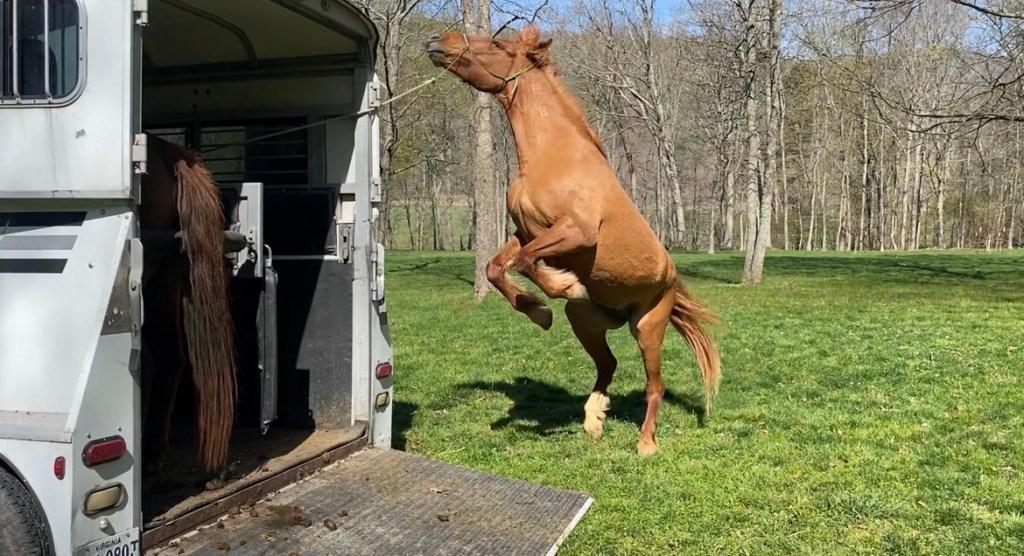
    Finally a barn move meant she had to be loaded up or left behind. I tried a larger stock trailer which was worse because of it’s unfamiliarity. In the end she loaded onto the small 2-horse we had worked on for at least a year or two. She’d had one semi-successful ride a few months back and then went backward not wanting to have to do that again… After an hour or so where she actually went under the chest bar and squeezed herself out through the front human door once (that was a terrifying moment for us all), I was able to hard wrap the lead rope to the chest bar and she stepped up to release herself and she was locked in for the short 7 minute drive up the road to her new home with the herd.

    After this I decided to try to continue the trailer work with her to solidify that experience and build on it. Wrapping the lead line to the chest bar had worked to create a scenario where she pulled against herself and could release by coming forward. Let’s try that again. As so often happens with her, you can get it done once, but she’s had a week now to consider how she might change the outcome… and she did. She put all that mustang strength into pulling and as I stood there waiting for her to come forward and be able to release her – instead she bent the metal, broke out the chest bar which gave her another 3 feet of treeline which then put her outside the trailer (NOT GOOD) and rearing up. She tried to go sideways and hung herself over the upper door hinges and now was strung like a fish and the rope around the chest bar pulled tight enough to not want to come loose either.

    My beloved sidekick Iva was watching from outside and had also been first witness to the mustang coming through the front door like toothpaste out of the tube a couple weeks before… stood calmly and said to me:

    Jaime, this is not good.

    Indeed.

    I was able to loose the rope and free the mare. I had rope burns and she was basically unharmed, shockingly no one was seriously injured- except my trailer which did go in for some repairs after this session.

    We returned to the field. I tied her to a tree while I reflected for a bit, and she stood quietly. I eventually set her loose and took a few months off to think.

    What am I missing with her? Every success so far in working with her like I would any other horse has always gone backward over time. There were periods where much was going so well with us. She’s a fine mare… big personality, athletic, balanced, smart, responsive. When things are good they are really good…

    One of my favorite riding sessions with Wyoming

    Was her purpose in life to humble me and remind me how limited I am? Show me that in fact I have much less control than I ever thought over things? Maybe every puzzle does not have a solution? What is her purpose in my life?

    I quietly reminded myself that I wanted a mustang to learn how to be a better horsewoman, and so regardless if she turned into a working riding horse or not, she is amazing at teaching me. The day I freed her from the trailer fiasco I was calm on the outside, knew to control my breathing and reaction, but deep down incredibly frustrated. In that moment I considered the term “breaking” a horse that many of us horsefolk have moved away from. And I asked myself, could I “break” this horse? and if I even thought I could… did I want to? Did I want her spirit broken if it meant I could control her? In this moment… frustrated as I was… was the closest I have ever come to wanting to break a horse’s will. And in the depth of my heart I knew… if I could do it… I would not.

    I knew that day that I wanted Wyoming to be her vibrant, wild, beautiful self and I wanted to have a relationship with her, but regardless if I ever got her on a trailer or under saddle, I did not want to break her. Because that would break something in me in the process. Something neither one of us would be able to ever recover.

    And after a couple months of down time to reset, I returned again this fall to the work… of learning how to work with this wild heart in a way that we could both live with.

  • What do you have going for you?

    What do you have going for you?

    I spent the past weekend in Colfax, NC at the Piedmont Saddle Club learning as much as I could from Joe Wolter.

    I enrolled in this clinic in February and had hoped I might take Wyoming but I knew in my heart that she was not adequately prepared for all the pieces and parts that would need to be in place for the weekend, the first of which being able to travel on the trailer without it blowing out her mind and emotional system. So it seemed when Susan Hopkins sent a note that the colt starting was cancelled due to lack of interest it was confirmation that this clinic was going to be for K and me.

    The many faces of K in ‘jail’ while at school

    Joe said many things that were not new, but timeless, through the weekend. For this post I’ll go over a few of the concepts that stuck out to me at this time.

    You’ve got to get the whole horse committed in their body to what is in the mind. There’s a difference between a horse that’s putting up with the human and one that’s committed, you can see it in the whole horse. It’s especially clear when the hind end is sticky. Many people get the front end working ok, but the hind end isn’t coming through. That’s a horse uncommitted.

    The idea of riding and working with the “whole horse” seems obvious but it really isn’t. If the horse is truly committed to working with the human their whole body works together to try. It was really interesting to me to see the couple of horses that look pretty good much of the time, then would “blow up” in a canter transition, or not lead well, or fuss about being asked to do something- these horses often had a “sticky” hind end on closer observation. Once my attention was drawn to it I could see it, but so much goes on in the head, the eyes, the ears, the neck and the shoulders that the hind end wasn’t drawing my attention. Maybe because it was doing the least in the whole picture, but that was part of the problem, the part we are focused on can be moving around or even fussing (ears pinned or mouth tight) but the hind is heavy and stuck in the movements. The horse wasn’t moving smoothly and in balance. When a horse doesn’t feel good physically (and balance is key to a horse feeling good!) they often will become sticky mentally too.

    I suppose it depends on the horse/human which of these comes first (mental or physical), but working on a horse finding balance and getting to move through all the way to the hind end can really help the horse begin to move through mentally as well. At one point Joe noted that the mare became more committed in her mind and you could see she “fixed it in her feet”. When Joe got the horse convinced that it was a good decision to commit to his request the whole horse moved more balanced through the change of direction or the leading or even a transition.

    When things aren’t working and you start to get frustrated you have to ask: what do I have going for me? Capitalize on what you do have, and then put the fun back in it.

    This idea of finding what you DO have going for you and building on it is really helpful. If we don’t feel good about what we’re doing it’s for sure the horse doesn’t either. And if the horse doesn’t feel good, what’s in it for them to be with us? And if the horse doesn’t want to be with us we have little chance of getting anywhere.

    Joe has a way of taking anything the horse offers (even if it is something most of us would consider ) and figuring out what to do with it. He said at one point, “I had to change my mindset to think: I don’t really care what happens I just want to see what happens.” It’s tricky as a human to have a clear goal (because if you don’t know the direction you’re heading you have little chance of getting anywhere) and then when the horse seems to be taking us away from our clear goal, not to think “this isn’t working” but Joe continually says: if you are getting something unexpected, or something different from what you thought you were doing… we just change the subject and I have a chance to figure something else out now. You have got to stay flexible and creative. Take what the horse is willing to give and see what can you do with that?

    I had a nagging question from working with Wyoming recently. I know the idea is to Get with the horse, so then the horse can get with you. Yet I found when trying this is real life I had concerns that when I focused on getting with Wyoming it ended up being zero leadership and no plan from me. I don’t think that feels particularly good to a horse either. My personality can see two distinct options: 1) my plan my way; 2) I have no plan– do whatever you want and I’ll tag along.

    During the clinic I wondered if I’d have an opportunity to ask how does this work? The last time I rode Wyoming I tried to direct her and that went poorly… then I tried to just sit on her and see what she’d do at which point she took over in a way I don’t think was helpful for either of us. After three days of sitting on my question and never really seeing a door to asking it I feel like Joe answered it through many of his statements over the hours of class. It’s so simple I could felt an internal facepalm.

    Take what the mare is offering to do, and MAKE IT YOUR IDEA.

    The biggest frustration I can imagine people having with this horsemanship is everything depends. Each horse is unique but there are also patterns horses get into that fall into similar tracks. At one point Joe said:

    Just present a puzzle to her. She’ll try hard to figure it out. (But) The horses that are cranky and ready for war they need you to go with them and change the pattern. The horses who are full of try can work out a puzzle so you set it up for them to find release. 

    Joe Wolter

    Some horses were already committed and interested to figure out what the human wanted to do, they were all in. For the most part this would be Khaleesi. She’s willing and she trusts me and most days she will give me all she’s got. Some horses were “cranky and ready for war” these horses for whatever reason expect to find a fight. Wyoming and I have had this dynamic in our relationship and looking back I can see evidence of what that does. I am pretty good at giving clear direction and leadership – always improving, but my personality lends itself well to these things. Early on with Wyoming I was working on clear direction and leadership and I created a war zone with Wyoming without understanding what I’d been doing.

    One of the mares who was ready for war

    This mare still needs me to get with her, take what she offers and begin to build on it as my idea. Now the whole application of that does not seem clear to me, it’s not my strong suit. I’m better naturally at pushing through, this takes much more finesse. Circling around a thing until she’s doing what I would like, in her own way, thinking it’s her idea.

    Let the horse do your thing in her way

    Joe Wolter from Ray Hunt
    She was very athletic

    I understand what I need to do, but how to do it will probably be messy and full of learning opportunities for me. The trailer loading process is coming along really well now and is stress free. I’d like to see her begin to feel comfortable enough to choose to stay on there but I’ll need to find some incentive because who wants to sit in a car for a long time without purpose? Why would she hang out on the trailer without a purpose when she could be not in confinement. I might have to find some alfalfa… I hear horses love that and if she could get that only on the trailer it might be worth it…

    What I still see cranky and ready for war is in riding. This is the place I haven’t changed her mind to see I am willing to be with her. I can saddle her pretty easily and she’ll stand for me to mount, and when I sit in the saddle she stands just fine. It’s the moment I begin to direct her things go sideways. So that will be my next steps. Experimenting with riding this winter and finding ways to take what she is willing to give and MAKE IT MY PLAN.

    After a little work she made some nice changes
    A horse must be balanced to work well. You’ve got to get all four feet underneath the horse. What happens when you pick up your reins? Is your horse preparing to position to do something or is your horse bracing and getting ready to pull against you? How sensitive are they? When do they notice you’ve picked up the reins? What is their pattern? What is your pattern? Before your horse takes a step do they get balanced so they can move in straightness? If you aren’t starting in balance you will struggle to find it, and the worst thing I can ask my horse to do is a transition when they are out of balance! Don’t ask a horse to speed up when it’s crooked. Get the horse ready to walk, ready to trot, ready to stop so they can do it in balance.

    For Khaleesi and I as a pair this was the biggest take away, and it built beautifully on the work Emily Kemp has been doing with us in her clinics this year. When Joe took a little time to work with us individually he noticed that every time I picked up my reins K turned her head to the right (I have also noticed this and wondered what to do about it). He observed my reaction was I used my left rein to suggest she get straight. He offered me an idea: don’t give her the answer, don’t use that left rein but instead hold tension on both reins equally and see if she will search for it. She did. She tried a few things and eventually she got her head and neck lined up and I released. Then he asked me to try again and when she was straight to walk her off. I did. He noticed that I’m having to ask her to walk off… this time he offered, “Let it be her idea, allow her to walk off when she’s ready” Like magic I picked up my reins the way Emily showed me, gently with smoothness, I held them both equally and she searched around for the release, when she was straight I released her into a really nice walk, and she went straight ahead like an arrow.

    Seeking straightness and balance

    I spent the following two days building on this one simple thing. I have been seeking straightness and balance for at least two solid years. Pieces have been coming together, but this clinic something really clicked for me.

    I felt it.

    Finally it seemed I could feel when her body was crooked, when weight was shifted here or there. I could pick up my reins and wait and wait (not at first, of course I had to release her for each try toward more straightness) but by the third day I’d hold there steady and she would get her neck straight but I knew her body wasn’t balanced and if I released her she would go “straight” forward but like a snake not like an arrow!

    I began to feel when I released her she would feel like an arrow heading straight forward.

    Then I began to work on walking a straight line to different points of the arena. The first day I did a little walk and trot for Joe to watch and I knew we were all over the place. By day three I began to find a few moment where she felt really balanced and straight in the walk and then ask for a trot transition and she could pick it up so smooth. At this point sometimes I could find a straight line and other times I’d have to do a lot of adjusting- but like Joe said: That’s ok! It’s an opportunity to work on getting back in line.

    K loves to be in school. She likes to solve puzzles and to learn, and I am pretty sure she really loves it when I learn because then we are better together, and we begin to move increasingly in harmony.

    I’ll close for now on these ideas with the first quote I took down on Friday morning. Something that is a great start, and a great end.

    Any living thing wants to be somewhere. What do horses want? They want enough to eat and room to move and someone to be with. I just catch the horse and then try to get him to want to be somewhere other than where they’re at then I’ll work on that. And when we get somewhere else I’ll see if I can get them to want to be somewhere other than that. If I can change their mind on one little thing- what can’t I change their mind on? 

    Joe Wolter

    I leave you with that fantastic idea…

    If I can change their mind on one little thing- what can’t I change their mind on?

  • Gates

    Gates

    Wyoming is in boarding school this month… For various reasons she is in a field by herself temporarily (about a month) and though at first it was a necessary transition, I quickly came to see it as an opportunity to spend some focused time with her while she wasn’t “on the job” with a herd. For the month of October her only friend (though she could see other horses not far across a driveway) was… me.

    I “gave up” on Wyoming in the late spring when a follow up trailer loading event went sideways and ended us both almost really injured. I had severe rope burns on my hands to remind me of the epic failure to communicate and she was temporarily hung up on a door hinge– which could not have felt good — though the wild one didn’t seem the worse for wear. One good thing about a mustang- I don’t think you can actually kill them.

    The very bad day of trailer loading practice.

    I gave the work with her a rest and began looking for ways to dig myself out of the doghouse of stupid, deaf (to horse language), untrustworthy human and spent some time dabbling in positive reinforcement. I think this was a really helpful step in our relationship. In positive reinforcement (R+) a major pillar is choice, and I began to give her total choice to work with me or walk away. I used hay pellets as a reward and she’s on massive pasture so she wasn’t starving for dried up grass. She was suspicious at first but Khaleesi helped me out by loving the classroom so much Wyoming couldn’t help but want to get involved.

    I used R+ to reintroduce the halter in the field and a new fly mask and we had a lot of fun with touching various objects and learning to learn with hay pellets this summer. I also began to get more serious about the idea of “thin slicing” my way to a desired behavior. As a goal minded person I naturally break down things into steps, however I tend to start small and then as things begin to work, I make impatient leaps. I began to see that horses- this wild red head in particular- needed a lot more small steps all the way through the process than I was willing to give her. This took A TON of time I didn’t want to admit could possibly be necessary.

    New fly mask

    One day I wanted to trim Wyoming’s feet and thought inside the barn would be easier. It’s a large roomy barn with huge doors and she had been in and out of the old barn more times than I could count, yet she would NOT enter this barn. It was this moment I began to see more clearly from her perspective. Khaleesi or Hope would enter about any barn I asked them to, depending on the space they may pause or need a smell or a look, but Wyoming was very suspicious of this space even though she had walked by the doorway to be fed for months. I found this interesting. The fact that she might be wary is understandable, but she was 100% not entering this space.

    Let me make clear a vitally important assumption: She was not “being an idiot” and she was not “acting stupid” or “refusing” for the sake of being difficult, she was not “being mare-ish”. If I believed any of these things things forward progress would be practically impossible. I know this horse is none of those things, there was a reason she would not enter that barn, and instead of slamming her through that “gate”, wisdom necessitated that I find out either why, or how to change her mind.

    In truth she didn’t have to come in, I have worked on her feet in the yard already. The barn was only marginally easier for me. This meant I had no goal that was more important than the curiosity of why this particular horse would be unable to walk inside a barn. Forgetting about her feet I began to experiment with inviting her closer, then inside and observe as she would try, focus her attention past the doorway and disappear into a deep processing time for minutes on end. I could tell she wanted to do it, she was willing, but there was something that had her convinced it was possibly a death trap or maybe a time machine in the least. I kept this simple, I asked her to stay focused on the barn entrance and only added minimal pressure if she turned her focus elsewhere, and I found over time she began trying to cross the threshold on her own.

    I think about 20 minutes went by with what seemed like zero progress but I observed a lot of deep inner processing often with her head down nose brushing the threshold, and just stood there with her curious. After probably 30 minutes she was taking a step or two in and then backing out and trying again. I think it could have been 45 minutes before she willingly walked into the barn, looked around, turned around fully to investigate and began to get comfortable.

    What fascinated me is I didn’t have to pressure her to walk in. She knew it was what I wanted even as I stood quietly occasionally gently lifting my lead rope arm. When she was ready she began doing it herself- taking steps in and then steps back out then immediately trying again until she could manage to get all four feet into the building. It was completely calm and even fun. She wasn’t panicked or stressed. I saw that if I simply gave her the time she needed to process (it seemed like eternity in comparison to other horses) she would figure it out and she would comply.

    Even more intriguing was the next day this same entrance took almost the same amount of lead time. Where I’d have thought she might pick up closer to where we left off, she spend about 20 minutes again processing the open barn door. Day 2 I might have taken 10 minutes total off the process. Day 3 still better but not by nearly as much as I would have expected. Each day was progress, but surprisingly for me how many steps back we would have to restart.

    It became perfectly clear this is how I was going to work the trailer. Only at that rate it could end up being 2 more years! The good news was I’d already given up, so two years from now is still an amazing improvement on never!

    Not long after I was able to invite her into the barn without trauma and confusion I decided to begin with the trailer. This isn’t a cavernous new barn, it was the baggage box! We have not racked up good associations with the trailer so I felt it was likely we’d be behind the zero.

    The first day over the summer of remedial trailer loading, it took an entire 90 minutes of her processing, standing outside, occasionally trying to evade to even begin to come up the ramp. After 90 minutes If I remember correctly, she came up the ramp and agreed to put her head in the trailer. In case you’ve never watched paint dry, I’m about done after 5 minutes. An hour and a half is eternity. And then I think she put on a foot or two so not even all the way on the trailer, but I was determined to see where this rabbit trail would go. Two things I observed:

    1. This was very non-stressful, she wasn’t upset at all.
    2. She was completely engaged the entire 90 minutes even if she was standing with everything still and processing for many minutes at a time, she didn’t not try to eat grass or ignore the work. She was invested.

    Over the couple of months I’ve come to appreciate the value of understanding threshold in a much more subtle way. I think everyone can appreciate the concept, and everyone who has worked with a horse probably would say of course they understand threshold, yet my guess from knowing a variety of horse folks that it probably has a different meaning to each person. I know a few people who can see the threshold from well in advance of it in very subtle signals like a tightening of the skin or a change in the jaw (and they respond accordingly- you actually get negative points for knowing subtle threshold signs and blowing by them!), and I know some people who are aware of the threshold because they are now on the ground and the horse is up a tree or gave them a kick out before running off. For some people it takes injury to the person or the horse to realize that’s where the threshold, well, where it “was” because at that point you’ve blown past it, in fact probably blown past a few of them.

    Yep, I know that person. I am her sometimes.

    Most people are probably a little like me, most of the time somewhere in the in-between. I think it’s more valuable than we give credit to- recognizing thresholds sooner and finding ways to help the horse through the gate instead of blowing through them with force until someone, or the horse, is hurt.

    Sometimes it takes this for me to stop and reconsider

    With Wyoming, and I think this isn’t completely unusual for horses, you can bust through some of the early gates with a moderate amount of force because the creatures at heart are so generous and willing. My lessons with this mare is that I’d think we were doing pretty well and finding success together and then over time it would start to go backward. I’ve begun to suspect that I missed the early “gates” and she wanted to work with me so she would try, but something wasn’t addressed properly and we would eventually come to a gate that she just couldn’t keep going with me through and then we’d come apart.

    Also I think there was a certain amount of pressure I let get to me that this mare had some kind of reasonable time line and I was so far outside of what was reasonable that I must be completely ineffective… if I would just stop playing around and push through, get it done, we’d “move forward” and I wondered if maybe that was right? Could I be wrong? Certainly. I tried it with riding her and pushed through some pretty intense rodeo action, and I tried it with the trailer which could have had us both really hurt but for the grace of God who seems to want me to learn these lessons alive to encourage someone else to maybe try a different way.

    What if we really did begin to love the process? What if we began to slow down and ask the horse: are you ok with this? and then care about the response especially if it’s “no, not really” and then what if we began to offer support and help even if it meant the only answer that would really solve the problem would be the gift of time? The most valuable thing we have… so valuable we rush through and force our horses often to get onto our timeline so we can do the things we want to do with the horses. What if we entered their world more often and really listened when they needed time to process, time to heal coming back from an injury more slowly or gradually, time to trust us, time to believe that we are actually asking, time to even answer us?

    What if we didn’t blow through the gates by force as long as we could get away with it?

    So many people I know say they enjoy the time with their horse, but when I look closer at my own behavior and I suspect I’m not alone… that really means I enjoy the time the horse does what I want her to (perform, trail ride, even get on the trailer). What my month of solo time with Wyoming brought more to the surface was that I wanted to enjoy the time I stood with her while the paint dried. I wanted to give her the gift of standing by her side when she stood on the trailer ramp for the 25th day and put her head down to process the idea of going into the box. To encourage her when she began to look around, but to allow her to decide when she’d go in, and to trust that she was giving me her best.

    Wyoming does go on the trailer now and it doesn’t take an hour, sometimes 5-10 minutes lately before she’ll put all 4 feet on. She only stands quiet for a limited time depending on how deep in she goes, and I don’t close her in yet. It’s clear to me she is not ready to be locked in. But she is very calm about the whole thing and enters and exits without stress and anxiety. She is begging to trust me again.

    I don’t know what the next steps will look like, I’m finding them as we go. But for this mare, I’m going to trust that the process will continue and someday she will ride on the trailer without the stress and fear that had her lathered in sweat that last time I got her on over a year ago. That process was a little faster but it was not nearly as honoring to her own unique thresholds and took advantage of her generosity and her try. I got it done but it only ended us up eventually backward and almost hurt.

    I hope I’m taking this lesson and applying it to my slightly easier creatures. I’ve been working on asking Khaleesi for permission for a while now and not forcing things on her even though I can. I try to balance that out with the reality that she’s a working animal that sometimes has a job to do, but I don’t use that card any more often than I have to, and if I find myself getting there too often I have to step back and ask why?

    Hope is more tricky because she’s been forced into so much over her life she doesn’t always engage in bothering to answer. She’s been trained to comply and go inside herself and shut down for survival. She has a lot of brace mentally and physically we are trying to release and free up for her. She’s starting to come out more and more and that’s a fun process to see. I love that the very easy and kind kids’ lessons are part of that story!

    It seems to me this is something that can continue to improve regardless of what level and where we are with our horses. I sense I’m getting a better feel, but I have far to go. And for anyone with multiple horses I think they have unique tells of when they are coming to a gate that isn’t free. It’s nice to have a horse that is super vocal about it, but most people don’t really want that horse! Often the cues are much more subtle.

    The next challenge becomes what to do. Horses and human both share a benefit from growth, we do want to go through the gates! However we have to find a way to support them in the growth. I think sometimes even acknowledging and letting them know you’re with them is a great start. There is no one answer that fits all, but isn’t that exactly the process we can enjoy? Getting to know this unique creature along a lifetime of communicating and experimenting and listening along with guiding or asking them to come along with us?

    Is there anything better than that?

  • Kemp Clinic August 2021… and GO!

    Kemp Clinic August 2021… and GO!

    It’s amazing that August is already coming to a close. The second clinic with Emily Kemp is already a few weeks behind and I’m only now finding a moment to update with the highlights.

    Emily gets a fun trail ride on Hope the night before the clinic.

    This clinic ran the full 5-days which is about as long as I like to go before adding some half days or days off to save my sanity and give Emily a break from the intense days she puts in here. These clinics don’t only give people tools to ride better, they seem to have a mental-emotional-spiritual component wrapped inside that makes them not only life changing on more than one front, but also somewhat intense and exhausting. In a good way!

    I have had a lion’s share of coming to face myself in the mirror of my horses over the years and it seems that clinic time is the most likely time things will surface if they’ve been shoved behind the furniture or under the sink on a normal day to day basis. I was glad that though some challenging moments presented at the clinic as people and horses worked out some inner processes— this time around my sessions with Khaleesi were smooth, overall successful and more fun than usual.

    Emily is about the most reluctant to unnecessarily stir the pot of anyone I know, so the things that surface in clinics is never because she is looking for challenge or dramatics. She does have amazing courage to help others through difficult bouts with fear, anxiety, ego, pride, too high or too low self-confidence, and various other hinderances that lurk within the horse-human relationship. Horses just don’t let us carry those things without consequence forever. There’s something in the purity of the equine spirit that refines the human weaknesses to surface- for better or worse depending on how you look at it.

    Amy & Luna have made amazing strides in their relationship!

    One highlight was seeing Griffin who has been participating in these clinics even going back before we had Emily coming, bring her daughter Skyler and her lovely gelding “Scooby”. Skyler at 8 years old was our youngest participant and she entertained us between lessons by picking wildflowers and arranging them on patient Peggy Sue as well as anyone who would sit still for her to bestow a flower crown on. Her riding is off to a great start and she has a good partner to help her along.

    Skyler and Peggy Sue

    Iva and Madison are they next young ones in line are also a joy to watch over time. Iva has been riding horses for many years and has helped out for lessons at a handful of barns before ending up working with me at Hope Horsemanship and is now part owner in Redemption’s Hope- our rescue project. Iva is doing a fine job of helping Hope expand her opinion of humans to include more positive experiences and learning about choice instead of force.

    Iva and Hope playing with steering.

    Madison is paired up with a challenging Arab gelding who has a lot of questions about life and watching her grow each clinic in her horsemanship understanding has been really fun. She isn’t taking the easy route with a horse who has matured physically past his mental-emotional capacity but never has an easy horse made a good horsewoman, so she has no choice but to grow. I love Madison’s tradition of finding heart shaped rocks in creek and river beds. She took the time this clinic to choose one for each of us- mind has a cherished spot on the mantle!

    Madison & Dimitri

    We also offered the first beginning kids horsemanship session and that was a blast!

    Fun kids session!
    Even Khaleesi agrees to help

    The biggest highlight of the clinic for me came working on balance and bend with Khaleesi. This is leading to higher levels of self-carriage and strength. Previously I have spent a few years riding from energy over aids (as much as possible) and straightness. Now the straightness is carrying onto circles with bend.

    She is beginning to use her hind end more powerfully which is really fun to engage in. I am learning how to improve supporting her without force. I’m starting to notice when her hind end and front end aren’t matching in speed or energy, and to slow down the front to match the hind. My feel for minute body changes in both of us is becoming more refined each time Emily comes and the changes made in almost imperceptible ways sent her into a deep processing pattern as she began to make changes along with my higher ability to feel us balance together. Super cool to do, probably pretty boring to watch.

    My take away concept was the idea of: And Go!

    I have been riding K through my energy for years now with increasing success. If I want her to pick up a trot I rarely have to use a physical aid, but if I change my energy from the 1-2-3-4 walk temp to a 1-2 1-2 1-2 1-2 she will almost always pick up a trot; if I put my energy to “zero” she’ll sometimes stop so abruptly I come off balance before I’ve ever touch the reins.

    Yet something I have never attempted is to create an energy shift in my body, and then hold it momentarily until I give the “And Go!” to execute.

    This is an entirely new dimension of communication for us. Instead of simple transitions now as I communicated them with my energy as I wanted them, I was giving a preparation for the transition. Previously I had the thought: I’d like to transition to a trot. Then I would bring my energy up to a trot, and as the horse sensed that happening she would pick up the trot (or if not I would add an aid to support her understanding of what I wanted). I was careful to control my energy not to be sending unwanted signals.

    Why this had never occurred to me before I’m not sure but it’s huge! Now I can take a moment to bring up the energy for a trot and then wait for it….. and when I’m ready give the and GO! This tool because key for coming into a higher level of balance because what I want when asking for the trot is to do it in balance. And another nugget I learned this clinic is that when energy leaks forward which looks like a speeding up into a transition, the balance is lost in the transition and the new gait is begun out of balance onto the forehand which is exactly what I want to change going forward.
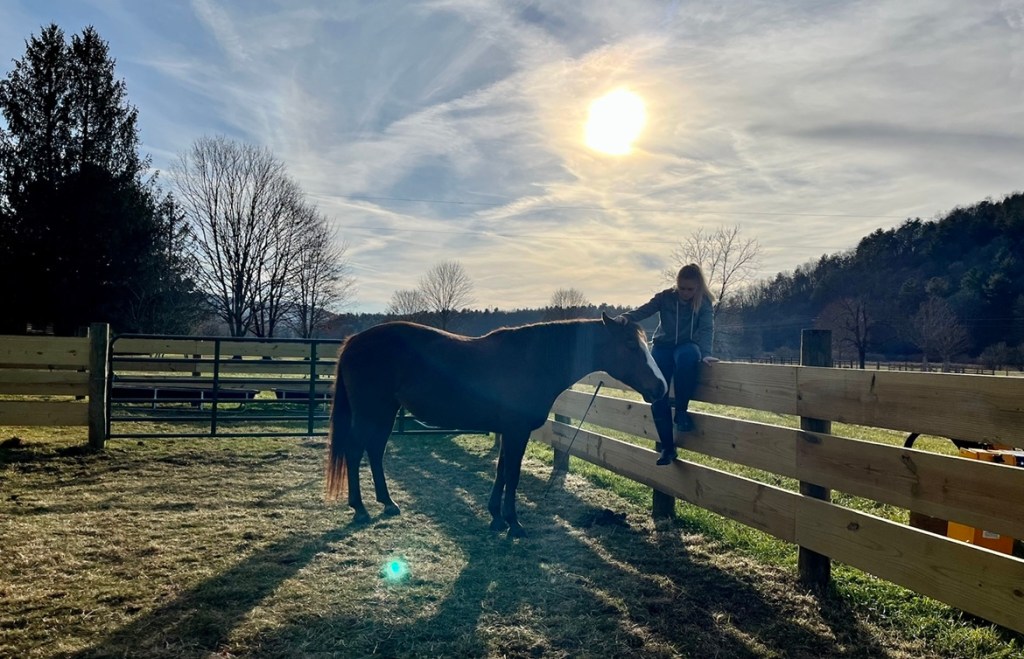
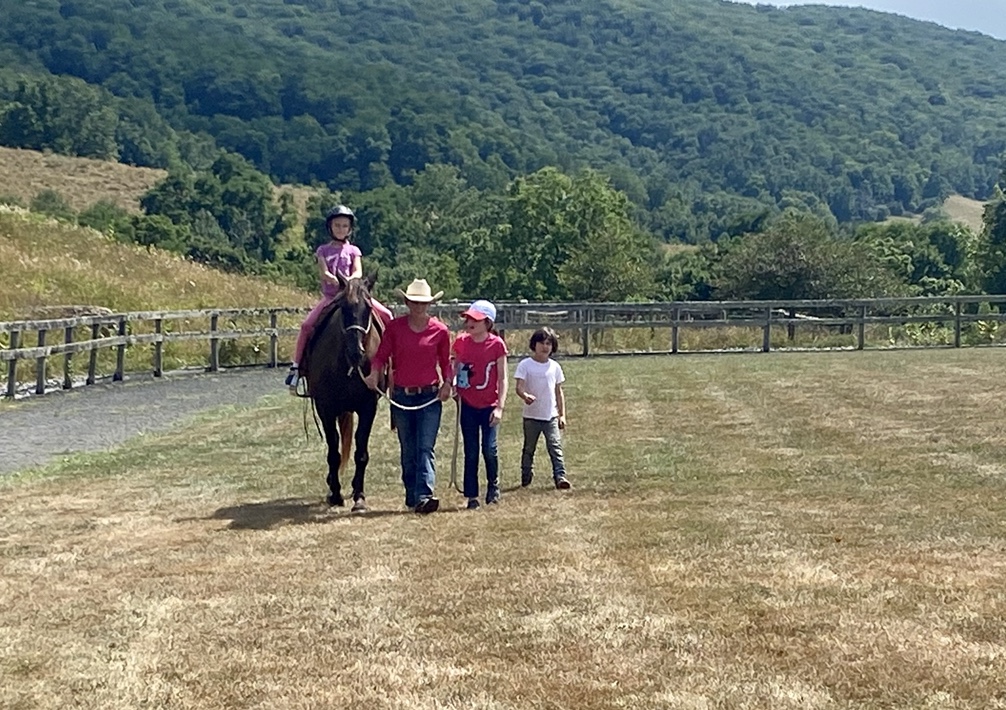
    Now as I began to work with this I would be at a walk in balance and begin to change the energy but ask her to wait for it, to prepare, and when I give the and GO then the transition is simply from a walk up into a trot without speeding up the walk in order to find the trot. This preparation gave K a moment to feel her energy build before the release of the energy which meant it could come in balance through her entire body more effectively.

    This added a layer to our previous energy-style of riding and at first she wasn’t clear on what I was doing. In the past energy up meant GO into the next gear. At first I had to use my aids to slow the “front door” by actually holding firm in my hands and not allowing her to rush forward then finding a way to translate that the energy was being released in the and GO. This I can’t fully explain how that feel came to me and it took me some time and experimentation to feel like I found a way to do it that she could understand and anticipate. When it worked she powered up into balance in the transition and it was great fun.

    When it didn’t work because of me trying to learn how to do this more effectively I would bring up the energy and shut the front door for energy leakage and she knew the energy was moving but didn’t know where to go so we danced a few times all over the arena sideways, sometimes backward and often a combination of everyway but forward as she knew she was supposed to respond somehow but I was saying not forward. What I was really saying was “hold onto it and I’ll give you the cue in just a sec” but with her dancing all over trying to sort out what to do with the energy I gave her that became tricky to execute.

    What’s been a blast is to practice this from a halt to canter. Recently she began giving me some real blast off departs off her spring loaded hind end and a few times I had to hold on and apologize as I lost balance when she gave me exactly what I asked for and I wasn’t truly prepared for what it would feel like.

    Halt to canter blast off

    I reflected that sometimes I sense this same thing happening in my own life. As I try to walk in step with God, early on I was getting pretty good at flowing with his movement and if I got the sense to move, I moved. However I have felt recently that I’m getting the message to prepare for a move. But hold on. I start dancing all around my life in every which way with ants in my pants because I know a change is coming. Now I’m beginning to see that he is being kind by telling me to get ready. It’s actually nice to have warning that things will change soon- but I have to wait to get the and GO signal. I think I’m still trying to learn what that is exactly.

    Something I would do for K when she would get bunched up and bothered trying to give me every answer she could think of when I was asking her to prepare, was to breathe out, relax slightly and rub her neck and give her the assurance: good girl, you’re just fine, thanks for paying attention- just wait one second and I’ll release you. The last thing I’d do would be to make her feel like she was wrong in her anxious response to this new level. I am always pleased when she responds with such sensitivity- even if it gets briefly counterproductive.

    I’m pretty sure God sees us in a similar way. When he begins to upgrade us to new layers of walking with him and we get anxious trying to figure out what he wants from us, I think he wants us to find some peace as he’s just asking us to prepare and be ready for the imminent release

    ….and GO!