Tag: trauma

  • Avoidance

    Avoidance

    Have you considered avoidance?

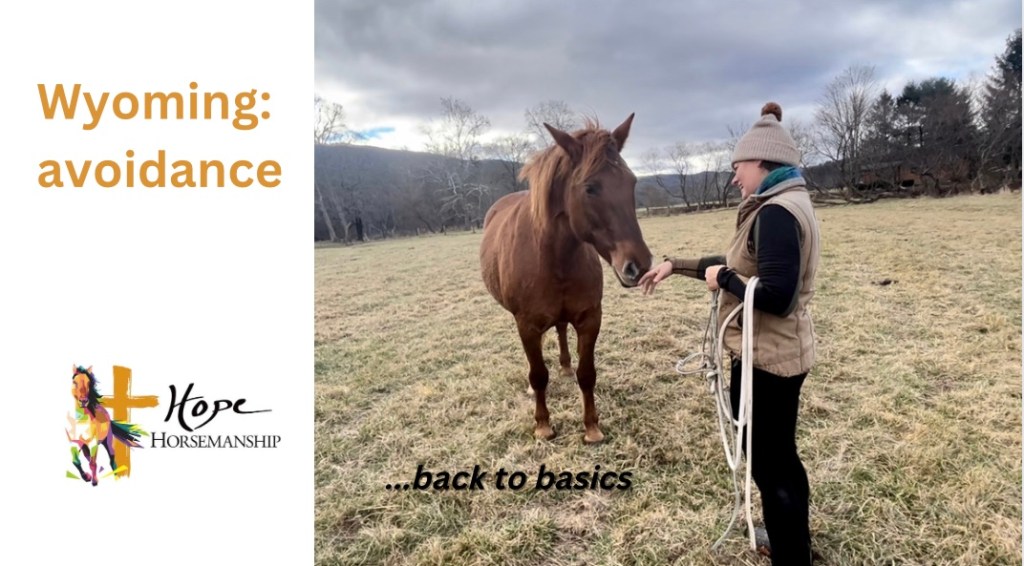
    In my somewhat “off grid” experiments with Wyoming this fall, I am changing my approach to her education away from the direct pressure paradigm and trying to lead her mind and emotions by guiding instead of driving. I am finding myself yet again back at the basics with this mare. Last winter I spent four months with complete liberty and no halter-lead rope where she had to choose to engage if we did anything. This winter I suppose we’ve stepped it up as now I find us in the step of putting the halter on and teaching her to be led.

    I had a friend take a video Monday of the process on a challenging high alert day because the farm cows were being moved around in the horse field so her environmental antennae were fully tuned and her ability to focus on me and consider being willingly restrained was very difficult. What a great opportunity to see how deep the cracks are in this trust foundation.

    What I saw in great clarity when I watched the video was avoidance. 

    In the video you can see Wyoming is not comfortable with the idea of being confined by wearing the halter attached to a lead rope. Her personality is fear based and her flight mode is easily triggered. Her freedom is her most sacred need. [Hm, they say our horses teach us about ourselves….] If she is attached to me I would interfere with her perceived need to move those feet (fast) when she feels enough worry to flip to the sympathetic nervous system and go into flight. I have come to understand more than ever for this mare to partner with a human it is going to take massive trust on a higher level than the average horse.

    When I position myself in the place I would put the halter on her, she is pressed to discomfort but not thrown over her threshold. This is an important factor in the work with her. If I break through her threshold I push her into full on flight-fight-freeze mode and we cannot do any mental work there. Note that with many horses you can work in that mode, but you are training reactions not responses and neither of you can access the horse’s brain when they are in sympathetic response mode. What I hope to find is the place where she is slightly uncomfortable because I’m pressing on that bubble but haven’t exploded it. This is where she can think and learn, and my hope is finally get some traction on progress with our partnership that is lasting.
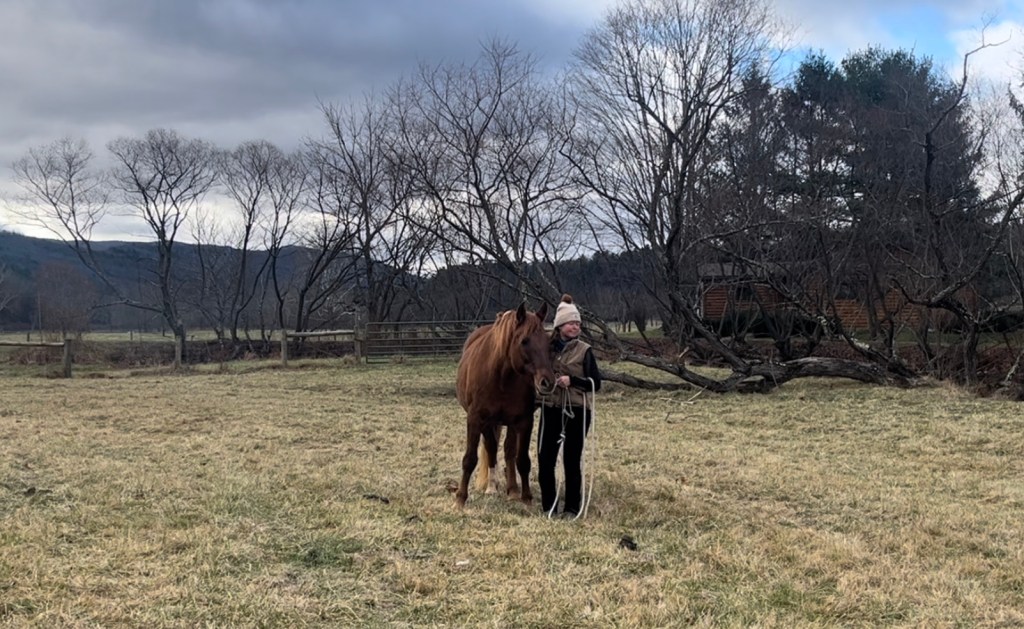
    How I know in this video that I have not gone into full flight mode is she is never attached to a tool (she has her freedom) and she doesn’t exit stage left. Still it is clear she is pressed into discomfort because she does “leave”, but in more subtle ways. 

    Avoidance.

    I knew it was happening but I saw it with more clarity from the 3rd perspective eye of the video. She didn’t want me to put the halter on and I could see this in the ways she would disconnect from being present with me. She would turn her full attention to the cows (mental). She walked a few steps away (physical). She “nipped” at me with her lips (emotional). She tried to ignore me through eating grass (how many of us have avoidance issues that turn us toward food or drink?).

    My response to these was not punishment. The goal of punishment is to change a behavior. While I am pressing on her comfort zone it only makes sense she is going to have to sort out what to do about it and telling me she is uncomfortable. I don’t want to change the behavior, I want to change her mind.

    In order to do this I will stay in the place where it’s pressing in but not exploding and make sure she knows I hear her. I let her know I hear her by not crossing the line she is most worried about. She is not uncomfortable with my presence around her body in any place. She is uncomfortable with the next step of losing her freedom to me (halter). So I stay in the conversation with her and let her know I will not force her to make the next step. This is how I build trust with her. I stay present with her exactly where she is until she can make the change mentally that she is safe with me and can relax.

    In the video I talk through the conversation I have with her as she uses various avoidance ideas to disconnect and not stay present with me in the uncomfortable place. I can tell you for sure- I can see that this mare is afraid of punishment. She is afraid of correction. I have to communicate with her so the correction is helpful and gentle while still guiding her toward a better path. If it’s too much she overreacts and goes into flight-fight. So when she “leaves” me mentally I do something to bring her back. This is part of the experimental part for me because I have to always find that sweet spot where she feels heard and led into a better place not thrown into sympathetic response mode. I wiggle my lead rope sometimes, I annoy her grazing attempts with my boot (and you can see how that works out!), I stay in step with her when she takes a few steps. 

    This kind of work takes unique understanding of each horse because there is no set answer to all horses. I would have to get much bigger to break Hope out of a shut down state and get her back to present in ways that would send Wyoming to flight. My relationship with Khaleesi is much stronger so I can do a bigger correction without her taking it as personally- she doesn’t have an unnatural response and we can move forward together more efficiently together.

    At some point the change I hope for comes and she releases the tension and worry she had been holding in her body with a big neck shake. On this particular day that is a great place to finish and I tell her thank you and walk away. I don’t pierce into the next level with the halter although the session before this (which was over a week before due to being out of town) we had put the halter on and done some leading work without worry.

    Each session I must take the horse I have and do what she can tolerate or I will create relationship damage. That is the thing I am coming to realize more and more as I “grow up” is that yes, we can go forward when we don’t have agreement and connection- but do we fully understand the damage that is caused? I wonder.

    This is the case with the humans around us as well. Some are more geared toward progress and goals and some are naturally geared toward relationship and connection. I see that both are strengths and weaknesses. Those goal-progress oriented can do a lot of damage as we believe the prize is worth it and everyone will see that eventually. We run over others mostly for their own good. And yet the relational-connection folks can get so stuck in the messy imperfect relationship questions that they don’t get the strength of relationship because they don’t press into the challenges with courage and intention.

    If I never ask anything of my horses it does not create any relationship. Asking them to do things they don’t understand or are not ready to do mentally destroys relationship opportunities.  

    I see great value in this work and will continue to experiment with it. 

    Wyoming has by far required me to understand new ways of thinking or one of us was eventually going to get really injured. Yet as she has kept me in the curious mindset (I am too stubborn to just give up on us) I am seeing an early harvest with this line of work with Khaleesi and Hope as well. Because these two are less of a challenge for every day “simple” tasks (like wearing a halter without anxiety) their changes have been deeper and exciting.

    As always, I appreciate the clarity working with these horses gives me on my own life. I have begun to see in others around me to deeper layers of questions below the surface behaviors and it helps me have more compassion and not get so focused on the “unwanted behavior” and realize it’s the deeper heart and mind cracks that are behind the behavior. I can’t always help each person depending on our relationship and connection, but I can have more freedom in my own responses and not go into sympathetic self-protection responses as quickly.

    More transformational still, it’s brought awareness to my own avoidance behavior. When am I uncomfortable and want to distract myself with “the cows over there” or trying to eat or drink (or pick up my phone to check emails and messages rather than engage a troubling situation or thought), when do I nip at those around me hoping to send them away so I can self-protect? Truly not everyone should have my full submission and trust and that must be built, but I’m certain I can do this more intentionally and made decisions instead of reactions if I slow down and try to understand why I am feeling so anxious, angry or afraid. I can sort out my own cracks and look for greater truths to strengthen with, and maybe stop some of the cycles around me of irresponsible relationship behaviors that leave people wounded and lashing out in self-protection (creating more wounds in others).

    Link to YouTube videos:

    Avoidance video

    Fear of pressure video

  • Am I Safe? (part 2)

    Am I Safe? (part 2)

    This is the continuation from Am I Safe? (Part 1).

    Mulling over some of the basic ideas I shared in part 1, I headed to the barn to experiment with Jim Masterson’s simple initial video of the bladder meridian to see what my herd had to say about it all. I have three diverse mares to explore:

    Ireland’s Khaleesi I’ve had 8 years now. She is the horse that began the grand experiment. I started her myself as a basically untouched 4-year old that was born into a herd running the western Virginia Mountains on a large property on St. Patrick’s day 2010. I wanted a horse that didn’t have much human interaction and all the mistakes in her development would be mine… I had little information and fewer tools, but I wanted to learn and grow. Boy have I gotten what I asked for. It’s had highs and lows, but the relationship between that mare and me is, if nothing else, authentic. I think that also makes it strong. I’ve been as honest as possible warts and all, and she’s had to put up with a massive learning curve. She has also been pretty honest with me and thankfully lets me know when it’s not going well on her end. If she held her thoughts to herself and just complied I would not learn as quickly.

    Every year I’m sure I write in one of my blog posts that we are finally connecting and what that tells me is there is always more- because every time I wrote it I believed it. I was sure we had come to a new level of connection. The truth as I look back is it was always right, and there are way more layers than I ever dreamed. So this year, including so much freedom, choice, and physical strength we have a lot more harmony of thought and movement and it’s a glimpse for me of the dream: that horse that feels like you’re one with when you think and she responds… and then there’s the day when she looks right at you and trots away down the trail you just finished riding and for what reason you cannot imagine decides to go back out and explore when you dropped the lead rope carrying the saddle to the truck hoping to get home before dark… or at the trot out for the vet at a ride you see an old friend and wave and find your attention snapped back when she nips at your elbow letting you know you’re not present… Regardless, we are friends and all the mess that goes along with it.

    Wyoming who I’ve had about 6 years now (who’s counting?) and have gone through many questions and confusion as to how she’s put together. I have had success with her but it always  falls apart at some point without me understanding why. She appears very physically healthy- in fact my friends and I tease nothing COULD kill that horse (not even a hand grenade) she is a tough wild BLM mare who is a little too adept at survival. However she appears to like me, and other people. She is the friendliest animal I have and loves to interact, she is unwilling to take much direction and is quick to take her toys and go home if you cross her threshold which seems to be amazingly a low one. She has been my greatest teacher. She makes me better than any other horse I’ve met so far.

    Redemption’s Hope is the rescue who has been quite sick in her second year in my care though she is on the long slow road to recovery now, she is quiet and came to me on the shut down side. She has a sweet nature and a soft eye but the lady has a vein of marble running through her and when she gets to a certain point you slam against the wall and nothing moves. 

    I purposefully brought her in to see if I could learn to help a shut down horse- one who had not been heard and had learned to cope by withdrawing and cooperating. This is a horse who (my best guess recreating from the pieces I’ve been given and physical evidence I’ve accumulated) probably tried hard to do what she was asked and was trained with pressure to some degree (like most horses today). She had trainers, owners, or handlers who did not realize they were causing her confusion, stress or pain mentally and physically. She likely didn’t have a real choice, the double-blind I mentioned in part 1 (comply or become more uncomfortable, where comply might have been physically painful, physically awkward, or confusing and unclear), so she began to learn to react rather than respond, to seek release instead of follow a feel or invitation, her right to think was taken away as was her right to communicate that she was confused or hurting. She shut down and seemed like a respectful obedient horse. She had all the signs of being that fabulous natured horse we all want for our kids to ride, until she really couldn’t anymore and then she’d dig in her heels and unable to continue finally say no until it looked like bucking and rearing. She was likely sold early on as a problem or injured horse, discarded to rescue, then returned twice to rescue (this I was told), picked up by a teaching stable operation, and failed out of teaching with two different instructors. Then abandoned to a field where the new owner hoped to figure out what to do with her at some point- glad to sell her to me for a song to have one less mouth to feed.

    My definition of a shut down horse.


    I began the Masterson experiment with Khaleesi because we have the most solid relationship and I should get an honest read from her. She is like my baseline case. True enough, I found his method of watching for reaction as I traced my fingers down her line seemed to work as he said it would. She didn’t have a lot going on but occasionally would have a reaction/tension spot and if I waited there she would respond with a release usually in a working of her jaw and tongue occasionally in a neck shake or deep sigh. 

    I did shorter pieces of the work with Hope and found her resistant at first in the way of being distracted and fidgety, but when she began to figure out what I was doing- and that it was helping her not expecting something of her that she couldn’t understand – she began to get still and engage in the process. 

    Hope was so sick physically in the late spring that I am certain if I didn’t get her to True North Vetrinarian Services I would have been digging a hole for her. I had routine standard vets look at her the summer and fall before as I observed issues that I knew weren’t quite right, but the standard vet answers of antibiotics some chiropractic adjustments didn’t address the healing of the root causes and the effects of them always wore off. True North does functional integrative veterinary care and Hope ended up staying with Dr. Hancock for a month (this was not our initial plan!) as they peeled back the layers to get to the roots and help her.

    She has been home three months and it’s a long road but she is improving. She came home after many sessions of osteopathic body work done slowly as her body could handle it, and many blood tests and radiographs to rule out diseases and injury, and ended up needing a dental adjustment to release pressure in her sinus cavity that was causing a constant low grade abscess. Right now her body is in much better shape except chest area is still holding deep hard tension —- gradually I see it releasing. When I began to do some of the Masterson work with her I was a bit surprised to find so much releasing around her hind end and less in the neck/shoulders. But she did seem to enjoy the process and even stopped eating grass to participate. She gave many release moments and I could see a change in her movement later that day when she trotted around the field with the herd in a more relaxed gait. She is also walking more fluidly as I do this work on her little by little. 

    I think Hope has come to trust that she is in a safe place and that I am here to help her. I hope that she has released the worst of the root damage in her physical and emotional system and is now on the road to healing and becoming truly better for it.

    It was Wyoming that had me the most intrigued.


    One morning I went into Wyoming’s stall while the herd was hanging in the barn in a relaxed way. I gave her a rub and told her what I was going to do and began at the poll like I had seen and didn’t get very far before I saw her eye blink a few times. So I made a note of the spot and moved my fingers lightly back up to see if that was coincidence, flies, or that spot would have the same reaction. I saw exactly the same eye blinking when I got to that spot. There was something going on there.

    In this method you only need observation and patience. First get good at observing very subtle reactions from the horse, then be prepared to wait with a very light touch calling attention to the place the tension is being held, if anything lighten the touch releasing your own energy to encourage the horse to let that tension go. When they release the protective tension they allow their body more into alignment which will enable the horse to move more freely.

    So I gently let a breath out, waited in the spot and whispered almost to myself: It’s ok, you can let that go whatever it is…

    This is where Khaleesi and Hope would have yawned, breathed out, shaken her neck or some sort of relaxing movement to release tension. So I waited for something to happen. But instead she stood quietly but not exactly relaxed. Her lips and eye looked tight.

    Then she moved her lips but it was not a release, it was more to make a kind of nipping in my general direction: I’m not comfortable with this, whatever it is…

    So I got softer, breathed out and whispered so my intent was clear: It’s ok, I’ll stay with you, you can let this go now.

    Again she stood still but not soft. We both waited, I tried softening my gaze and also looking other places to leave her feeling the least pressure possible. Then I saw her ears begin to pull back and she bared her teeth in my direction clearing telling me: I said I AM NOT comfortable with whatever it is you’re doing.

    There was no misunderstanding in this. She was saying NO and she was getting louder.

    Because I have been offering real choice and freedom whenever I can, I set aside my goal of getting Wyoming to release her tension and/or trauma and I stepped back and gave her a friendly rub and told her: Ok, you don’t have to do this now, but I’m telling you, you can. It’s safe here. I am here to help you. When you’re ready.

    I left her stall and went into Khaleesi’s and noticed Wyoming had turned away from toward the wall and was snaking her head in interesting angles and yawning- working her jaw in all kinds of ways. She was releasing or processing something over there way outside the normal. I don’t know that she was releasing that tension I brought her attention to. I think it’s more likely that she was processing the unexpected response I gave her when she said No thank you to my healing plan. It might have been both. I know that I did the right thing for her in the moment- I honored her prerogative to choose not to let that tension go and find more healing. I did not force or even press the issue, especially not telling myself it was for her own good. I walked away.

    It seemed abundantly clear to me she did not feel safe to do that healing work with me in that moment.

    As I left that barn that morning it was like additional lights pinging to create dots in a constellation that finally began to take recognizable shape. Wyoming has been a mystery to me- and she still is. I am far from ready to share my brilliant understanding of the neuroscience of healing of trauma. However the fact that all the good horsemanship I’ve studied to help us become more successful has only worked between us for a time and then gone backward and unraveled every time has been confounding. 

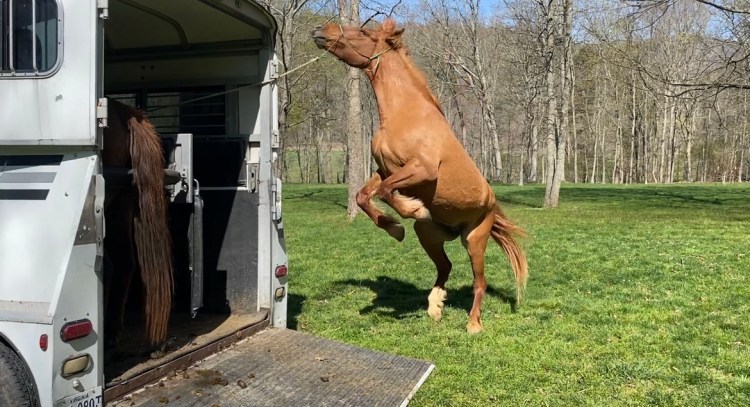
    I’ve had some truly stunning moments of riding this powerful mare — stunning in her balance and grace under saddle, stunning in her athleticism to buck and dance in protest, and less stunning as I stood next to her on trail in confusion as she laid down and tried to roll in a pile of leaves (she got so good at this I’d barely have time to jump off before she was on the ground!). I have video of her running with me around an obstacle course at complete liberty and I’ve had her threaten me violence for asking for some simple circles and figure 8s. I’ve gotten her to ride on the trailer – twice in 6 years and also had her almost kill us both trying to do loading practice last year. I’ve looked at our experience together and wondered if I am simply a terrible horsewoman or if she might be demon possessed.

    At this point, I’ve accepted that Wyoming is atypical and is not here at the moment to be a trail riding companion, but is excellent at her job if she was sent to teach me patience, humility, a higher level of observation and response, and make me laugh – at myself and her. For all the danger we have gotten into over the years with her willingness to try and then zero to sixty in a millisecond emotional threshold responses, the thing that has kept me from turning her into dogfood (in a manner of speaking) is that she apparently likes me, and she is both the most difficult horse I’ve yet come across in my limited experience and also the most friendly with me and other humans. She is not actively plotting to kill me, but she comes to a place of survival where she cannot think rationally. On the flip side, she is everyone’s favorite in the herd and she’s never met a stranger.

    So this interaction of Masterson’s technique revealed to me something in her poll-neck area she was holding tension and refused to allow me to be a part of that release process gave me another clue: she does not feel safe to be that vulnerable with me- even today.

    I have had this horse for 6 years, and I have always done my best with what I have known at the time to create a safe place that took her needs into account. I have learned a whole lot in those 6 years to know that early on I missed a lot of things I understand differently today. So it wasn’t six years of heaven for her, however I have had Khaleesi for 8 years and was the same person Wyoming had to work with. Though it’s completely clear to me that doing my best until recently was actually falling short of the horsewoman I hope to be next year, Khaleesi has been able to shift with me and I’ve seen her bloom in the atmosphere I’ve learned to cultivate in the past year and season while Wyoming is still stuck.

    The question isn’t as much is Wyoming safe as it is does she FEEL safe

    I walked away with a new clarity that she likes me and she is willing to try, but what I saw the last time I tried to push my way through with the trailer loading debacle is that she will try and try and try and then comes a point where she is past her safe zone and then survival kicks in and as a wild horse it becomes life or death regardless of if she likes me or not- we both might get killed because she is not responding she is now reacting. The lizard brain of fight-flight-freeze has taken over and we are way past freeze.

    It was that day after the trailer incident that I made the decision not to listen to the people who told me I was just not getting it done with her and she needed to see it would be ok if I just put enough pressure on her and forced her to comply. From now on I knew with Wyoming, we were going to have to honor her emotional threshold and I was going to have to get a whole lot better at reading the very early signs, and this mare was going to have to go at the speed of what she felt she could do without fear. Which it turns out seems to be not all that much…

    The potential was high that this horse could have deeper emotional trauma layers both from my ignorance and from her previous experiences being wild (there are plenty of trauma opportunities in the wild), rounded up, penned up, and then transferred around for the mustang makeover program, which she failed out of due to an injury, resulting in her ending up with a TIP (trainer incentive program) to get her gentled and started in TN before I adopted her and relocated her to VA. You can imagine plenty of opportunties for trama in this mare’s life.

    If she has never felt safe to release the deeper things and allow her nervous system to rest and heal, it would make sense to me she would try to assimilate and get so far and then failure would set in when she couldn’t hold it together. It really was like watching her come apart on me. In fairness she would give me clues she was not doing ok, but they are subtle and as a human I would think they were small so we could handle that. Over time I’ve come to see it’s best not to blow by the small signs because trouble would be ahead when they got bigger in exponential fashion. The worry cup was filling up… and eventually it runneth over!

    And yet this horse still looks to me as her friend, she still comes to me for help if she’s in trouble, and she knows I am here to make things better. So the question I had to ask is:

    What can I do to help her feel safe enough to heal?

    And that maybe I can wrap up in a part 3…

    Read part 3 here…