I’m experimenting with a few new things this fall as we move toward a new season next year—one that will bring some fresh HH activities and adventures.
You, my subscribers, are truly my HH family, so I want to share some of these early tests with you first!
One change I’m making is a shift in my YouTube channel. I’ll be adding a few different types of videos—ones that I hope will reach a wider audience and offer practical ideas for finding your own horsemanship path.
The first few videos will focus on some of the core concepts that have shaped my work with horses over the past few years. I plan to follow those with example videos that show those ideas in action.
To be honest, I don’t know yet how helpful this new approach will be—especially breaking the teaching into two parts (the concept and then the application). And of course, trying new things always comes with a learning curve! These early videos won’t be perfect in form or presentation.
But as I was reminded yesterday, “perfect is the enemy of good.” Sometimes you just have to be willing to publish, learn, and grow as you go.
So, thank you in advance for watching as these new videos roll out. If you find any of them helpful—or know someone who might—please share them! It really helps the channel. And if you have feedback or ideas, I’m all ears. There’s definitely plenty of room for growth.
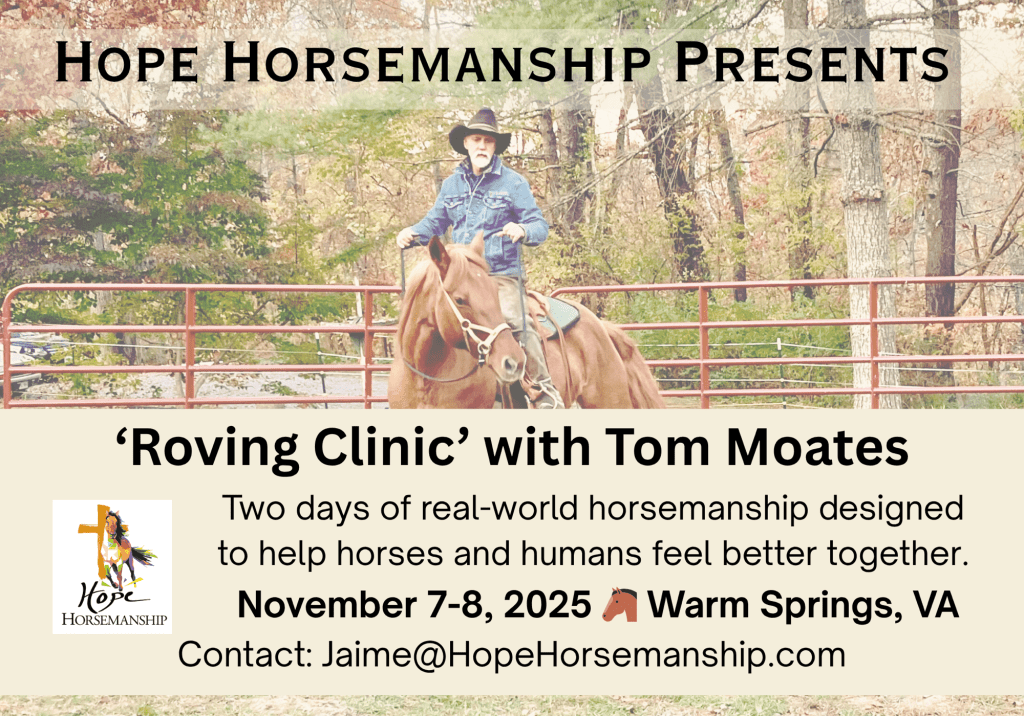
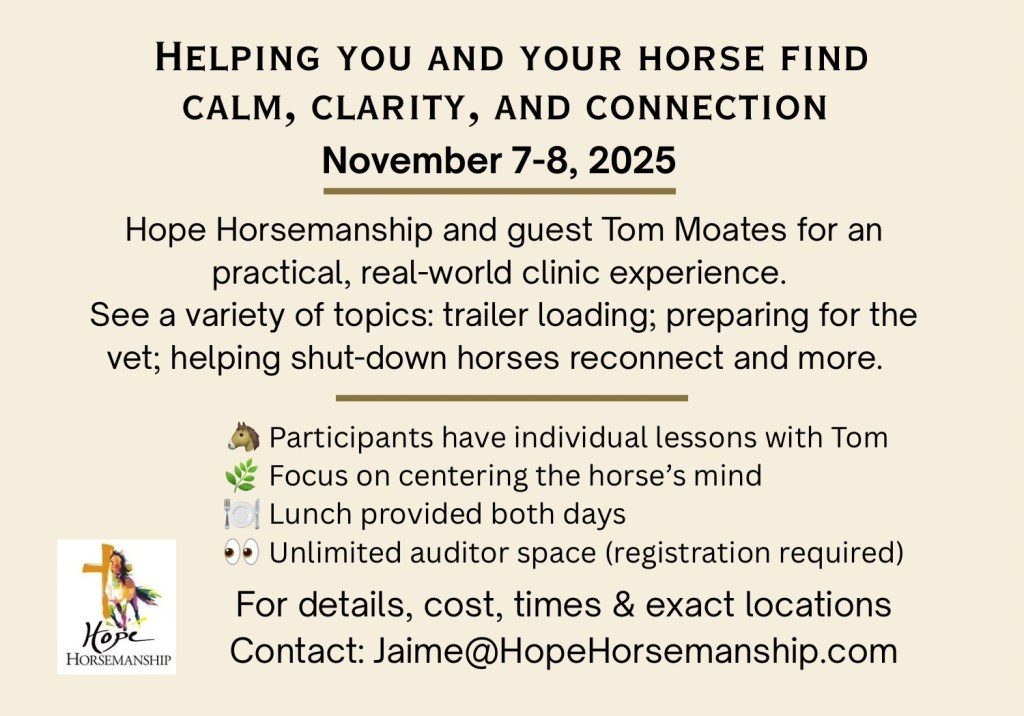
Finally, we’re getting ready for the last Tom Moates Roving Clinic of 2025, coming up November 7–8 in Warm Springs, VA. It’s always a fun weekend with a wide variety of horse work among friends.
Participant spots are currently full, but I can put you on a waitlist if you’d like to bring a horse. There’s also lots of room for auditors, and it’s a great way to learn and be part of the experience.
Hope to see you soon—and thanks, as always, for being part of this journey.
If you don’t have something working really well in ideal conditions, you don’t have much hope of them working out in adverse conditions…
I’ve heard Harry Whitney remind people of this as a fundamental answer to various questions they ask about trouble spots with their horses. It pairs well with another quote, which was my own take home from two days in June watching him at Mendin Fences (TN):
In my experience, most people don’t know what it looks and feels like to have a horse truly mentally centered and present with you, and so most people don’t really get there, and this is a reason many people can’t seem to get a real change come through. The horse was never really centered up and present.
It’s been a priority to address Wyoming’s mental centeredness since I’d met Tom Moates early last year. Tom has been learning from Harry for years, and attention to the horse’s mind is a central focus for him as well. This doesn’t mean I’ve been successful it. We’ve made some significant strides in helping her become more relaxed, less angry, and significantly more cooperative than the other approaches I’ve tried over years. Yet I sensed a trouble in her that I had not gotten to the other side of, even as of this summer and the clinic we hosted in July.
Harry Whitney, Wyoming & Jaime in Floyd VA, August 2024
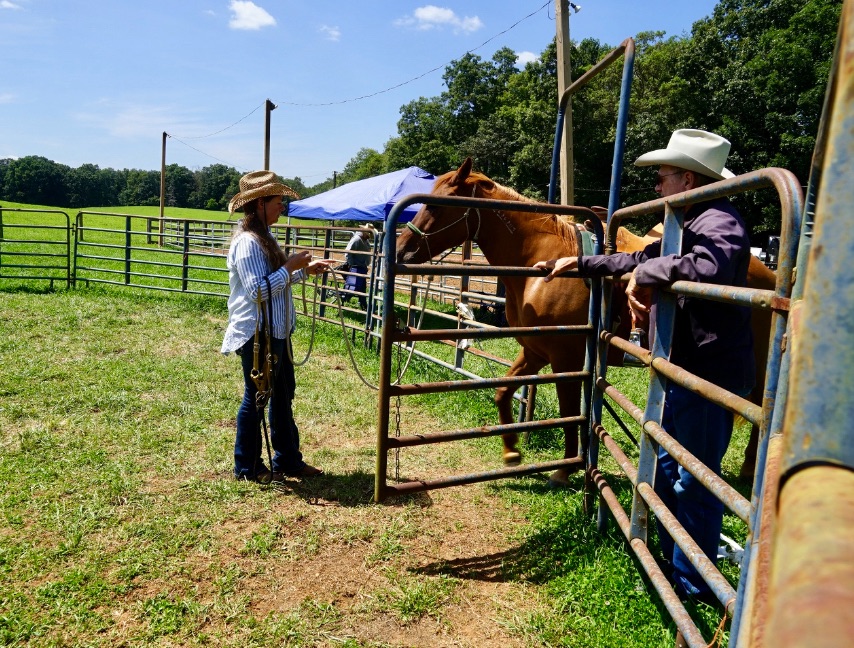
In mid-August, during Harry’s five-day clinic in Floyd (hosted by Tom), the question came to each participant: what is it you most hope to address this week with your horse?
I had one request: show me what it looks like to get Wyoming mentally centered and present.
Harry was willing to guide us through this, and on day one, our lesson hour was spent, from the field to the work space, on learning what she looks like when she is fully present and how to require that she make that a way of life for now.
Additionally, my job was to make the times she was present and relaxed as sweet as possible. This is the place that feels good. At first, any time I asked for her attention, she would start throwing out options I might ask her for, like walking a circle. It was as if she had a hard time believing I could ask for her to be relaxed, ready, and present and then just breathe a moment and find peace in that space. Probably I don’t find as much peace with these creatures as I could, and a change here will serve us both. This was all we did.
Harry & Wyoming finding a sweet spot with her mind present.
At the end of our session that day, Harry suggested I take her all the way back to her paddock walking backward and not taking a step she wasn’t “with me.” It took a lot for me to stay that present and focused.
It took a lot of focus on day one to walk backward to the gate connected at every step to release Wyoming from class. But I was committed to the process. Harry helped me to be able to see when she was present, and bring her back when she wasn’t. The entire week I did not take a step without expecting she would come back to being mentally centered. This is not to be confused with being “hyper focused” on the human at every second for fear of punishment. There are training methods where a horse is ambushed or punished for looking around. Though I use a flag for some of this work, it is built around creating an indirect distraction or sound or movement that draws the attention back to me. The key difference is intention: the actions is not at her – not a threat toward her. I need to become more important or interesting than the other distractions. Working with Harry, we don’t use fear or force as a motivating factor. Doing this takes a shift in thinking.
Once this becomes a way of life, the horse can look around and notice the environment because they have learned to quickly make note, let it go, and return to the place of peace which is back mentally centered with the human in the work. It is part of learning to let go of a thought that doesn’t serve the horse.
Wyoming is a highly sensitive horse that has her attention split, keeping everything around her in check in order to survive each day. When she is distracted keeping tabs on everything within five miles, she can throw out autopilot training moves, but she cannot stay present in the active conversation I want to have with her. I don’t want push button autopilot. This has not served us at all. I want actual communication, in real time, addressing the present moment we are in. In order to do this she has to let go of the other things and stay with me. As Harry helped us make this a reality, secondary issues began to dissolve on their own.
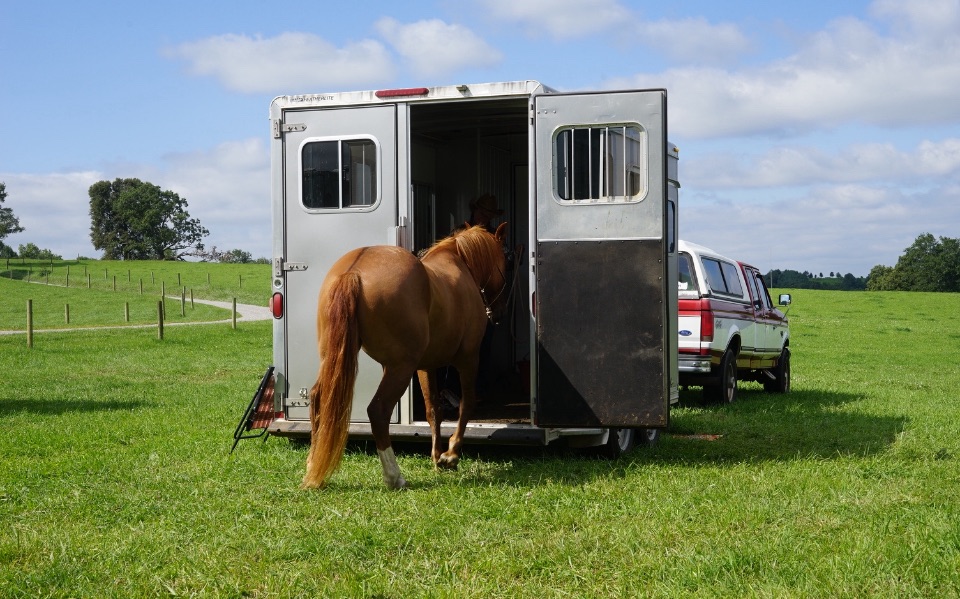
During the week we addressed some different challenges I had been working on. We loaded her onto a trailer that was darker and had a step up entrance (instead of a ramp).
Borrowing a strange trailer
I worked on “knot work”- addressing the claustrophobia from early halter trauma that’s been present in some form the entire time I’ve had her. The day we explored knot work, I expected to see at least some extreme reaction to the halter, but it simply never came.
Knot work
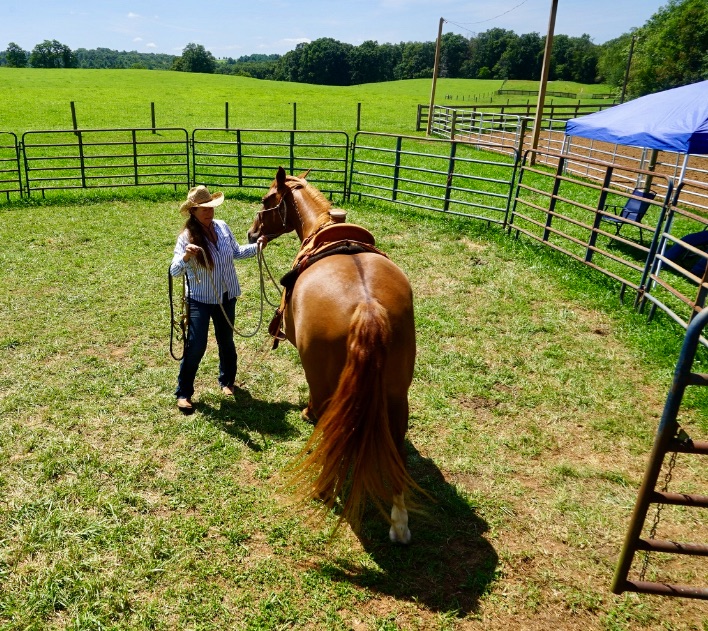
I rode her in the round pen; I’d had trouble in the past getting a forward thought to walk on without driving her. We came up against a little drama here, but worked through it in short order, and had a nice shift in riding as well.
Finally I felt a shift that seemed a significant change and I’ve continued this work at home. If this mare is not mentally present or centered up things do not go well. She gets annoyed at having her thoughts interrupted when she’s concerned about other things. Sometimes she still gets dramatic when she shares her feelings about her own ideas being interrupted or blocked. When she is mentally centered she is like the wonder horse I’ve always wanted. She is soft, adjustable, responsive, and willing.
I’ve been riding her at home in my round pen, enjoying great sessions where we are building like one would a green colt, forward, steering, stopping and backing.
I am trying to start this journey in as ideal conditions as possible. I continued to prioritize mental connection. I can put on the halter without fuss, load her on the trailer, and ride her in the pen. Each day more positive experiences and progress. Last week, Matt and I took her on a solo adventure, loading her on the trailer for a short drive to our local recreation area. We unloaded her, took a walk, then loaded her and returned home. It was a great success.
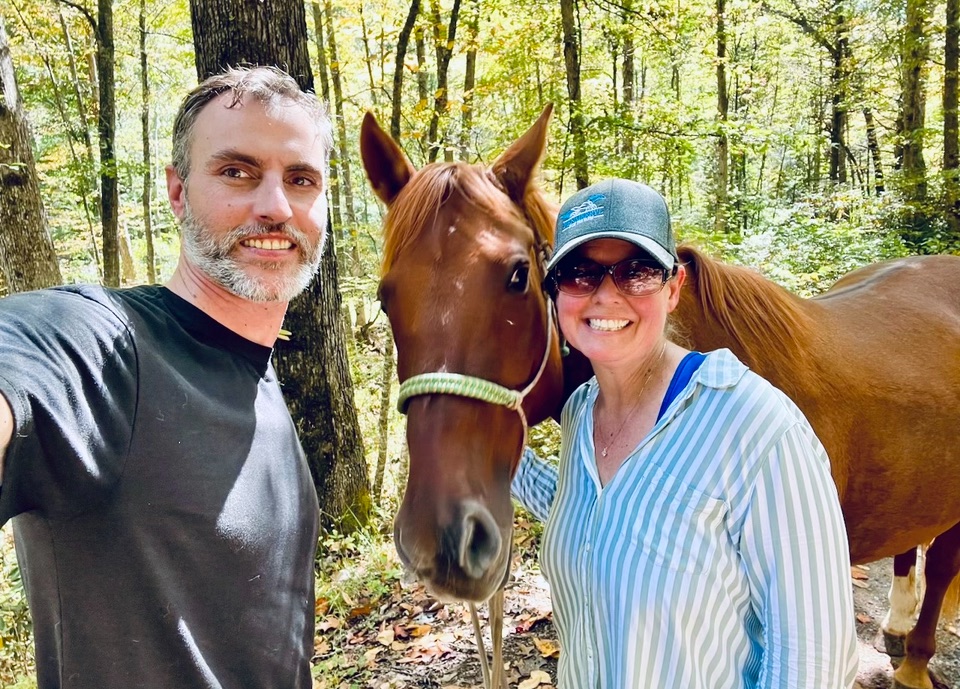
Matt, Wyoming & Jaime have a successful adventure
My next plan was to bring her to visit my farrier for Khaleesi’s shoe visit on Friday. I want to keep building on experience a real horse can have and farrier visit seemed a great next step to me. I trim Wyoming’s feet myself, and if we were able to get some trim work done or not was not important. Simply the experience of going on the trip successfully was the goal. Keep it simple.
What I did not account for was hurricane Helene.
Adverse conditions.
First, Hurricane Helene turned tropical storm was making her way through the South and though we never had the destructive storms, we had almost 2” of rain and gusty winds. All this boils down to prey animals on high alert. The mares were spring loaded by the time to get going came.
Second, the weather was crummy enough that though I was minimally willing to do what seemed necessary to have this adventure, I was less willing to go out early enough to assess her mental state, and intervene to find a working mindset before even considering loading. I gravely underestimated the effect of these adverse conditions. I might normally have planned a few minutes to shape this up… What I really needed in these conditions (in hindsight) was an hour of focus… and still, it might not have brought success.
Third, we had a soft deadline. I highly value my farrier and drive an hour over the mountain to haul to him. He was at home, and happened to be flexible. Still, night would fall at some point, and though I had a time window, it wasn’t endless. Time restrictions always feel like pressure. Pressure brings fear of failure which often makes for poor decisions.
To make a painfully long story shorter, Matt and I did the things that were successful in the past for about an hour. Over that time I watched the stubborn mare I used to know show up stronger to the forefront and dig in her heels. The more we insisted she join us with the trailer plan the more she resisted.
I made a pretty good mess of it as I became desperate to get it done. Matt was a phenomenal help, and he never got frustrated though things were not going well. When our best efforts and closest moments dissolved into escapes off the ramp in panic, I saw I was doing more harm than good and creating problems I was going to have to fix. I knew the frustration I kept at bay was getting closer to the surface, and I knew that would only make things even worse.
I made one good decision to set aside my own stubbornness. I made the call to abort the mission, put her back in the lot, and take the horse who needed shoes before we had to abandon altogether. Wyoming did not have to make this trip.
It was hard not to consider this admitting defeat and total failure. Because that’s exactly what it felt like, and I am not one to admit defeat easily. I told myself years ago I would NOT allow work with my horses to become a win-lose scenario. I am not in this to make my horses into losers. How I want to function is a growth model, and it’s a long journey. I was recently reminded by Adam Grant in his book Hidden Potential:
though straight line growth feels faster in the short term, it’s been proven many times that growth curves and loops are the only way to get farther over the long term.
For a straight line thinker I have to remind myself of this intentionally, often.
The mare was not with me, and we were way too deep in adverse conditions to swim out- especially considering it wasn’t necessary. Hopefully this was a loop in the long term trajectory that would carry us farther than my preferred straight lines of success ever would.
My biggest miscalculation was to think I could get her out of the field after a half day of being jacked up by her environment, and then load her as if we had already mastered this because we had a few successful trips in ideal conditions. If I would have stopped to ask myself if she was mentally centered up sooner it would have been obvious that she was not. For some reason I thought I could overcome this deficiency by sheer willpower. Strangely enough eight years of trying to overcome her inattentive mind to get her to do anything never worked. Why I thought I could revert to my old ways and get a different outcome is… mostly embarrassing.
After over thirty minutes of this idiocy, I saw it clearly. I realized she was minimally mentally present and that was my biggest problem. She wasn’t running me over or creating a danger and so I accepted it as good enough- but she was still highly distracted. After starting the process and getting very poor results I took her away from the rig to address her mental connection.
This was the most challenge I’ve ever had getting big enough for her to let go of every outside distraction a stormy day could bring. She would look at me and immediately avert her eyes, head, neck or even her body, to a sound or rustle or leaf in the air. To her this was survival and self-preservation. I couldn’t keep her mind for more than two seconds at a time. I worked very hard to get very big and very loud and very active and I could get maybe five seconds. If so I would take a few steps do it again and get a few seconds and take a few steps. In this mode I got her all the way onto the trailer, but as soon as matt touched the butt bar she would explode off because even though I could get her body on, her mind had not settled there.
It was a lost cause. I might have stopped after I realized she was not capable of staying present, and I should have realized that within five-ten minutes. I could have asked that question sooner and I might have realized that I was into depths we could not swim successfully. Possibly if I’d have addressed the mental state better in the first few minutes I might have had a chance. I don’t know.
As always there are the growth opportunities. I get to experience once again as a reminder what many people I care about are also experiencing when they get some momentum with their horses and then skip over – sometimes purposely and sometimes without realizing it- to the deep end and get into a bad situation. Not only is it humbling for me to hit a place I cannot overcome in one fell swoop, it’s good for me to have to experience what people around me are going through. I am willing to go through challenges in order to learn things that might be able to help others. And so as James tells us in his letter: Count it all joy when you meet trials of various kinds! For you know the testing produces steadfastness, and let this have its full effect that you may be complete, lacking in nothing!
Also, it reveals to me me the dark, stubborn, frustrated part of me I hope to identify and eradicate. If I could have done so, I would have picked up that horse, hog tied her into that stall, and forced her on the journey. At some point I lost most of my compassion for her and the real sense of threat and pressure she felt.
Working in ideal conditions
In ideal conditions I have grown so much! I have tons of patience and empathy for what the horse thinks and feels. I can say I am here to help you and mean it. When the conditions squeeze me, what comes out? Eventually frustration and the desire to beat her with my flag until she complied by force, broken mind and broken will. I did not go there, but it was because I know that doesn’t work- not because of my stunning maturity and grace. It’s good to be reminded of the garbage that remains in the darkest corners that still need cleaning out. Lord help me, and thank you for exposing it without me acting on it.
Something encouraging I considered in my personal debrief: this mare has a history of going to fight mode unusually quickly. She has threatened violence when she feels treated unfairly, with punishment or force. Friday, her stubborn will engaged, refusing to be loaded on the trailer, however, she never threatened with dragon ears, rearing, or nipping. She refused, but she didn’t fight.
In the end, the conditions didn’t seem adverse enough to me to create this trial. I was wrong. Also, I had thought that our ideal conditions work was going well and it was. But I’ve learned from Harry that me, and many of us who are pursuing excellence and a higher working connection, are not aware enough yet of the subtleties in the ideal conditions that his eye would be. I can hear him say: you’d better get that working better because it won’t hold when things get adverse. The same as he has observed: most people don’t know what it looks and feels like for a horse to be fully present and truly mentally centered.
Practicing going forward and back through the gate keeping her present each step.
It seems many of us have to feel in mortal danger before we dig into what seems good enough. Apparently, for each person, there is a different threshold for working good enough. All foundations have a certain amount of weakness. Will it result in a tragic wreck or only sub-standard performance? It probably will depend in part on what kind of conditions you face. For Khaleesi, these adverse conditions were not a huge deal, for Wyoming they were a deal breaker. I want to be someone who digs deeper even when things are not downright scary and grow even when things seem good enough.
Harry… the ‘Coast Guard’ Whitney
I still having a long way to go. This means more time in the ideal to expose foundational cracks and more gradual steps into incremental adversity so the cracks are patched up before being totally overwhelmed beyond hope without a rescue effort from the coast guard. Someday I hope to see morelike Harry. Because of his experience and attention to details, time for him is shorter in the shallow end, and he has more tools and experience in the deep end- I suppose in some ways Harry is the coast guard.
Today I am grateful that horses have memories and experiences, yet they also shift quickly with their experiences. I am pretty sure I caused problems I’ll have to fix, but if I show up fresh the next day, I believe she will as well, and if I bring my A game she will respond. Nothing is beyond repair, even though repairing damage I’ve caused isn’t a good way to proceed.
Epilogue.
The following day we had a break in the rain and I spent some time with Wyoming to assess the damage. She was more difficult to halter in the field, but once I had her on line she came with willing softness and keeping her attention centered was easier in the calm sunny afternoon. I struggled to load her as easily as previous, but Matt had been watching and asked if he could try. It took some communication and patience, but he was able to load her twice fully on where she felt relaxed and calm. We did not close the bar, but took the progress and moved on.
Matt and Wyoming regroup after the storm
Matt then kept her attention and held the rope while I attended to her feet which did need a trim. She did so well we also put on her saddle and did some work in the round pen. All of this went well and Matt took the lead (literally) on much of it. He has a grace and patience for that mare I sometimes struggle with, and she responds well to it.
Yes there are some setbacks, there was a price from the poor choices and miscalculations I made, but these things will pass, the growth will continue in loops and curves. As always… Hope continues.
Last year I spent some time with Harry Whitney, read some books by Tom Moates– and invited him to come visit with us here in the mountains, and listened to a fair amount of Mark Langley‘s podcast. I was steeping myself in this way of considering the horse that was a fundamental shift in my approach as much as possible.
I had some nice changes with Khaleesi over the year that I’m loving watching take root into an early harvest this Spring. As we prepare for some events this year, I can feel her new levels of relaxation and adjustability in movement! However Wyoming and I had a rougher go of the changes and trying to sort out how to understand each other in a better way. Last summer there were a fair amount of death threats (probably from each of us) as the lines of muddled communication began to untangle, and sometimes things get looking worse before they begin to smooth out.
Regardless, I knew there was something important in the process so I kept at it.
Then the horses moved home in November which has been a big change for all of us that is settling in nicely now six months into it… and I’ve begun to spend some time working with them again.
The initial work with Wyoming this year has been promising, and in the subsequent sessions, I’ve seen continued progress toward more partnership. Certainly the difference rests mostly in me. Change is possible, but it has to begin with “me” because usually the horse is a perfectly good horse doing what horses are created to do, and usually what the exhibit is in response to the way their environment (mostly human caused) has shaped in them. So regardless of who that human (or humans) were and what it was that did the shaping- that’s not nearly as important as where to go next. The change has been happening in me as I continue to seek and grow and take an honest assessment of my flaws and weaknesses in order to commit to address them.
I’m encouraged by the start of this year, and it gives me hope that there really is change possible for the two of us. I have a sliver of excitement that maybe this could be “the year” for Wyoming and me to begin to function together in a positive way!
Change is possible, but it has to begin with “me”
People have mentioned lately that staying with this dysfunctional situation for over six years must mean I have a whole lot of patience and determination. I suppose in some respects that is a little true. However… I remind them that she had more patience and determination to help me, because she is the one who refused to get on a trailer for that long- and I live in the end of nowhere… which meant I couldn’t move her on if I wanted to and pass her education on to someone else! Unless I was willing to shoot a perfectly healthy horse (which I did consider once or twice, but never seriously!) I wasn’t left with many options but to keep slogging onward. Considering in all those years of lots of sound and fury and threatening, she only once gave me a bruise from trying to bite the halter and grazing my arm, I think she’s been the one to praise. Apparently she never gave up on me.
I won’t get ahead of myself yet. We have a long journey ahead of us, but I think we’ve begun to sort out a better path, and maybe you’ll begin to see some exciting changes in our story this season… stay tuned and see!
Meanwhile, here are two videos that will show more than my words are able how the progress is coming for now.
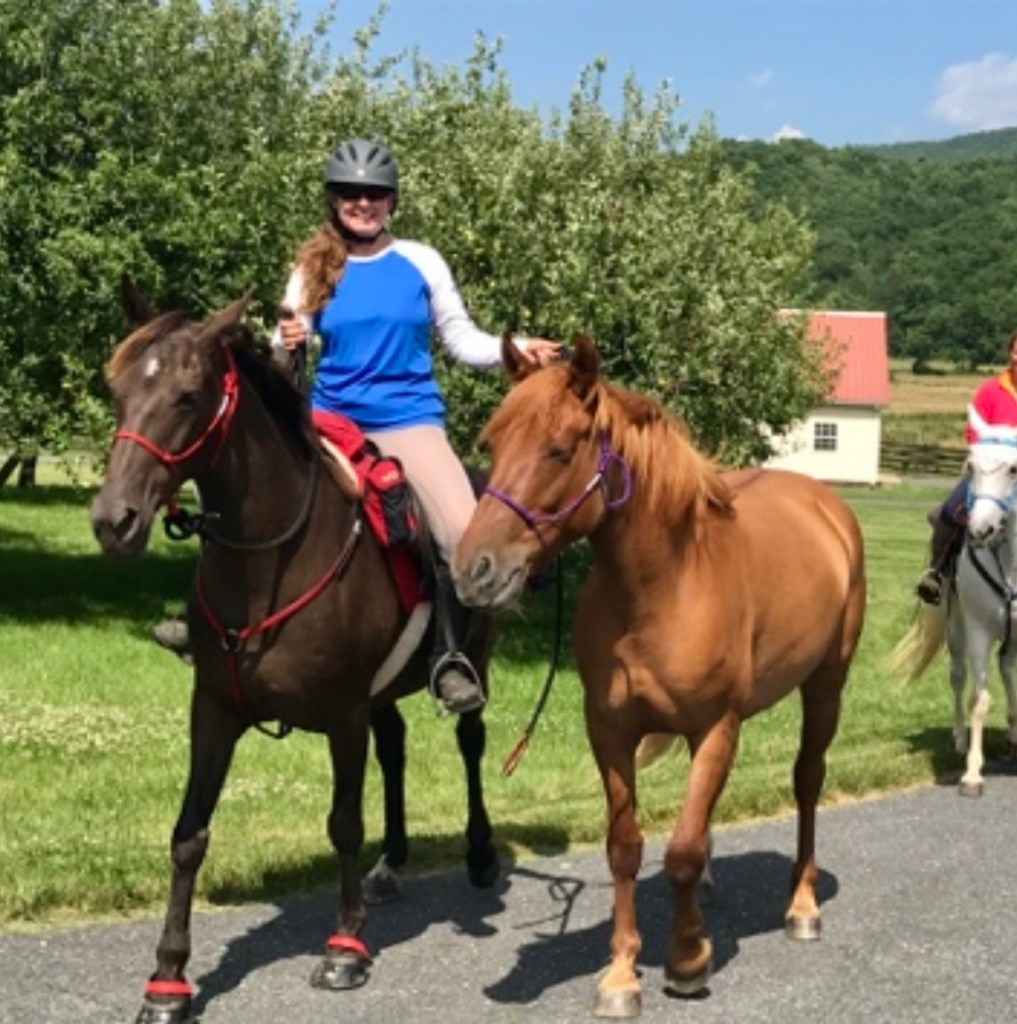
Khaleesi was the first horse I started. She was what I’d consider basically feral. She was intentionally bred then born on a massive mountain property and handled minimally spending her first four year running with a large herd. I thought she would be the perfect project for me- a horse without a lot of human influence. After enjoying that process and the things I learned from it I was inspired by my past (living in the west) to the plight of the wild horses and was inspired to adopt a mustang. I wanted to do one small part to help the overwhelming issue of unwanted wild horses, and I knew a native equine would teach me even deeper layers of horsemanship. I had met a couple other mustangs in recent years that were fine horses with great connection to their humans and so I looked into finding one of my own.
The night I met Wyoming after a long drive to TN
Wyoming (then called Wild Heart) was in the TIP (Trainer Incentive Program) and so was supposed to have a solid start and good foundation and only needed some finishing miles. Somehow I had enough sense to realize it would not be best for me to start with an unhandled wild horse after only one experience in colt starting. Lets begin with one that has a good foundation-
I think I can take that on. I thought.
I had no idea what was to come.
Over the few years I’ve had Wyoming I have seen “success” in moving forward and then always sideways and backward in progress. I won’t attempt in this post to cover all the layers of our time together and my journey as a horsewoman. There were significant holes in her foundation, I’m certain some trauma I will never know, and there were plenty of shortcomings in my own communication skills and observational accuracy.
And so here we are beginning once again as I have a few times in the past. Another opportunity to learn from this mare, a horse of lifetime… I hope… because I can’t imagine having another one this challenging for me to uncover what she needs to become my partner.
I think this is the third time I’ve taken time off to re-evaluate and begin again. The first pause was for over a year where I left her with the herd for the most part and didn’t ask much of her except good manners. She is a friendly mare and enjoys to be close (sometimes too close) and I had hands on her regularly but didn’t do anything that would require more than basic cooperation. This first break came on the heels of working with a friend who was interested in the mustang project as well. If the fit was right the mare could eventually become her horse, but for the start we’d share the responsibility and work together. I was committed to her for life regardless how things went.
We brought her home and began some simple ground work sessions to get to know each other, introduced her to her herd, did some ponying on trail, and in a few weeks got her under saddle (she had been started and ridden by her TIP trainer) and began to move forward in a slow but steady way that normally would have built confidence and trust.
Things progressed at first, then after a certain point she began to refuse to go out. We checked saddle fit, made sure we had a French link bit that wouldn’t be harsh, my friend was an experienced rider, we had her physically evaluated, we took her out with herd mates for confidence. Yet she would turn around on trail and get more and more forceful when we would press through… she began to rear up and crow hop and buck if we insisted. This wasn’t a ride through it and she’ll see it’s ok situation.
Both of us worked on various levels in as many creative ways as we could come up with, we added hand walking, sometimes I’d pony her for a time from the lead mare, (please don’t give me suggestions, I promise we put a LOT of thought and asked for ideas from trusted sources, and in the end- it always got worse, not better). Finally one day I hopped on her when she began her refusal as my friend was not feeling so confident and I have less fear (maybe less sense). She turned rodeo horse on the trail without a lot of room to maneuver. I was able to ride her straight up the mountain (no trail) but back toward the barn making life much harder than if she were to just continue on the nice trail as we’d asked. I worked her through trees and around rocks in an attempt to connect her feet and her brain, and she didn’t put me off, but she never changed- she never softened or come to me. She put up with it and then eventually we went on home. She wasn’t the right horse for my friend that was for sure, so we dissolved that partnership – and yet I wasn’t sure what to do to help her. She was beginning to get more frustrated and occasionally going into fight mode as we worked with her. Things were going backward, so she went into the field until I could figure out what to do that would change things for the better, not continue to make them worse. In the meanwhile a reset seemed like the best starting point.
It was in that time I renamed her. I told her one day in the field: you aren’t Wild Heart anymore – you belong here, you have a herd, a “family” and you don’t have to be wild anymore. You can trust this home for life. You are no longer fending for yourself, for resources, for a herd, for your life, for survival. You are “home” now. What do you want to be called? I was reminded where she came from… Wyoming. It had traces of heritage in it, but didn’t brand her with the “wild” streak which I’d like her to let go of in time. It seemed like a good name for her.
Wyoming it is.
We began again. I’d done some work with her, had a fabulous horsewoman come help me get her out of kindergarten in our ground work and begin to prepare to take a rider again. A crash course due to time limitations of restarting her, but at least helping me get more tools to help her in the process. I’d also been working on trailer loading (this has been a very long term process with mild success and failure). Christmas of 2019 I had a clear sense it was time to put on a saddle and try riding her again.
I began with some ground basics. Got some conversation sorted out and then got on her. It was a beautiful Christmas gift.
I only rode her for 20 minutes or so, in the front yard, but it was hopeful. She was willing to try, and no western show.
I continued the slow gradual work and eventually had some help from Emily Kemp once again in a spring clinic. I inherited a really great western saddle that suited our purposes better, and we were progressing together — building small steps toward her becoming a solid riding horse.
Eventually she was on the trail again, I was enjoying her though never truly confident she felt solid.
Once again, very gradually, things began to go sideways. First she would try to roll (while I was riding her on trail) and then she would be reluctant to leave the property, if I worked her in the yard she would stick her feet and not want to move. Eventually she would refuse to leave altogether and began to go western in the yard. I have limits to my riding skills, but in the bucking and rearing I sat through as calm as possible (I did not think she was trying to kill me, she was trying to communicate) it never got better.
During her trail riding season
Riding it out or even making her work harder to show her just walking along is much less effort- it didn’t help. She only escalated each week. And I became aware that though with other horses you can push through the sticky points, build their confidence and move forward, with this horse once she got to the “I can’t” she would eventually stop thinking completely and do anything to get out of whatever situation she felt was overwhelming her in increasing drama and volume until the “pressure” was removed. It wasn’t a choice anymore. It was like blind instinct, or raw emotion.
And yet. The horse seems to “like” me. She never seemed to want to hurt me (she absolutely could have), and she was always willing to try to work with me again. This mare was quite a puzzle, a lot of try in her and a desire to please, but a point gets crossed where she simple cannot do it anymore.
Everything continued to go sideways or backward and I used every creative thought process I had to help encourage her, build confidence, go back to fundamentals, try to go forward into a new challenge that might inspire her, more groundwork, less groundwork, lots of encouragement, more demands (she is incredibly intelligent and physically athletic and balanced so maybe she needed to be challenged to use her gifts more?). Everything had limited success… everything went sideways or backward by the second or third time.
Finally a barn move meant she had to be loaded up or left behind. I tried a larger stock trailer which was worse because of it’s unfamiliarity. In the end she loaded onto the small 2-horse we had worked on for at least a year or two. She’d had one semi-successful ride a few months back and then went backward not wanting to have to do that again… After an hour or so where she actually went under the chest bar and squeezed herself out through the front human door once (that was a terrifying moment for us all), I was able to hard wrap the lead rope to the chest bar and she stepped up to release herself and she was locked in for the short 7 minute drive up the road to her new home with the herd.
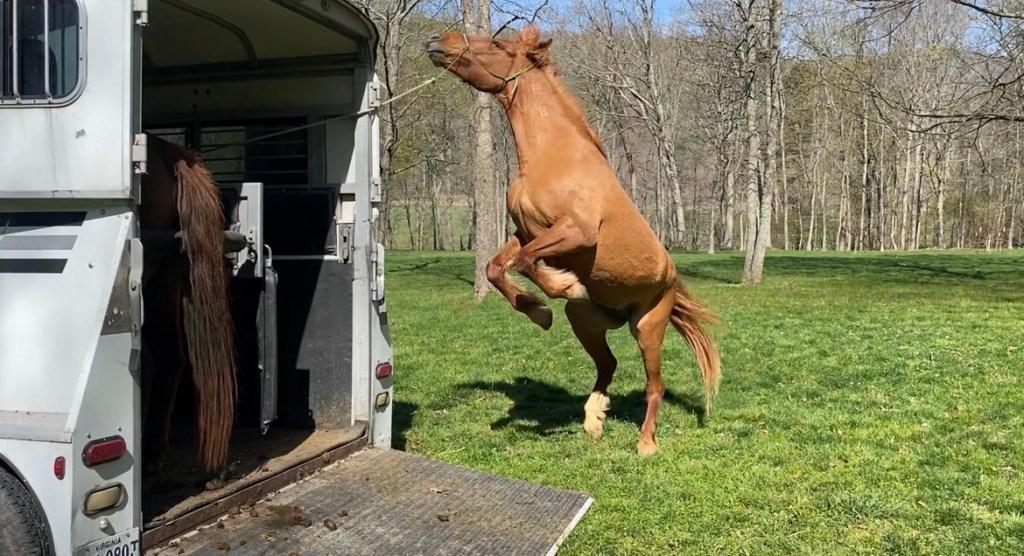
After this I decided to try to continue the trailer work with her to solidify that experience and build on it. Wrapping the lead line to the chest bar had worked to create a scenario where she pulled against herself and could release by coming forward. Let’s try that again. As so often happens with her, you can get it done once, but she’s had a week now to consider how she might change the outcome… and she did. She put all that mustang strength into pulling and as I stood there waiting for her to come forward and be able to release her – instead she bent the metal, broke out the chest bar which gave her another 3 feet of treeline which then put her outside the trailer (NOT GOOD) and rearing up. She tried to go sideways and hung herself over the upper door hinges and now was strung like a fish and the rope around the chest bar pulled tight enough to not want to come loose either.
My beloved sidekick Iva was watching from outside and had also been first witness to the mustang coming through the front door like toothpaste out of the tube a couple weeks before… stood calmly and said to me:
Jaime, this is not good.
Indeed.
I was able to loose the rope and free the mare. I had rope burns and she was basically unharmed, shockingly no one was seriously injured- except my trailer which did go in for some repairs after this session.
We returned to the field. I tied her to a tree while I reflected for a bit, and she stood quietly. I eventually set her loose and took a few months off to think.
What am I missing with her? Every success so far in working with her like I would any other horse has always gone backward over time. There were periods where much was going so well with us. She’s a fine mare… big personality, athletic, balanced, smart, responsive. When things are good they are really good…
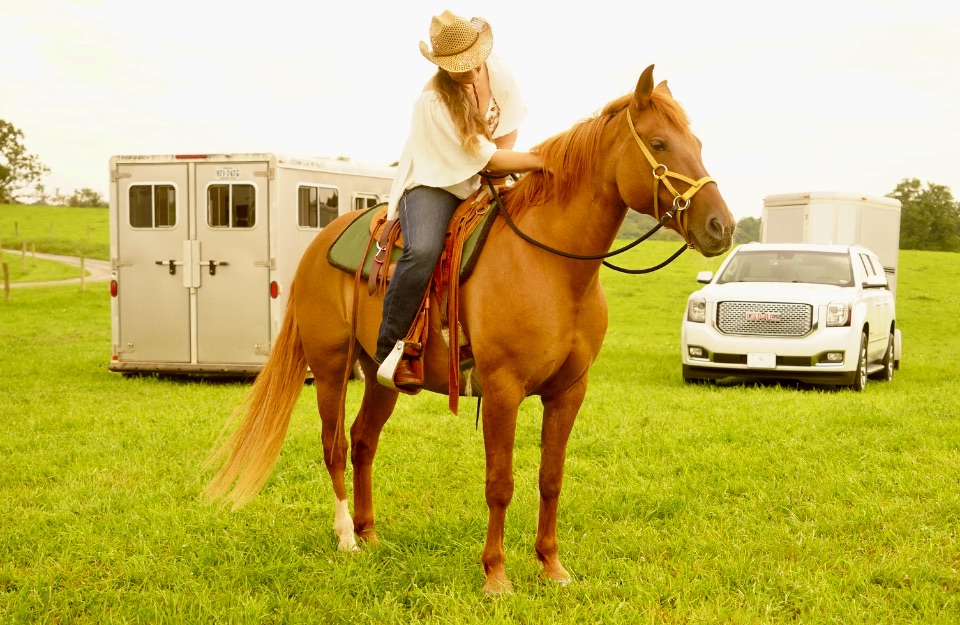
One of my favorite riding sessions with Wyoming
Was her purpose in life to humble me and remind me how limited I am? Show me that in fact I have much less control than I ever thought over things? Maybe every puzzle does not have a solution? What is her purpose in my life?
I quietly reminded myself that I wanted a mustang to learn how to be a better horsewoman, and so regardless if she turned into a working riding horse or not, she is amazing at teaching me. The day I freed her from the trailer fiasco I was calm on the outside, knew to control my breathing and reaction, but deep down incredibly frustrated. In that moment I considered the term “breaking” a horse that many of us horsefolk have moved away from. And I asked myself, could I “break” this horse? and if I even thought I could… did I want to? Did I want her spirit broken if it meant I could control her? In this moment… frustrated as I was… was the closest I have ever come to wanting to break a horse’s will. And in the depth of my heart I knew… if I could do it… I would not.
I knew that day that I wanted Wyoming to be her vibrant, wild, beautiful self and I wanted to have a relationship with her, but regardless if I ever got her on a trailer or under saddle, I did not want to break her. Because that would break something in me in the process. Something neither one of us would be able to ever recover.
And after a couple months of down time to reset, I returned again this fall to the work… of learning how to work with this wild heart in a way that we could both live with.
Wyoming is in boarding school this month… For various reasons she is in a field by herself temporarily (about a month) and though at first it was a necessary transition, I quickly came to see it as an opportunity to spend some focused time with her while she wasn’t “on the job” with a herd. For the month of October her only friend (though she could see other horses not far across a driveway) was… me.
I “gave up” on Wyoming in the late spring when a follow up trailer loading event went sideways and ended us both almost really injured. I had severe rope burns on my hands to remind me of the epic failure to communicate and she was temporarily hung up on a door hinge– which could not have felt good — though the wild one didn’t seem the worse for wear. One good thing about a mustang- I don’t think you can actually kill them.
The very bad day of trailer loading practice.
I gave the work with her a rest and began looking for ways to dig myself out of the doghouse of stupid, deaf (to horse language), untrustworthy human and spent some time dabbling in positive reinforcement. I think this was a really helpful step in our relationship. In positive reinforcement (R+) a major pillar is choice, and I began to give her total choice to work with me or walk away. I used hay pellets as a reward and she’s on massive pasture so she wasn’t starving for dried up grass. She was suspicious at first but Khaleesi helped me out by loving the classroom so much Wyoming couldn’t help but want to get involved.
I used R+ to reintroduce the halter in the field and a new fly mask and we had a lot of fun with touching various objects and learning to learn with hay pellets this summer. I also began to get more serious about the idea of “thin slicing” my way to a desired behavior. As a goal minded person I naturally break down things into steps, however I tend to start small and then as things begin to work, I make impatient leaps. I began to see that horses- this wild red head in particular- needed a lot more small steps all the way through the process than I was willing to give her. This took A TON of time I didn’t want to admit could possibly be necessary.
New fly mask
One day I wanted to trim Wyoming’s feet and thought inside the barn would be easier. It’s a large roomy barn with huge doors and she had been in and out of the old barn more times than I could count, yet she would NOT enter this barn. It was this moment I began to see more clearly from her perspective. Khaleesi or Hope would enter about any barn I asked them to, depending on the space they may pause or need a smell or a look, but Wyoming was very suspicious of this space even though she had walked by the doorway to be fed for months. I found this interesting. The fact that she might be wary is understandable, but she was 100% not entering this space.
Let me make clear a vitally important assumption: She was not “being an idiot” and she was not “acting stupid” or “refusing” for the sake of being difficult, she was not “being mare-ish”. If I believed any of these things things forward progress would be practically impossible. I know this horse is none of those things, there was a reason she would not enter that barn, and instead of slamming her through that “gate”, wisdom necessitated that I find out either why, or how to change her mind.
In truth she didn’t have to come in, I have worked on her feet in the yard already. The barn was only marginally easier for me. This meant I had no goal that was more important than the curiosity of why this particular horse would be unable to walk inside a barn. Forgetting about her feet I began to experiment with inviting her closer, then inside and observe as she would try, focus her attention past the doorway and disappear into a deep processing time for minutes on end. I could tell she wanted to do it, she was willing, but there was something that had her convinced it was possibly a death trap or maybe a time machine in the least. I kept this simple, I asked her to stay focused on the barn entrance and only added minimal pressure if she turned her focus elsewhere, and I found over time she began trying to cross the threshold on her own.
I think about 20 minutes went by with what seemed like zero progress but I observed a lot of deep inner processing often with her head down nose brushing the threshold, and just stood there with her curious. After probably 30 minutes she was taking a step or two in and then backing out and trying again. I think it could have been 45 minutes before she willingly walked into the barn, looked around, turned around fully to investigate and began to get comfortable.
What fascinated me is I didn’t have to pressure her to walk in. She knew it was what I wanted even as I stood quietly occasionally gently lifting my lead rope arm. When she was ready she began doing it herself- taking steps in and then steps back out then immediately trying again until she could manage to get all four feet into the building. It was completely calm and even fun. She wasn’t panicked or stressed. I saw that if I simply gave her the time she needed to process (it seemed like eternity in comparison to other horses) she would figure it out and she would comply.
Even more intriguing was the next day this same entrance took almost the same amount of lead time. Where I’d have thought she might pick up closer to where we left off, she spend about 20 minutes again processing the open barn door. Day 2 I might have taken 10 minutes total off the process. Day 3 still better but not by nearly as much as I would have expected. Each day was progress, but surprisingly for me how many steps back we would have to restart.
It became perfectly clear this is how I was going to work the trailer. Only at that rate it could end up being 2 more years! The good news was I’d already given up, so two years from now is still an amazing improvement on never!
Not long after I was able to invite her into the barn without trauma and confusion I decided to begin with the trailer. This isn’t a cavernous new barn, it was the baggage box! We have not racked up good associations with the trailer so I felt it was likely we’d be behind the zero.
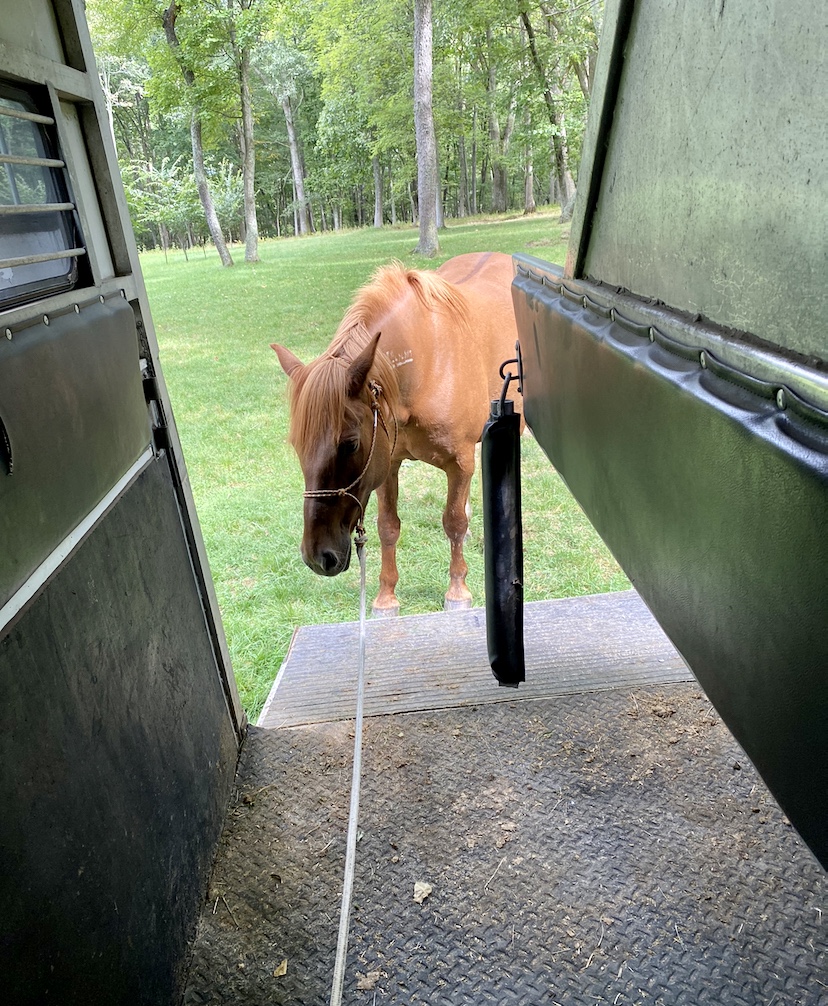
The first day over the summer of remedial trailer loading, it took an entire 90 minutes of her processing, standing outside, occasionally trying to evade to even begin to come up the ramp. After 90 minutes If I remember correctly, she came up the ramp and agreed to put her head in the trailer. In case you’ve never watched paint dry, I’m about done after 5 minutes. An hour and a half is eternity. And then I think she put on a foot or two so not even all the way on the trailer, but I was determined to see where this rabbit trail would go. Two things I observed:
This was very non-stressful, she wasn’t upset at all.
She was completely engaged the entire 90 minutes even if she was standing with everything still and processing for many minutes at a time, she didn’t not try to eat grass or ignore the work. She was invested.
Over the couple of months I’ve come to appreciate the value of understanding threshold in a much more subtle way. I think everyone can appreciate the concept, and everyone who has worked with a horse probably would say of course they understand threshold, yet my guess from knowing a variety of horse folks that it probably has a different meaning to each person. I know a few people who can see the threshold from well in advance of it in very subtle signals like a tightening of the skin or a change in the jaw (and they respond accordingly- you actually get negative points for knowing subtle threshold signs and blowing by them!), and I know some people who are aware of the threshold because they are now on the ground and the horse is up a tree or gave them a kick out before running off. For some people it takes injury to the person or the horse to realize that’s where the threshold, well, where it “was” because at that point you’ve blown past it, in fact probably blown past a few of them.
Yep, I know that person. I am her sometimes.
Most people are probably a little like me, most of the time somewhere in the in-between. I think it’s more valuable than we give credit to- recognizing thresholds sooner and finding ways to help the horse through the gate instead of blowing through them with force until someone, or the horse, is hurt.
Sometimes it takes this for me to stop and reconsider
With Wyoming, and I think this isn’t completely unusual for horses, you can bust through some of the early gates with a moderate amount of force because the creatures at heart are so generous and willing. My lessons with this mare is that I’d think we were doing pretty well and finding success together and then over time it would start to go backward. I’ve begun to suspect that I missed the early “gates” and she wanted to work with me so she would try, but something wasn’t addressed properly and we would eventually come to a gate that she just couldn’t keep going with me through and then we’d come apart.
Also I think there was a certain amount of pressure I let get to me that this mare had some kind of reasonable time line and I was so far outside of what was reasonable that I must be completely ineffective… if I would just stop playing around and push through, get it done, we’d “move forward” and I wondered if maybe that was right? Could I be wrong? Certainly. I tried it with riding her and pushed through some pretty intense rodeo action, and I tried it with the trailer which could have had us both really hurt but for the grace of God who seems to want me to learn these lessons alive to encourage someone else to maybe try a different way.
What if we really did begin to love the process? What if we began to slow down and ask the horse: are you ok with this? and then care about the response especially if it’s “no, not really” and then what if we began to offer support and help even if it meant the only answer that would really solve the problem would be the gift of time? The most valuable thing we have… so valuable we rush through and force our horses often to get onto our timeline so we can do the things we want to do with the horses. What if we entered their world more often and really listened when they needed time to process, time to heal coming back from an injury more slowly or gradually, time to trust us, time to believe that we are actually asking, time to even answer us?
What if we didn’t blow through the gates by force as long as we could get away with it?
So many people I know say they enjoy the time with their horse, but when I look closer at my own behavior and I suspect I’m not alone… that really means I enjoy the time the horse does what I want her to (perform, trail ride, even get on the trailer). What my month of solo time with Wyoming brought more to the surface was that I wanted to enjoy the time I stood with her while the paint dried. I wanted to give her the gift of standing by her side when she stood on the trailer ramp for the 25th day and put her head down to process the idea of going into the box. To encourage her when she began to look around, but to allow her to decide when she’d go in, and to trust that she was giving me her best.
Wyoming does go on the trailer now and it doesn’t take an hour, sometimes 5-10 minutes lately before she’ll put all 4 feet on. She only stands quiet for a limited time depending on how deep in she goes, and I don’t close her in yet. It’s clear to me she is not ready to be locked in. But she is very calm about the whole thing and enters and exits without stress and anxiety. She is begging to trust me again.
I don’t know what the next steps will look like, I’m finding them as we go. But for this mare, I’m going to trust that the process will continue and someday she will ride on the trailer without the stress and fear that had her lathered in sweat that last time I got her on over a year ago. That process was a little faster but it was not nearly as honoring to her own unique thresholds and took advantage of her generosity and her try. I got it done but it only ended us up eventually backward and almost hurt.
I hope I’m taking this lesson and applying it to my slightly easier creatures. I’ve been working on asking Khaleesi for permission for a while now and not forcing things on her even though I can. I try to balance that out with the reality that she’s a working animal that sometimes has a job to do, but I don’t use that card any more often than I have to, and if I find myself getting there too often I have to step back and ask why?
Hope is more tricky because she’s been forced into so much over her life she doesn’t always engage in bothering to answer. She’s been trained to comply and go inside herself and shut down for survival. She has a lot of brace mentally and physically we are trying to release and free up for her. She’s starting to come out more and more and that’s a fun process to see. I love that the very easy and kind kids’ lessons are part of that story!
It seems to me this is something that can continue to improve regardless of what level and where we are with our horses. I sense I’m getting a better feel, but I have far to go. And for anyone with multiple horses I think they have unique tells of when they are coming to a gate that isn’t free. It’s nice to have a horse that is super vocal about it, but most people don’t really want that horse! Often the cues are much more subtle.
The next challenge becomes what to do. Horses and human both share a benefit from growth, we do want to go through the gates! However we have to find a way to support them in the growth. I think sometimes even acknowledging and letting them know you’re with them is a great start. There is no one answer that fits all, but isn’t that exactly the process we can enjoy? Getting to know this unique creature along a lifetime of communicating and experimenting and listening along with guiding or asking them to come along with us?